CompleteOverviewofSwimmingLessonPlanningandSoftwareforSwimSchools[2026]
![Complete Overview of Swimming Lesson Planning and Software for Swim Schools [2026]](/_next/image?url=https%3A%2F%2Fzvblogpostimages.s3.eu-west-3.amazonaws.com%2FAUTOMATISCH_UPLOAD%2F1_ceceb96a879f.jpg&w=3840&q=75&dpl=dpl_FJwcKYU1WneRMMovk4KpoLXjy37E)
Summary
- Digital swimming lesson planning saves swim instructors up to 8 hours per week on administration
- 14% of Dutch children do not have a swimming diploma, partly due to waiting lists and inefficient planning
- Free tools like Swimmigo combine planning, progress tracking, and parent communication in one app
- Worldwide, 300,000 people drown annually: efficient swimming lesson planning literally saves lives
TLDR
- Digital swimming lesson planning saves swim instructors up to 8 hours per week on administration
- 14% of Dutch children aged 6 to 12 do not have a swimming diploma, partly due to waiting lists and inefficient planning
- Free tools like Swimmigo combine planning, progress tracking, and parent communication in one app
- Worldwide, 300,000 people drown annually: efficient swimming lesson planning literally saves lives
Why swimming lesson planning makes the difference between water safety and waiting lists
Imagine: as a swim instructor, you stand at the edge of the pool with 8 children in the water, trying to remember which exercise Tim still needs to do, whether Lisa is ready for level 4, and if Samir’s mother knows the lesson is canceled next week. This is the daily reality for thousands of swim instructors worldwide. And this is exactly why good swimming lesson planning is not a luxury, but a necessity.
The numbers don’t lie. According to the World Health Organization, approximately 300,000 people drown worldwide each year (2026). Drowning is the third leading cause of death among children aged 5 to 14. The good news: the WHO states that investing in swim education and water safety could save as many as 774,000 children’s lives by 2050. Effective swimming lesson planning, ensuring every child receives the right lessons on time, is a crucial link in this chain.
In the Netherlands, a country with more water than roads, the situation is also concerning. The National Council for Swimming Safety reports that in 2024, 14% of children between 6 and 12 years old have no swimming diploma at all: about 4 children per class of 30. At the same time, swim schools face historically long waiting lists due to a shortage of qualified instructors. Planning swimming lessons is more complex than ever: limited pool capacity, mixed skill-level groups, varying instructor availability, and parents expecting real-time updates.
This overview shows how, as a swim school—whether you have 20 or 200 students—you can make a difference with the right planning tools. From paper schedules to free all-in-one apps: we cover all options, with concrete examples and practical tips you can apply today.
The hidden costs of poor planning: time, money, and safety
Scheduling a swimming lesson seems simple: child in a group, instructor assigned, time in the schedule. In practice, it is one of the biggest headaches for swim schools. Let’s outline the impact of inefficient planning.
What poor planning really costs you
Conversations with dozens of swim instructors reveal that the average solo instructor spends 5 to 8 hours per week on planning and administration. That’s nearly a full workday not spent teaching. Causes include manually updating schedules in Excel, tracking absences on paper lists, calling parents about schedule changes, and manually moving students to the next level.
For a swim school with 200 students, this quickly adds up to 15 to 20 lost hours per week. That time could be used for extra lessons, smaller groups, or simply a better work-life balance for instructors—a key factor in a sector struggling with staff shortages.
But the real hidden costs lie in safety. If an instructor’s attention is on administration during lessons instead of the children in the water, the risk of accidents increases. If a child stays too long in a lower group because no one tracked progress, motivation is lost. And if parents don’t know a lesson has been rescheduled, a child unnecessarily misses class and falls behind.
Waiting lists: the Dutch perspective as a mirror for the world
Waiting lists for swimming lessons in the Netherlands have exploded in recent years. Some swim schools have waiting lists of more than 350 children, including unborn babies already registered. The main cause: a severe shortage of swim instructors, worsened by the aftermath of the COVID-19 pandemic.
This problem is not unique to the Netherlands. In countries like Australia, the United Kingdom, and the United States, swim schools report similar staff shortages. The U.S. CDC emphasizes that formal swimming lessons significantly reduce drowning risk in children, yet the communities with the highest risk have the longest waiting lists.
Smart planning is key here. By optimally grouping based on skill level rather than age, immediately registering absences and automatically filling freed spots, and automating communication with parents, a swim school can help up to 30% more children with the same pool capacity.
From paper schedule to digital planner: the transition every swim school benefits from
The limitations of paper planning
Many swim schools, especially smaller ones, still use paper lesson schedules. A whiteboard in the staff room, a folder with absence lists, and a binder with student data. It’s familiar, it’s worked for years, and it costs nothing. But the disadvantages pile up as a swim school grows:
- Schedule changes must be manually updated and communicated
- Progress data gets scattered across multiple folders and instructors
- No central overview of current groupings when an instructor is sick
- Parents must call or email for the simplest questions about lesson times
- Historical data on student progress is hardly accessible for analysis
What digital planning makes possible
Switching to digital is less disruptive than many swim instructors think. A modern planning app works on the smartphone you already carry. The benefits are immediately noticeable:
- Real-time insight: during lessons, see each student’s current progress and level
- Automatic communication: parents receive push notifications for schedule changes, absences, and level promotions
- Multi-instructor collaboration: all instructors work in the same system, no one misses information
- Data-driven decisions: instantly see which skill groups are overcrowded and where capacity is available
- Scalability: from 20 to 200 students without exploding administration
Practical example: planning an afternoon without and with a digital tool
Imagine it’s Tuesday afternoon at 2:00 PM. You teach group 4, but two children are reported sick. Without a digital tool: you jot it down on scrap paper, call parents on the waiting list after class, and hope someone can come. With Swimmigo: you tap the absence on your phone, the system automatically moves the next student on the waiting list up, and the parent immediately receives a push notification. That takes 10 seconds instead of 20 minutes.
Or take the moment Lisa is ready for level 5. Without a digital tool: you note it in her folder, maybe forget to share it with the coordinator, and Lisa unnecessarily stays three weeks in the same group. With Swimmigo: you update the level in the app, the coordinator sees it immediately, and Lisa’s parents get a push notification with congratulations and a personalized digital certificate. Motivation guaranteed.
What to look for when choosing planning software for your swim school?
1. Ease of use: an app you actually use during lessons
The best planning software is the software you actually use. A tool with a hundred features you never get to is less valuable than a simple app you can operate with one hand while standing at the poolside. Look for features like swipe gestures for quick actions, a clear dashboard showing your schedule at a glance, and support on both phone and tablet. Swimmigo is specifically designed for poolside use: creating groups, moving students, and updating scores can all be done with a swipe.
2. Integration with progress tracking
Planning and progress are inseparably linked. A student ready for the next level should automatically move up in the schedule. A planning tool separate from your progress tracking means double work. Choose a system where you can record scores per exercise during lessons (for example, Swimmigo’s 0 to 6 smiley system) and where those scores are directly linked to level and group placement.
3. Parent communication: no more separate WhatsApp groups
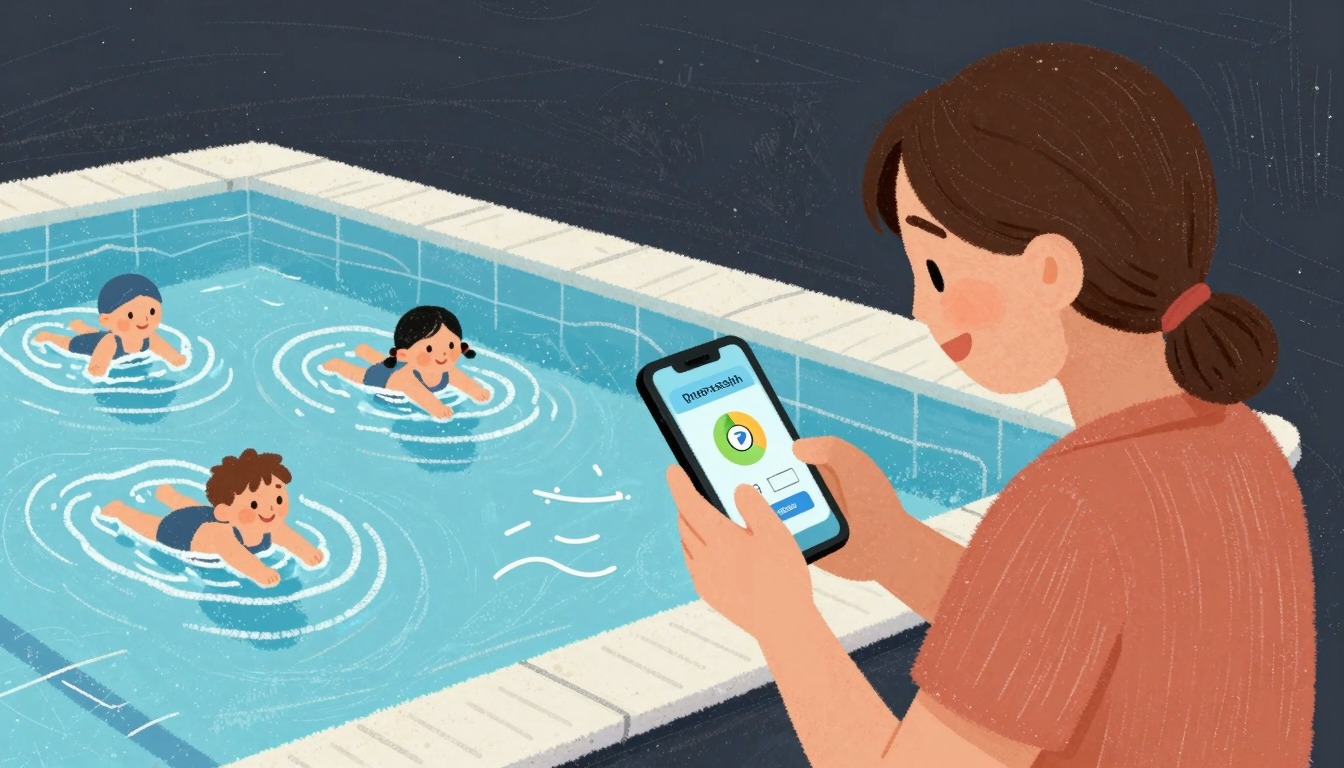
Parents want to know how their child is doing. But endless calls, emails, and app messages cost instructors hours per week. A good planning tool automatically sends notifications to parents: schedule changes, absences, level promotions. Swimmigo links planning directly to a free parent app where parents see their child’s progress in real time, per exercise, in a visual overview. This reduces parent contact moments by 80%, according to user experiences.
4. Multi-location and multi-instructor functionality
Once your swim school grows to multiple locations or multiple instructors, central coordination becomes crucial. You want instructor A at West location to see that student Emma has lessons next week at East location because her regular instructor B is on vacation. Swimmigo supports multi-instructor collaboration and multi-location management, keeping all data synchronized regardless of where or by whom the lesson is given.
5. Costs: what should it really cost?
Commercial swim school software often costs between 50 and 200 euros per month. For a small swim school or independent instructor, that’s a serious budget hit. The good news: there are free alternatives. Swimmigo is completely free: no subscription, no hidden costs, no functionality limits. The revenue model is in optional premium features for large commercial swim schools, not in the basic planning that every swim school relies on. In a world where swimming lessons already cost parents hundreds of euros per year, a free tool that makes planning more efficient is a no-brainer.
The international dimension: why planning matters worldwide
Swimming lesson planning as a global safety tool
The challenges of swimming lesson planning don’t stop at national borders. In countries with less developed swim infrastructure, the need for efficient planning is even greater. The WHO reports that 92% of all drownings occur in low- and middle-income countries. In the WHO Western Pacific Region, drowning is the leading cause of death for children aged 5 to 14.
Swimmigo is available in 5 languages: Dutch, English, German, French, and Spanish. This makes the app usable for swim instructors and parents in dozens of countries. The planning functionality is universal: whether you teach in Amsterdam, Berlin, or Buenos Aires, the principles of group division, progress tracking, and parent communication are the same.
Expat families: bridging the language gap with multilingual tools
An underestimated problem in the swimming lesson world is the language barrier. In countries with many expats, like the Netherlands, Dubai, and Singapore, children from international families take swimming lessons in a language their parents don’t always master. Instructors struggle to explain progress to parents who don’t speak Dutch or English. A multilingual app solves this: Swimmigo shows swimming progress in the parent’s language, with the same structure and visual display in all 5 languages. This lowers the barrier for expat parents to enroll their child in swimming lessons, directly contributing to water safety in international communities.
From theory to practice: how to implement digital planning in your swim school
Step 1: Map your current workflow
Before switching, it’s useful to document how you currently work. How much time do you spend on planning? Where are the biggest bottlenecks? What information do you repeatedly have to look up? A simple time tracking for a week often provides surprising insights. Most instructors discover they spend 30 to 40% of their non-teaching time on tasks an app can automate.
Step 2: Start small, scale later
You don’t have to overhaul your entire workflow at once. Start with one group or one aspect of planning, for example, absence registration only. Once that runs smoothly, add level management. Then parent communication. Swimmigo is built so each module can be used separately: you can start with just planning and later activate the progress module and parent app when you’re ready.
Step 3: Train your team in 30 minutes
The biggest resistance to new software is often not the technology but the learning curve. A good planning tool should be learnable within 30 minutes. Swimmigo uses familiar swipe gestures (left/right to move, tap for details) everyone knows from their smartphone. Short instructional videos are available on the instructor page and a help center with all FAQs.
Step 4: Measure the results
After a month, evaluate: how much time do you save? How many fewer calls from parents do you get? How much faster do students move to the next level? These figures are not only motivating for you and your team but also valuable for business management. A swim school that demonstrably works more efficiently can take on more students, shorten waiting lists, and increase water safety in the region.
The future of swimming lesson planning: AI, predictions, and personalization
Artificial intelligence in the pool
The next wave of innovation in swimming lesson planning comes from artificial intelligence. Systems that predict when a student is ready for the next level based on historical progress data. Tools that automatically calculate the optimal group division based on skill level, age, and available instructors. Push notifications that not only inform but also motivate with personalized tips for parents.
Swimmigo is actively working on AI-driven features, such as automatic group optimization and predictive progress analysis. But the core philosophy remains: the tool is there to support the instructor, not replace them. The human eye of an experienced swim instructor remains irreplaceable.
The role of data in water safety
Aggregated, anonymized swimming progress data can eventually be of enormous value for water safety research. Which exercises take the most lesson time on average? At what age do children make the fastest progress? Which skills are the best predictors for water safety in open water? Insights like these, generated from planning data of thousands of swim schools, can improve swim education worldwide.
Get started: your next step
Whether you’re just starting as an independent swim instructor or have been running a swim school for years, switching to digital planning is one of the most impactful decisions you can make. You save time, improve lesson quality, and make life easier for your instructors and the parents of your students.
Swimmigo is free, works on any smartphone, and is available in 5 languages. You can create an account today at swimmigo.com and create your first group within 5 minutes. No obligations, no subscription, no fine print.
Frequently Asked Questions
Sources
- World Health Organization (WHO): Drowning Fact Sheet, May 1, 2026
- National Council for Swimming Safety (NRZ): More children obtain swimming diplomas A, B, and C, November 10, 2025
- Mulier Institute: More children have A, B, and C diplomas, November 2025
- Centers for Disease Control and Prevention (CDC): Preventing Drowning, accessed July 2026
Bob van Soest
As an expert in operating sports facilities (such as swimming pools) and developer of, among others, Swimmigo.com, I am passionately committed to making swimming lessons simpler, more fun and more insightful for parents, swimming instructors and everyone who wants to learn to swim.
Frequently Asked Questions
Related articles

Adjusting Swimming Lesson Planning for Swimming Anxiety
Tips to reduce swimming anxiety with home water activities and adjusted swimming lesson planning.

Effective Swimming Lesson Planning for Children in Foster Families
Discover practical tips to plan and manage swimming lessons for foster children clearly and purposefully.

Adjusting Swimming Lesson Goals for Swimmers with Multiple Disabilities
Practical tips for adjusting swimming lesson goals for swimmers with multiple disabilities.
Discover Swimmigo
The all-in-one app for swimming lesson progress. For parents, swim schools, and adult swimmers.