SwimmingLessonsforaChildwithaDisability:WhatDoestheHealthInsuranceCover?[2026]
![Swimming Lessons for a Child with a Disability: What Does the Health Insurance Cover? [2026]](/_next/image?url=https%3A%2F%2Fzvblogpostimages.s3.eu-west-3.amazonaws.com%2FAUTOMATISCH_UPLOAD%2F1_2f761d619258.jpg&w=3840&q=75&dpl=dpl_DqUHNtsMUTtGEGNaUbbB2t9YQZM4)
Summary
- Regular swimming lessons are not covered under the basic package, not even with a diagnosis. Physiotherapy or exercise therapy in water sometimes is.
- Children up to 18 years: the first 9 treatments from the basic insurance, with a maximum of 9 extra, and all treatments if the condition is on the chronic list.
- The municipality decides whether to reimburse additional costs for adapted swimming. Apply at the social desk, Wmo desk, or youth desk.
- In research among children with a disability, 13 percent do not obtain a swimming diploma, and 45 percent are not self-reliant in the water after the process.
- Document hours, goals, and agreements per lesson. Without a report, an application to the municipality or insurer becomes a matter of feeling.
The offer is built around the average child
A child with a motor disability, developmental delay, or autism spectrum disorder learns to swim in a different order than the textbook prescribes. Sometimes getting into the water goes fine, but putting the head underwater does not. Sometimes the entire water familiarization phase is a long struggle with tears at the changing room door. The National Council for Swimming Safety listed the stumbling blocks, and almost all of them are in the first phase of the process: getting into the water, breathing control, daring to look underwater, daring to lie on the back.
The numbers behind this explain why parents struggle with this for so long. In research among children with a disability or developmental problem, 13 percent do not obtain a swimming diploma, and 45 percent of parents say their child is not self-reliant in the water after the process. Parents also find appropriate swimming education more difficult than parents of children without disabilities. This is not due to unwillingness in the swimming sector, but due to time, guidance, and money. This is exactly where families encounter rules.
Internationally, the picture is clearer. The WHO counts about 300,000 drowning deaths per year. Children under five account for nearly a quarter of these, and drowning is the fourth leading cause of death among children aged 1 to 4 years and the third among children aged 5 to 14 years. Swimming skills are therefore not a luxury for those who easily achieve them. The question is who bears the costs if the path takes longer than usual.
Five routes to explore
There is no counter that arranges everything for you. There are five tracks you can use alongside each other: health insurance, the municipality, a fund, the swimming school itself, and what you arrange yourself. Each track has its own conditions, and most parents discover along the way which track yields something.
Track 1: health insurance
The swimming lesson itself is not healthcare
Regular swimming lessons are not covered under the basic package, not even with a diagnosis. This is not a harsh judgment on your child: the lesson is not a treatment. As soon as a therapist enters the water, this changes. Then it is called physiotherapy or exercise therapy in water, and the rules of the health insurance apply.
Children up to 18 years: nine treatments, sometimes nine extra
For young people up to 18 years, the basic insurance reimburses the first 9 treatments of physiotherapy or exercise therapy. If these are insufficient, the insurer can reimburse up to 9 additional treatments. If your child's condition is on the chronic list associated with the basic insurance, then all treatments are covered. For adults, the limit is different: they receive the first 20 treatments themselves and only from the 21st treatment get reimbursement, and only for a condition on that same list.
Therapeutic swimming is rarely included in the basic package
Hydrotherapy, or therapeutic swimming in heated water, is not included in the basic package in 2026. Many insurers include it in supplementary packages, with a maximum amount or a maximum number of sessions per year. Sometimes there is room from the basic insurance, namely if therapeutic swimming is part of a treatment plan with a medical indication. This is customized, and the answer differs per insurer.
What to check beforehand
- Check if your child's condition is on the chronic list associated with the basic insurance.
- Check if the practice or therapist has a contract with your insurer. Without a contract, reimbursement may be lower.
- No referral letter is needed for physiotherapy, except for a movement program against falls.
- Ask whether swimming is part of the treatment plan or considered a separate session, and what your policy says about this.
Track 2: the municipality
Wmo for additional costs, transport, and aids
Sports with a disability involve extra costs, and the Wmo is intended to compensate for such additional costs. Think of transport to the lesson or a sports wheelchair. Municipalities decide for themselves how generously they apply this and record their choices in their own regulations. Disabled Sports Netherlands lists the schemes and funds.
For children, part runs via youth care
If your child is under 18, part of the support runs via the municipality's youth care instead of via the Wmo. Whether swimming is included depends on the regulation and whether the support for your child is considered necessary. The youth desk or the Wmo desk of your municipality will tell you how your municipality handles this. Ask for a client supporter if you find it complicated: this help is free via the municipality.
Policy differs per municipality
One municipality has a generous scheme, the next does nothing. Some municipalities have a child package or a contribution for sports and leisure for families with low income. For example, the municipality of Lelystad has Opportunities for Children, where families can apply for a contribution for sports, culture, and school. Read the regulation of your own municipality instead of relying on what someone in another city received.
How to apply
Call or email the social desk of your municipality, explain what your child needs, and ask which scheme fits. Keep track of what you say and what you get back. If you receive a rejection, ask for the reason in writing. Then you can supplement or appeal specifically.
Track 3: funds and schemes
Most funds are for organizations, not families
This costs parents the most time. Funds such as the Johan Cruyff Foundation, Disabled Sports Fund, and Foundation for Disabled Children contribute to sports offerings, but that money goes to associations, swimming schools, and projects. They are not subsidies for individuals, so as a parent you cannot get a swimming lesson trajectory from them. What you can do: ask your swimming school if they have applied for such a contribution and if that changes the offer or the rate.
The Youth Fund for Sports and Culture remains the route for low income
If your family's income is below the threshold, the Youth Fund for Sports and Culture can cover the lesson fees. An intermediary applies for this on your behalf, such as a neighborhood sports coach, youth nurse, or someone from the district team. More routes and ways to reduce costs are listed in the overview with ways to reduce swimming lesson costs.
What a swimming school can arrange itself
Schools sometimes solve it internally, with a social rate, a smaller package, or a spread lesson card. Others choose a separate rate for individual guidance alongside the regular group rate. Ask about it, because not every school posts this on their website. In the Swimmigo app, a school composes lesson packages itself, one-time or as a continuous subscription, with its own conditions and optionally a discount for one student. The money goes directly to the school's account.
Which route for what
| Route | Who decides | Where to apply | What it covers |
|---|---|---|---|
| Basic insurance | Health insurer | Policy conditions and member service | Physiotherapy or exercise therapy in water, not regular swimming lessons |
| Supplementary insurance | Health insurer | Policy conditions | Therapeutic swimming up to a maximum per year |
| Municipality | Board of mayor and aldermen | Social desk, Wmo desk or youth desk | Additional costs, transport, aids, and sometimes a contribution for sports |
| Youth Fund for Sports and Culture | The fund, via an intermediary | Neighborhood sports coach, youth nurse, or district team | Lesson fees for income below the threshold |
| Fund for sports offerings | The fund | Your swimming school or association | Sports offerings and projects, no individual lessons |
| Swimming school | The school itself | Directly at the school | Own rate, smaller package, discount, or spread lesson card |
Track 4: more guidance, a personal trajectory
One-on-one or in a small group
More guidance means more hours from an instructor, and that is the largest cost item. A school can choose a separate group with a maximum of three children per instructor, or individual lessons. Ask about group size and what happens if the regular instructor is sick. For a child attached to one fixed person, a change is not a detail.
Own goals instead of the standard trajectory
Not every child achieves the national A, B, and C. That is not a failure. The goal is that your child can save themselves if unexpectedly in the water, and that goal can be broken down into smaller steps. A school can set its own intermediate goals and maintain the pace per child.

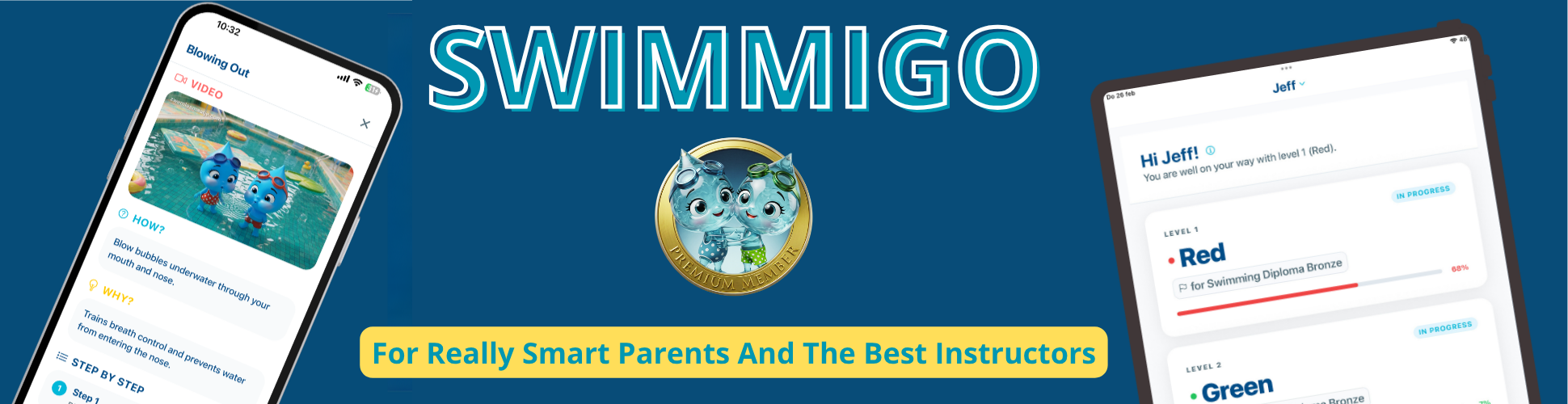
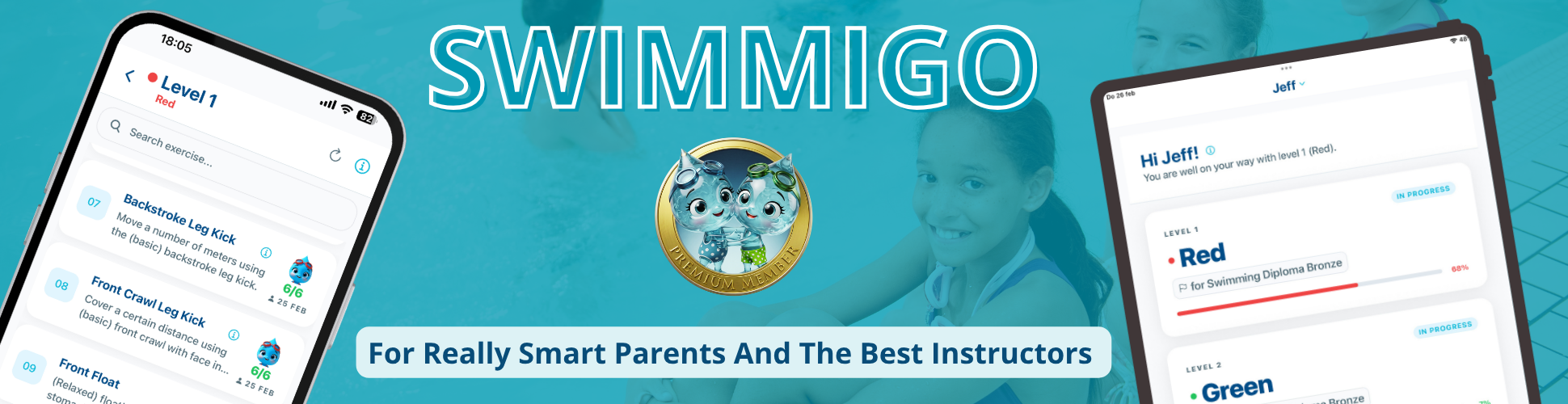
In the Swimmigo app there are 7 levels with 86 skills, and per exercise there is a score from 0 to 6. A child can therefore stay on one skill for a long time without disappearing from the registration, and the school issues a certificate per completed level. The highest levels come with a personalized diploma with name and date. These are Swimmigo certificates and diplomas, not national A, B, or C. The page with levels shows what this structure looks like.
What to look for when choosing a school
- Experience with your specific question, not just the promise that every child is welcome.
- A fixed instructor and a fixed group, with clear agreements for replacement.
- Quiet lesson times when the pool is not crowded. Stimuli are a bigger problem for many children than the water itself.
- Insight into progress, so you can see after ten lessons whether the trajectory works or something needs to change.
If you are looking for a school or want to know what parents can see, the page for parents gives an idea of what is visible in the app.
Track 5: everything you document
A file is your negotiating position
An application to a municipality or insurer relies on evidence. Without a report of what your child did per lesson, how often they came, and where they got stuck, the conversation becomes a matter of feeling. Note the date, attendance, and the skill focused on per lesson. Also document what happens outside the lesson: practicing in an outdoor pool, a visit to the physiotherapist, a conversation at school.
What a school keeps track of and shares with you
Ask the school for an overview per period. A school that works with Swimmigo sees per student which exercises have which score, and parents see the same progress in their own app. Messages in the app have a read receipt, so you can later find that an appointment was received. That sounds administrative, but it is exactly what you need if you have to explain why a trajectory took longer.
Notifications in the language you speak at home
Swimmigo works in five languages: Dutch, English, German, French, and Spanish. Notifications are stored as keys with variables and only translated upon display, so a parent reads the message in their own language instead of a language they only partly understand. This is extra important for adapted swimming, because the agreements are detailed: which day, which exercise, which aids to bring.
Who does what within the school
A school divides rights via team roles: owner, administrator, and instructor. This way, as a parent, you know who to contact for questions about rates, schemes, or planning, even if the school works with multiple instructors and locations. For the school itself, there is a statistics layer on top that shows which children have been stagnant for more than a number of weeks, so adjustments are not a matter of gut feeling. More about this is on the page for swimming schools and instructors.
| Who | Cost | What you get |
|---|---|---|
| Parent or guardian | Nothing | Progress per exercise, certificates, messages with read receipt, and notifications in your own language |
| Independent swimming instructor | Solo subscription, 9.99 euros per month | Unlimited students, all lesson functions, 30 days free trial from the first linked student |
| Swimming school with team or multiple locations | School subscription, 59.99 euros per month | Unlimited instructors and students, team roles, statistics, lesson payments with 7.5 percent transaction fees per payment |
How to approach it step by step
- Request the diagnosis or condition on paper, with the medical term on it. The chronic list is linked to this.
- Call your health insurer and ask if therapeutic swimming or physiotherapy in water is reimbursed, and if the practitioner has a contract.
- Look up your municipality’s regulation and call the social desk asking which scheme fits adapted swimming.
- Ask your swimming school what rate applies for more guidance and if a smaller group or individual lesson is possible.
- Check via an intermediary if the Youth Fund for Sports and Culture can do something for your family.
- Document per lesson what was practiced and how it went, and keep decisions and confirmations.
- After ten to twelve lessons, check if the trajectory works and adjust before agreeing on a new block.
Conclusion
A child with a disability usually needs more lessons and more guidance, and the costs rarely come from one pot. The swimming lesson itself is not in the basic package, therapeutic swimming sometimes partially is, the municipality reimburses additional costs in some cases, and the Youth Fund can help with low income. What remains is a school that dares to break up the trajectory and a parent who keeps track of what happens per lesson. That combination makes the difference between a child who after years is still at the first skill and a child who can save themselves in the water.
Sources
- National Council for Swimming Safety: Swimming with a disability, consulted September 2026
- Association Sport and Municipalities: risk group children with a disability, based on research by the Mulier Institute, 2026
- Mulier Institute: Barriers to learning to swim for children with a disability, 2021
- Dutch Government: are physiotherapy and exercise therapy included in the basic package?, 2026
- Health Insurance Guide: reimbursement hydrotherapy (therapeutic swimming) 2026, 30 October 2025
- Disabled Sports Netherlands: subsidy schemes for people with a disability, 2026
- Municipality of Lelystad: Opportunities for Children, 2026
- WHO: Drowning fact sheet, 1 May 2026
Bob van Soest
As an expert in operating sports facilities (such as swimming pools) and developer of, among others, Swimmigo.com, I am passionately committed to making swimming lessons simpler, more fun and more insightful for parents, swimming instructors and everyone who wants to learn to swim.
Frequently Asked Questions
Related articles
![Complete Overview of Swimming Lesson Costs: What Does Swimming Lesson Cost in 2026? [2026]](/_next/image?url=https%3A%2F%2Fzvblogpostimages.s3.eu-west-3.amazonaws.com%2FAUTOMATISCH_UPLOAD%2F1_42d9549f2924.jpg&w=3840&q=75&dpl=dpl_DqUHNtsMUTtGEGNaUbbB2t9YQZM4)
Complete Overview of Swimming Lesson Costs: What Does Swimming Lesson Cost in 2026? [2026]
Discover the real cost of swimming lessons in 2026: from group lessons to private lessons, municipal subsidies, and hidden costs. A complete overview for parents and swimming schools.
![Hidden Costs of Swimming Lessons: What Every Parent Should Know Before the Bills Arrive [2026]](/_next/image?url=https%3A%2F%2Fzvblogpostimages.s3.eu-west-3.amazonaws.com%2FAUTOMATISCH_UPLOAD%2F1_ba1b34d3a484.jpg&w=3840&q=75&dpl=dpl_DqUHNtsMUTtGEGNaUbbB2t9YQZM4)
Hidden Costs of Swimming Lessons: What Every Parent Should Know Before the Bills Arrive [2026]
Registration fees, diploma costs, mandatory life jackets: hidden swimming lesson expenses can add up to hundreds of euros per child. Read what to expect and how to keep control over your spending.
![Saving on Swimming Lesson Costs: 7 Proven Ways to Save on Swimming Lessons Without Quality Loss [2026]](/_next/image?url=https%3A%2F%2Fzvblogpostimages.s3.eu-west-3.amazonaws.com%2FAUTOMATISCH_UPLOAD%2F1_27de3f9fff7a.jpg&w=3840&q=75&dpl=dpl_DqUHNtsMUTtGEGNaUbbB2t9YQZM4)
Saving on Swimming Lesson Costs: 7 Proven Ways to Save on Swimming Lessons Without Quality Loss [2026]
7 proven ways to reduce swimming lesson costs: subsidies, the Youth Fund, school swimming, smart payment models, and progress tracking. Including 2026 rates.
Discover Swimmigo
The all-in-one app for swimming lesson progress. For parents, swim schools, and adult swimmers.