Swim lesson plan by age: ready-made lesson plans for ages 3, 5, 7 and 9 [2026]

Summary
- One new skill per lesson, the rest is repetition and variation.
- Five fixed blocks: getting used to water, repeat, new skill, game, success moment.
- At 3 and 4 years it is about daring and stepping in, not about floating or arm stroke.
- Only advance a child after they show the movement three lessons in a row.
- Note five lines per child after each lesson, so the next lesson builds on it.
Why a lesson plan by age is different from a plan by level
In one group a 6-year-old and a 9-year-old can be on the same swimming level. The same exercise still works differently for them. A 9-year-old wants to know why they are doing something, and can work ten minutes on one movement if they see the purpose. A 6-year-old needs short blocks, a game format and someone who joins in. Ignoring that difference produces a plan that looks right on paper and falls apart in the water.
Level tells what a child can do, age tells how they learn
Level is a status update, what skills the child currently masters. Age says something about attention, language and motivation. A lesson plan needs both. Level determines the content, age determines the format: how long a block lasts, how much explanation fits and whether you work with a game, an assignment or a demonstration.
A lesson plan is not a timetable
Those two are often mixed up. A timetable arranges who is in the pool when, who teaches the lesson and which group follows which. A lesson plan describes what happens in those 30 minutes. You need both, but you write them at different times and for different purposes.
The nine core skills every plan rests on
The Learn to Swim Framework from Swim England builds lessons around nine core skills instead of the four strokes: entering and exiting the water, floating and balance, turning and orienting, streamlined movement, breathing under water, propulsion and coordination, water safety, and fitness. The strokes come only once those building blocks are in place. That is why an age-based plan works: you choose two of those building blocks per lesson and adapt the form to what the group can handle.
The American Academy of Pediatrics (AAP) says something similar about the timeline. Lessons can start from 1 year as an extra layer of protection, most children are ready for real swim lessons around their fourth birthday, and many children master freestyle around age 5 or 6. These are guidelines, not deadlines. A child who starts at 3 is not automatically finished at 5, and a child who starts at 7 can sometimes catch up within a year. (The WHO names drowning as one of the leading causes of unintentional death worldwide.)
Swimmigo · For swim schools
Run your swim school fully digital
Students, schedules, absences and parent communication in one app, with your own rates and branding.

The basic plan in five blocks
The four age plans below use the same five blocks. Only the content differs per group.
Block 1: getting used to water and space (3 to 5 minutes)
The first minutes determine how the rest of the lesson will go. Children arrive cold, noisy and in a group they do not know. Start with something that always succeeds: stepping in, splashing, stroking the water with the hands. With 3-year-olds you join in. With a group of 9 a short assignment is enough, for example swim calmly to the other side and back.
Block 2: repeat what already works (5 minutes)
Repetition is not wasted lesson time. A movement a child did once last week is not yet in their body. Bring back two or three exercises from the previous lesson in the same form, so the child notices they can do something. In this block you also see whether there is room for something new.
Block 3: one new skill (10 to 12 minutes)
One. Not two, not three. The rest of the lesson may vary, the new skill stays the same. Build it up in three steps: demonstrate and do together, then alone with a support, then without. Staying too long on the first step keeps a child dependent. Moving too fast to the final step asks for something that is not there yet.
Block 4: game with the same skill (5 minutes)
Games belong to the practice itself: the same skill, different form. It is not a reward you hand out if there is time left. A relay with floating, a race to the other side, who can lie stillest on their back. Swim England itself names this playful approach as the route along which children absorb new skills. The game changes the form, not the goal.
Block 5: finish with something that succeeds (3 minutes)
End with an exercise the child masters, not with the hardest task of the lesson. A child who leaves the lesson with a succeeded movement returns more easily next week. Also briefly name what will come next time, so there is direction without pressure.
These five blocks are the base. What you put in block 3 and how long a child stays focused depends on age.
Lesson plan for 3 and 4 year olds: water familiarization without pressure
What a 3-year-old can handle
Around age 3 a child is working on daring, not technique. They do short tasks, love to imitate and learn through play and repetition. Do not expect a ten-second floating position or arms above water. Expect that after a few weeks a child will step in without protest and dare to get their face wet.
Programs differ in the moment when independent lessons start. The Red Cross lets parents be in the water until age 3 and then starts a separate toddler line with three levels, with independent movement in the water as the end goal. That boundary is useful: until 3 years old a parent in the water is not a weakness, but the norm.
The lesson, minute by minute
- 0 to 4 minutes: step in via the steps or the edge, sit on the side, splash with hands. You sit at eye level and join in.
- 4 to 9 minutes: walk around in shallow water, step over a float, catch a toy fish. The goal is to feel the water move and to sense the bottom.
- 9 to 19 minutes: the new skill, for example getting the face wet or blowing on the water. Demonstrate, do together, add a song.
- 19 to 25 minutes: game with the same goal, for example who blows the ball the farthest.
- 25 to 30 minutes: exit via the edge, high five, one more exercise that certainly succeeds.
If a child does not want to get in the water
Stay seated on the side and let the child watch. A child who watches a whole lesson and the next time puts one toe in the water has progressed. Forcing takes weeks. Let a parent stay nearby if that helps, and keep the rest of the group busy with something that does not require an instructor next to the pool.
Lesson plan for 5 and 6 year olds: from floating to the first stroke
What changes around the fifth year
From age 5 a child can usually remember an assignment, wait their turn and work ten minutes on something without losing interest. That brings floating, exhaling under water and the first arm stroke within reach. According to the AAP most children who take lessons master freestyle around age 5 or 6. The Red Cross places children of roughly 4 and 5 years in three toddler levels and then in six child levels, where each skill must be mastered before moving to the next. Not every child reaches that at that age, but it is a realistic goal for this group.
The lesson, minute by minute
- 0 to 4 minutes: step in and swim two lengths with the shoulders wet.
- 4 to 9 minutes: repeat floating on front and back, ten seconds per side.
- 9 to 20 minutes: new skill, for example rhythmic exhaling: three blasts, one inhale.
- 20 to 26 minutes: relay with floating and a ball, same breathing rhythm as in the previous block.
- 26 to 30 minutes: finish with the exercise that worked last week, plus a short look ahead.
When to let a child advance
Not by age and not after one good lesson. Only move a child on when they show the movement three lessons in a row, also when tired or poorly slept. Swim England calls that consistent execution: a skill that works once is not yet a skill. That criterion protects the child, because moving to a group that goes too fast costs more time than staying one month longer.
Lesson plan for 7 and 8 year olds: technique and breathing rhythm
What this group needs
Children of 7 and 8 want to see results. They compare themselves to others and lose interest if something stays too easy for too long. Technique becomes interesting now: why do you enter your arm like that, why keep your head low. In this group you can work 10 to 12 minutes on one stroke, provided you vary the movement in between with another form of the same movement.
The lesson, minute by minute
- 0 to 4 minutes: step in, swim two calm lengths, loosen shoulders and ankles.
- 4 to 9 minutes: repeat the previous lesson, adding one detail (longer glide phase or a steadier head).
- 9 to 20 minutes: new skill in three steps, with two or three repeats per step over 10 to 15 meters.
- 20 to 26 minutes: game form with the same stroke, for example a relay where each child swims one length.
- 26 to 30 minutes: finish with a short technique task that certainly succeeds, and name the goal for next week.
Handling level differences in one group
Give the same assignment with two difficulty levels. A stronger swimmer works on breathing rhythm over 25 meters. A child still finding their way does the same movement over 10 meters with a kickboard. That keeps the group together and everyone works on the same goal. It also reduces preparation: one assignment, two variants, no second lesson plan.
Lesson plan for 9 to 12 year olds: endurance and personal goals
Why older beginners react differently
A 10-year-old who still cannot swim is often ashamed. They do not want to stand among preschoolers and they certainly do not want others to see failures. Start with what they can already do, however small, and explain why an exercise works. This group can track a goal themselves and benefits from a visible overview of what remains to be achieved.
The lesson, minute by minute
- 0 to 5 minutes: step in and warm up calmly, with an assignment that can be done independently.
- 5 to 10 minutes: repeat the previous lesson, with the child naming what improved.
- 10 to 22 minutes: new skill, with room for technical explanation and two to three sets of 25 meters.
- 22 to 27 minutes: a set where the new skill returns over a longer distance.
- 27 to 30 minutes: rest, exit, and decide the goal for the next lesson together.
Goals they can track themselves
A preteen who sees after each lesson which skills are still open works more purposefully than a child who has to hear it from the instructor. Make the overview visible, for example with a screen or a short feedback per lesson. That works better than grades or a report at the end of the season.
What to ask per age and what not
Use this table as a quick check when you write or adopt a lesson plan. The column with what you do not ask yet prevents most disappointment.
| Age | Can ask | Do not ask yet | What to watch for |
|---|---|---|---|
| 3 and 4 years | Stepping in, daring to get the face wet, blowing on the water, staying standing | Floating without help, arm stroke, jumping from the edge | Cold, crying, keeping attention |
| 5 and 6 years | Floating on front and back, exhaling under water, first arm stroke with assistance | A complete stroke over 25 meters, turns | Waiting your turn, daring to let go |
| 7 and 8 years | Technique per stroke, breathing rhythm, 25 meters with a rest moment | Pace, long distances, competition stroke | Comparing with others, motivation |
| 9 to 12 years | A personal goal, endurance, self-reliance in the water | Joining a toddler group or receiving lessons that feel too childish | Shame, independence |
Record your lesson plan so the next lesson builds on it
Five things to note after each lesson
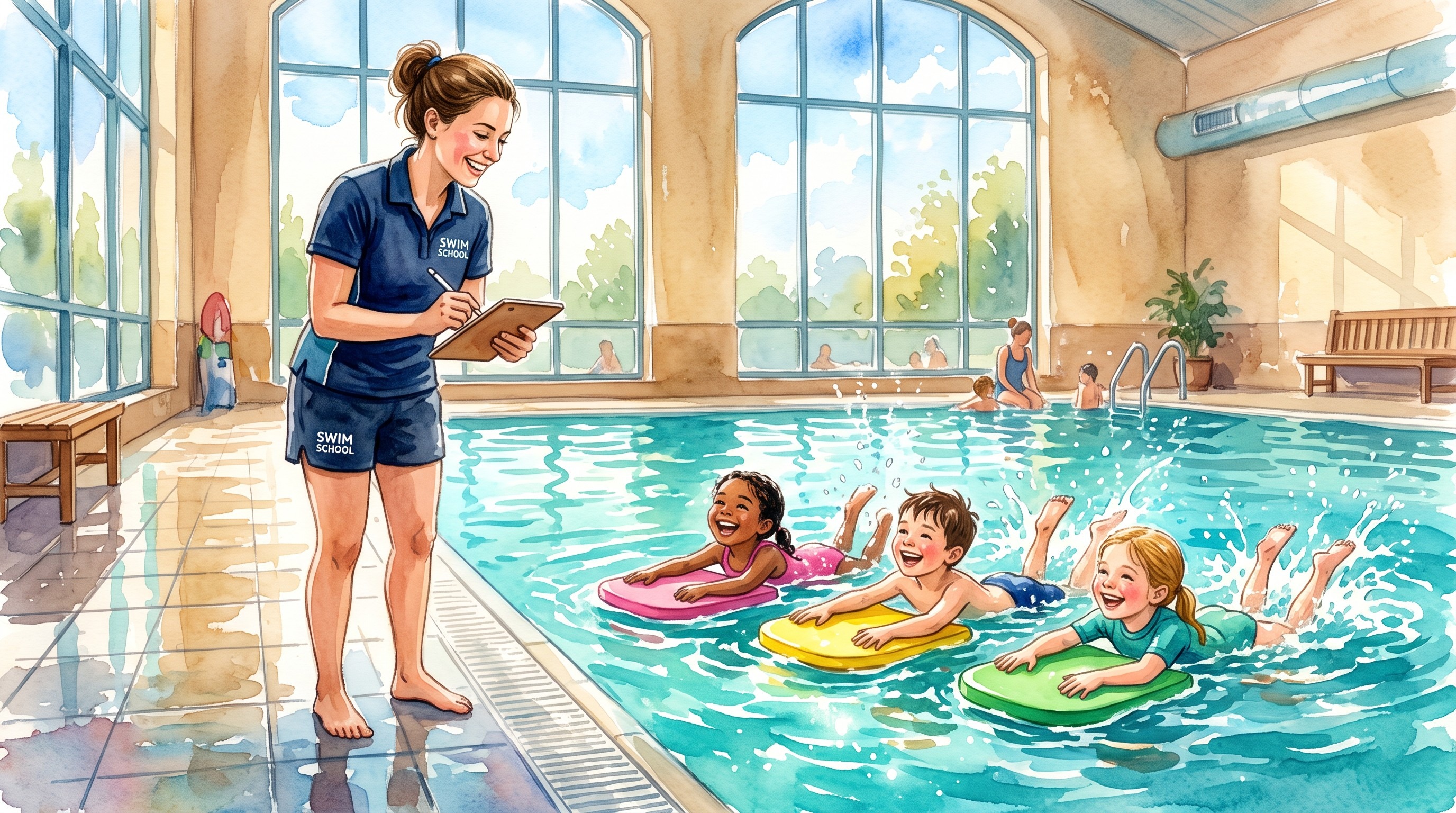
What you do not write down, you will lose next week. Note per child the skill that was central, the step reached (together, with help, alone), what did not yet work, one remark about how the child behaved in the lesson and what you want to do next time. Five lines per child are enough. You will not write half a page per child after a busy Saturday.
Handover to a colleague or substitute
A lesson plan that lives only in the head of the regular instructor is a risk when someone is sick. Make sure a colleague can see in two minutes where the group stands and what was done last week. That reduces hassle during illness and keeps continuity when a child switches instructor or lesson day.
What parents want to know
Parents do not want your entire lesson plan. They want to know where their child stands, what was practiced this lesson and what will come next time. When you share that briefly per lesson, questions at the poolside disappear and you do not have the same conversation every week.
Mistakes that undo a good lesson plan
Too many new things in one lesson
A lesson with four strokes, a diving exercise and a rescue hold teaches a child nothing. Practice time per skill becomes too short to store anything. Keep to one new skill per lesson and use the rest of the time for repetition and variation.
Repeating the same exercise for too long
Repetition works, boredom works against learning. Repeat the movement in another form: the same step, a different game, a different distance. Children then do not notice they are doing the same thing, while the body does exactly what is needed.
Copying a plan without looking at the group
A lesson plan from last season is a starting point, not a guarantee. Look in the first five minutes how the group is: who is tired, who is scared, who has a new lesson day. Then adapt your block 3. A plan you do not adjust is a plan you do not use.
How your lesson plan lands in Swimmigo
One place for plan and skills
Swimmigo works with 7 levels and 86 skills, with a score of 0 to 6 per exercise. Your lesson plan therefore does not need to be separate from what you register: choose the skill that is central in block 3 and see immediately which children are ready for it. Levels run from Red to Gold, with a certificate per completed level and a personalized diploma at Bronze, Silver and Gold.
Tick off while you are in the water
Tick scores on your phone or tablet without leaving the lesson. Groups are prearranged, so you do not have to search who is in which group. After the lesson everything is recorded, and you do not have to transcribe a notebook in the evening.
What your team and parents see
Team members have their own role (owner, manager or instructor), so a substitute sees the group but not the revenue. Parents see their child's progress as soon as you update something. They receive messages in the app with read receipts and notifications in their own language; the app is available in five languages, Dutch, English, German, French and Spanish, with Portuguese in development. Those who want more than progress will find statistics and School Pulse, lesson payments with custom packages via Stripe, and the Marketing Toolkit with flyers, diploma maker and QR linking in the same environment.
You can try the platform for free with an unlimited demo, then with a 30-day free trial. The parent app is free. More about the instructor side is on swimmigo.com/instructors, the full feature overview on swimmigo.com/features and the student tracking system on swimmigo.com/leerlingvolgsysteem.
Further reading
- The ideal swim lesson structure: warm-up, core and finish in 30 minutes for the anatomy of one lesson.
- Complete overview of tools for swim instructors for choosing software alongside your lesson plan.
- Planning swim lessons for mixed-level groups when you work with different levels in one group.
Summary
An age-based lesson plan starts with attention and daring, not with the stroke you want to teach. Use the five fixed blocks as a base, choose one new skill per lesson and adapt the form to what the group can handle. Record in five lines after each lesson where the group stands, so the next lesson builds on it instead of starting over.
Swimmigo · For swim schools
Run your swim school fully digital
Students, schedules, absences and parent communication in one app, with your own rates and branding.
Sources
- Swim England: Learn to Swim Framework Stages 1 to 7, 2017
- Swim England: Learn to Swim Stage 1 to 7 Awards and learning outcomes, 2026
- American Academy of Pediatrics: Swim Lessons for Children, when to start and what to watch for, updated May 18, 2026
- American Red Cross: Swimming Lessons for Kids
- World Health Organization: Drowning fact sheet

Bob van Soest
As an expert in operating sports facilities (such as swimming pools) and developer of, among others, Swimmigo.com, I am passionately committed to making swimming lessons simpler, more fun and more insightful for parents, swimming instructors and everyone who wants to learn to swim.
Frequently Asked Questions
Related articles
Choosing the right swim instructor for swim lesson planning
Practical tips to select a qualified swim instructor for your lessons.

Sharing swim lesson materials efficiently with colleagues
Tips to easily share swim lesson materials and knowledge with colleagues for better collaboration.
Complete overview of tools for swim instructors: independent and free
Overview of tools for swim instructors: student tracking system, lesson planning, and parent communication compared. Swimmigo offers everything free in one platform [2026]
Discover Swimmigo
The all-in-one app for swimming lesson progress. For parents, swim schools, and adult swimmers.