Swimming Lessons with Type 1 Diabetes: How to Keep It Safe and Manageable [2026]
![Swimming Lessons with Type 1 Diabetes: How to Keep It Safe and Manageable [2026]](/_next/image?url=https%3A%2F%2Fzvblogpostimages.s3.eu-west-3.amazonaws.com%2FAUTOMATISCH_UPLOAD%2F1_7144c264da3e.jpg&w=3840&q=75&dpl=dpl_Hu1x2EbRzyTSftZtTMNnZb6dPFyi)
Summary
- Swimming suits type 1 diabetes: exercise makes insulin more sensitive, so blood sugar moves along with the lesson.
- Measure before every lesson and do not start below 5 mmol/l; the target for exercise is around 7 to 10 mmol/l.
- Fast sugars should be at the poolside, not in a locker, and the instructor must know where they are.
- The hours after the lesson require the most attention: a hypo can occur when your child is already home on the couch.
- In the Swimmigo app, per student, the swim instructor sees what they need to know, visible only to that instructor.
Half an hour of swimming lessons. Your child swims, plays, jumps off the edge, and uses muscles that are hardly strained the rest of the week. With type 1 diabetes, something happens during that half hour that you can’t see from the outside: the blood sugar moves along. Often it drops. Sometimes only two hours later, when your child is already dressed and sitting on the couch.
Swimming and type 1 diabetes go well together. Worldwide, an estimated 1.52 million children and young people under 20 live with type 1 diabetes, and most swim, do gymnastics, and play sports just like their peers (IDF Diabetes Atlas). What it requires is preparation that you arrange properly once: a safe starting value, fast sugars within reach, and a swim school that knows what’s going on.
This overview is not medical advice. You adjust your child’s approach with the pediatrician or diabetes nurse. Below is what parents and swim schools agree on in practice, with sources so you can read up on what is and isn’t known.
Swimming affects blood sugar more than you think
Exercise makes insulin more sensitive
During swimming, your muscles take up glucose from the blood, and they do this with less insulin than at rest. The Diabetes Fund describes this effect: exercise improves insulin sensitivity, which lowers blood sugar. For a swimming lesson, this means one practical thing: the value your child had before the lesson is not the same at the end of the lesson.
In water, blood sugar often drops faster than during an hour of gym
Swimming demands a lot from the whole body, and the resistance of the water makes every stroke harder, while the water supports the weight. Children therefore notice the effort less than on land. Temperature plays a role: warm water and warm days can lower blood sugar even more (Type1Support, a Canadian research platform including McGill University). Stress does the opposite: a first time in a new or deep pool can raise the value.
Type 1 diabetes affects more than just children
Type 1 diabetes is still often seen as a childhood disease, but that image is outdated. In 2022, 1.52 million of the 8.75 million people with type 1 diabetes worldwide were under 20 years old, and 62 percent of all new cases that year were 20 or older (IDF Diabetes Atlas). The WHO counted nine million people with type 1 diabetes in 2017, most living in high-income countries. Swim schools in the Netherlands, Germany, or Spain face the same questions, and the approach does not differ by country.
Before the lesson: the check and the bag
Measure before your child enters the water
Exact limits vary per child and treatment, but sources agree. The Diabetes Fund advises not to start exercising with blood sugar below 5 mmol/l or above 16 mmol/l. diabetes.nl mentions 4 mmol/l or lower as a cutoff not to start. The international guideline for young people with type 1 diabetes aims for 7 to 10 mmol/l for exercise (ISPAD, 2022 guideline). These numbers are a starting point for discussion with your healthcare provider, not something to adjust insulin on your own.
Fast sugars go poolside, not in the locker
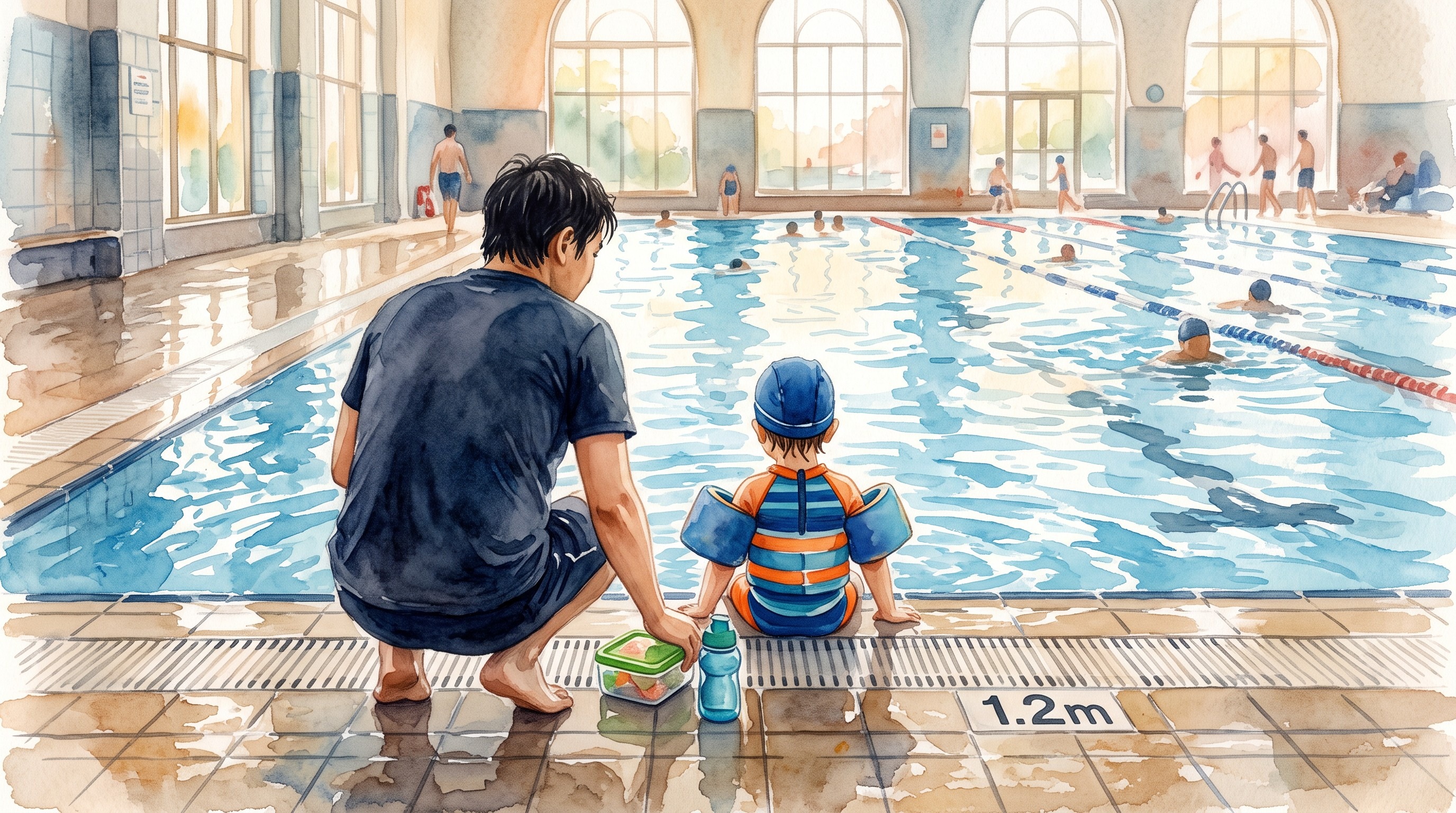
A hypo during swimming is the scenario everything is built around, and that includes a bag your child can access themselves. Think of dextrose tablets or glucose tablets, a small juice box or sports drink, and something with slow carbohydrates for afterward. In a hypo, it’s about quickly absorbable carbohydrates, in liquid or fast-absorbing form, such as sports drink, glucose tablets, or syrup (Diabetes Fund). Put them in a separate pouch or box that goes with your child to the poolside. In a locker or bag in the hallway, they are useless when you need them.
Sensor, pump, and bandage: waterproof is not the same as indestructible
If your child wears a glucose sensor, it usually can go into the water, but it can also come loose. An extra patch or band helps prevent this (Type1Support). For an insulin pump, water resistance varies by manufacturer and device. Disconnecting is the most recommended approach: the catheter stays in place and the pump is removed. Do not disconnect the pump for longer than about two hours and reconnect it after swimming, with insulin. Some pumps may stay in the water, but waterproof practically means resistant to splashes or accidents, not intended to be underwater for half an hour.
The last meal before the lesson matters
What your child eats before the lesson partly determines how they start the lesson. A meal with carbohydrates two to three hours before swimming is easier to manage than a quick snack right before changing. Avoid trying new foods on a swimming lesson day: if the value behaves strangely afterward, you won’t know why. What works and doesn’t for before the lesson is explained in what your child can eat before swimming lessons.
Swimmigo · Swim lesson app
Free for parents
Follow your child's swimming progress, see where you stand and report absences in the app.

What you agree with the swim school
Who checks, and where is the bag
The Diabetes Fund advises informing the sports instructor. In practice, this means a short conversation where four things are arranged: where the bag with sugars is, who watches if your child participates normally, at what signs your child comes out of the water, and who calls you if something is wrong. Put it in writing, even if your child has been swimming at the same school for years. Instructors change, and an agreement only in someone’s head disappears with them.
Signs a swim instructor should recognize
A hypo does not always announce itself clearly. Pale appearance, yawning, becoming sluggish, not responding to instructions, lingering in a corner of the pool, or clumsy movements are signs that require a check. They are harder to see in the water than on land, and a child who doesn’t feel well often keeps swimming because they don’t want to disrupt the lesson. When in doubt, the instructor takes the child out of the water and lets them eat something. With a hypo, swimming continues no further, because almost any exertion lowers blood sugar further (diabetes.nl).
What is recorded per student in the app
In Swimmigo, each student has a notes field where you can add health information and other points of attention, from fear of water to a condition. That note is only visible to the swim instructor linked to your child. You can also cancel a lesson if your child does not participate, and send messages to the school that are marked as read, so you know something has been received. Swim schools using this see at a glance what needs to be arranged for a student upon arrival (more about the swim school side).
The school’s emergency plan should be available
A swim school should know who does what if something happens, who takes the child out of the water, who calls emergency services, and who notifies the parents. That plan has nothing to do with diabetes and everything to do with preparation. How to create such a plan is explained in the swim school emergency plan guide. Review with the school who will be present on your child’s day.
The hours after the lesson
The drop sometimes only comes at home
The lesson is over, your child is dressed, and everything seems fine, until an hour later they sit quietly on the couch. Exercise effects last for hours because muscles replenish their glucose stores and insulin continues to work better. diabetes.nl warns that a hypo can occur hours after exercise, and the Diabetes Fund has a separate section about this. So keep a close eye on your child in the first hours after the lesson, with a check or sensor alarm.
An evening lesson requires a night check
Swimming lessons late afternoon or early evening extend into the night. Turn on the sensor alarm if you have one, check before going to sleep, and discuss with your diabetes nurse whether basal insulin should be adjusted on swimming days. Also record the morning value the next day. After a few weeks of data, you can see if a pattern requires adjustment.
Limits you cannot ignore
| Situation before the lesson | What the sources advise | Who says this |
|---|---|---|
| Lower than 3.0 mmol/l | Do not start exercising. First treat until the value is above a safe limit. | ISPAD, 2022 guideline |
| 3.0 to 4.9 mmol/l | Wait and take carbohydrates until the value rises above 4.9 mmol/l. diabetes.nl uses 4 mmol/l or lower as a cutoff. | ISPAD, diabetes.nl |
| 5.0 to 6.9 mmol/l | Take extra carbohydrates to the poolside, 10 to 15 grams for 30 minutes of light exercise. | Diabetes Fund |
| 7.0 to 10.0 mmol/l | Target value for exercise in young people with type 1 diabetes. | ISPAD, 2022 guideline |
| 15.0 mmol/l or higher with ketones | Do not swim. First address ketones and insulin with correction and waiting time. | ISPAD, 2022 guideline |
| Hypo during the lesson | Immediately out of the water, fast-absorbing carbohydrates, about 20 grams, and wait until the value is stable. | Diabetes Fund, diabetes.nl |
This table summarizes general exercise guidelines, not a personal treatment plan. Your child has individual values to respond to, which you adjust with the healthcare provider.
Ketones: skipping the lesson
A high value with ketones is a reason not to swim. The ISPAD guideline is clear: no exercise with ketones above 1.5 mmol/l, and first address the ketones. If your child is between 0.6 and 1.5 mmol/l with a value above 15 mmol/l, a correction with waiting time is required. As a parent, you often notice something is wrong earlier: your child feels unwell, is thirsty, or breathes faster. That is the moment to measure.
A hypo during the lesson: out and eat
With a hypo, your child immediately gets out of the water. Exercising with a hypo makes it worse, as almost any exertion lowers blood sugar further (diabetes.nl). Then fast-absorbing carbohydrates, such as dextrose, sports drink, or syrup; the Diabetes Fund mentions 20 grams for low blood sugar. Wait to return until the value is safe again, and report it to the swim school. The instructor needs to know what they saw, even if the lesson continues afterward.
When sick, feverish, or after a bad night
With fever, vomiting, or a night with lots of waking, the day is not suitable for swimming lessons, and missing one lesson is always better than a hypo in the water. Report it via the app to the school, so the instructor and scheduling know what to expect.
Keeping an overview without taking on another job
One place for agreements per child
What you agreed with the school, where the sugars are, and how the lesson went—you want to find that without searching through last month’s messages. In Swimmigo, agreements are stored with the student, you can see what was practiced per lesson, and communication stays part of the swimming lessons instead of a group chat with thirty parents (what parents see in the app).
A logbook to bring to the diabetes nurse
You are the best source for adjusting insulin for swimming lessons. Note the value before the lesson, what your child ate, how the lesson went, and the value a few hours later. Type1Support recommends such a logbook to see which approach works. With a series of five or ten lessons, you see patterns that a single measurement never reveals, and that is exactly what the diabetes nurse can use.
With a new instructor or different swim school
If something changes in guidance, the conversation starts again. That’s not an exaggeration: a new instructor doesn’t know your child or what a hypo looks like for them. Explain what’s going on, point out the bag with sugars, and check if the information is in the school’s system. When changing schools, transferring the skill level is the second conversation you have.
What the app does not do
Swimmigo is not a medical device. The app does not read sensor values, does not alarm for low blood sugar, and does not replace treatment. Measuring, treating, and adjusting remain with you, your child, and the healthcare provider. What the app does do is keep agreements and progress in one place accessible to the swim instructor when needed.
How to make it discussable at the club
Ask about the emergency plan and safety protocol
A swim school that often teaches children with a condition usually already has a protocol. Ask for it, even if your child has been swimming there for a while. If nothing is on paper, this is the moment to arrange it together. Half an hour at the table prevents a lot of uncertainty at the poolside.
Attend the first lesson
Joining the first lesson at the poolside is the fastest way to see how the lesson goes and to talk to the instructor. For some children, that is distracting, so agree on how to do it: watch the first lessons and then by appointment. You don’t need to stand at the edge every week to know what’s happening. In the app, you see which exercises were checked off per lesson, and that usually tells more about progress than a glance through the window.
What you don’t need to explain
You don’t have to give a medical story at reception. What the school needs to know fits on half an A4: what condition your child has, which values are reasons not to swim, where the sugars are, what your child looks like during a hypo, and which number to call. The rest is for the healthcare provider. Swim schools using Swimmigo put those agreements with the student so the instructor sees them when the group enters the pool (see the possibilities).
Conclusion
Swimming lessons with type 1 diabetes are very doable as long as the agreements are right: a safe starting value, fast sugars within reach, and an instructor who knows what’s going on. The lesson itself is rarely the difficult part; the hours afterward require the most attention. Arrange it properly once with the swim school, keep a short logbook, and bring it to your healthcare provider.
Swimmigo · Swim lesson app
Free for parents
Follow your child's swimming progress, see where you stand and report absences in the app.
Sources
- ISPAD: Clinical Practice Consensus Guidelines 2022, chapter 14 on exercise in children and youth with diabetes (2022)
- IDF Diabetes Atlas: Type 1 diabetes estimates in children and adults (2022, accessed October 2026)
- WHO: Diabetes, fact sheet (November 14, 2024)
- Diabetes Fund: exercise and diabetes (updated September 2026)
- diabetes.nl: hypos and hypers during exercise with type 1 diabetes (accessed October 2026)
- Type1Support (McGill University): swimming and type 1 diabetes (2026)
- Nemours KidsHealth: helping your young athlete with type 1 diabetes (accessed October 2026)
- Bas van de Goor Foundation: swimming and diabetes, how do you do that? (2026)
Bob van Soest
As an expert in operating sports facilities (such as swimming pools) and developer of, among others, Swimmigo.com, I am passionately committed to making swimming lessons simpler, more fun and more insightful for parents, swimming instructors and everyone who wants to learn to swim.
Frequently Asked Questions
Related articles
![Swimmer's Ear in Children: How to Prevent Ear Pain After Swimming Lessons [2026]](/_next/image?url=https%3A%2F%2Fzvblogpostimages.s3.eu-west-3.amazonaws.com%2FAUTOMATISCH_UPLOAD%2F1_c46e581d096a.jpg&w=3840&q=75&dpl=dpl_Hu1x2EbRzyTSftZtTMNnZb6dPFyi)
Swimmer's Ear in Children: How to Prevent Ear Pain After Swimming Lessons [2026]
Swimmer's ear is an inflammation of the ear canal that often occurs after swimming. Here's how to recognize it in your child, prevent it, and treat it. [2026]
![Can My Child with Asthma Swim? How to Approach Swimming Lessons Safely [2026]](/_next/image?url=https%3A%2F%2Fzvblogpostimages.s3.eu-west-3.amazonaws.com%2FAUTOMATISCH_UPLOAD%2F1_f517784b370a.jpg&w=3840&q=75&dpl=dpl_Hu1x2EbRzyTSftZtTMNnZb6dPFyi)
Can My Child with Asthma Swim? How to Approach Swimming Lessons Safely [2026]
Can your child with asthma swim? Yes, usually. Here’s how to approach swimming lessons safely: doctor’s advice, medication, chlorine smell, and what the instructor needs to know [2026]
![Complete Overview of Swimming and Health for Children: How to Keep Your Child Healthy In and Around the Pool [2026]](/_next/image?url=https%3A%2F%2Fzvblogpostimages.s3.eu-west-3.amazonaws.com%2FAUTOMATISCH_UPLOAD%2F1_babb0737688b.jpg&w=3840&q=75&dpl=dpl_Hu1x2EbRzyTSftZtTMNnZb6dPFyi)
Complete Overview of Swimming and Health for Children: How to Keep Your Child Healthy In and Around the Pool [2026]
Swimming is healthy for children but also has risks: swimmer's ear, warts, chlorine smell, and stomach flu. Here's how to keep your child healthy in and around the pool [2026]
Discover Swimmigo
The all-in-one app for swimming lesson progress. For parents, swim schools, and adult swimmers.