SwimmingLessonswithGlassesorContacts:HowtoProtectYourChild'sEyes[2026]
![Swimming Lessons with Glasses or Contacts: How to Protect Your Child's Eyes [2026]](/_next/image?url=https%3A%2F%2Fzvblogpostimages.s3.eu-west-3.amazonaws.com%2FAUTOMATISCH_UPLOAD%2F1_e0a034e660c5.jpg&w=3840&q=75&dpl=dpl_FEcJLWFaZFj4CsT2F159aPzMcoRK)
Summary
- Chlorine dries out the eyes, and contacts in the water increase the risk of a persistent corneal infection.
- The advice from the Oogfonds, Thuisarts, the CDC, and eye doctors is unanimous: remove contacts before swimming.
- Prescription swim goggles are the simplest solution for most children; a well-fitting non-prescription swim goggles also helps.
- Inform at registration if your child sees poorly without glasses, so the instructor can adjust their explanation.
- If eyes are still painful or red twelve hours after swimming, call the GP.
Your child stands at the edge of the pool, the instructor points something out across the water, and you see your child searching for a moment. Without glasses, the outlines of a swimming pool are difficult: the water reflects light, the instructor stands outside the pool, and children move around your child. Anyone who wears glasses themselves recognizes that feeling of swimming in a blur.
The question quickly arises: can those glasses go into the water, and are contacts an option? Eye doctors and eye foundations are clearer about this than most parents expect.
Why water and eyes are not an easy combination
Chlorine keeps the water clean, but not for everything
Chlorine does its job in the pool, but it is not a friendly substance for the eyes. The tear film that keeps your eyes moist and smooth is affected by chlorine and other disinfectants. You notice this after swimming: dry, red, or itchy eyes. Those who spend a lot of time in the water experience this effect longer and may develop dry eyes, according to the American Academy of Ophthalmology (AAO).
More importantly, what chlorine does not kill. The Oogfonds mentions the single-celled parasite acanthamoeba, which occurs in lakes, rivers, seas, swimming pools, and tap water. For most people, this causes no issues. If the parasite enters the cornea through a small wound, a painful infection called acanthamoeba keratitis can develop. The group at highest risk by far: people who wear contact lenses.
More than one in seven young children wears glasses
How common glasses are at swimming lesson age is shown by figures from the CBS. Among children aged 4 to 12 years, 14.2 percent wear glasses. Among teenagers, this rises to over a quarter, and nearly 6 percent of 12- to 16-year-olds wear contacts. Statistically, in a group of eight children, at least one wears glasses.
| Age | Wears Glasses | Wears Contacts | Other Aid |
|---|---|---|---|
| 4 to 12 years | 14.2% | 0.4% | 0.6% |
| 12 to 16 years | 26.4% | 5.8% | 1.7% |
| 16 to 20 years | 34.2% | 15.8% | 1.1% |
| 20 to 30 years | 38.4% | 20.0% | 1.6% |
These figures come from the Netherlands, but the pattern is broader. According to the WHO, uncorrected refractive error is one of the leading causes of visual impairment worldwide, in children as well as adults.
What a child notices when vision is blurry in the water
Seeing in a swimming pool is harder than seeing on land. There is movement, water gets into the eyes, light reflects off the water surface, and the instructor often stands outside the pool while your child is inside. A child without glasses or swim goggles therefore misses details more easily: the finger pointing a direction, the example just demonstrated, the position of other children in the lane.
This does not automatically translate into slower progress. It does affect how confident a child feels. Children who see poorly in the water are less likely to jump or dive off the edge, simply because depth is harder to judge.
Glasses, contacts, or swim goggles: what works in practice
Regular glasses stay out of the water
Regular glasses are mainly a fragile item in the pool. They slip off during a jump, get lost on the pool edge, or break underfoot. Many pools therefore ask that glasses be taken off or stored; check with the reception if you are unsure what is customary at your pool. Put them in a hard case in the bag or in a locker. Children who see very little without glasses benefit more from their own swim goggles.
Soft contacts and swimming: the risk you don’t immediately notice
Advice about contacts in the water is remarkably unanimous. The Oogfonds states simply: do not wear contact lenses while swimming, showering, bathing, or visiting a sauna. The US health service CDC even lists swimming with contacts as a factor that increases the risk of acanthamoeba keratitis. The reason is simple: water gets between the lens and cornea, and pathogens remain trapped underneath.
What makes this infection so troublesome is its course. Symptoms often start as a common red, painful eye, so diagnosis is not always immediate. Treatment consists of disinfecting eye drops, initially day and night, and often lasts months. Some patients are left with scar tissue. In the Netherlands, about a quarter of patients with acanthamoeba keratitis eventually require a corneal transplant, reports the Radboudumc.
What to do if your child has been in the water with contacts
Swimming once with contacts does not mean something will go wrong. However, pay close attention afterwards. Thuisarts, the general practitioners’ information site, advises removing the lenses immediately and wearing glasses. If the eyes are still painful or red twelve hours later, call the GP. If you see a white spot on the colored part of the eye, call the doctor the same day.
Daily disposable lenses as an intermediate solution
The Oogziekenhuis Rotterdam mentions disposable lenses as a reasonable option for those who absolutely want to swim with contacts: put them in before swimming, remove immediately after, and throw them away. Hard lenses are less likely to become contaminated but are more easily lost in the water. For a child’s swimming lesson, this is usually not the most practical route, as it requires discipline at a time when there is already a lot to manage.
Prescription swim goggles: the choice with the least explanation needed
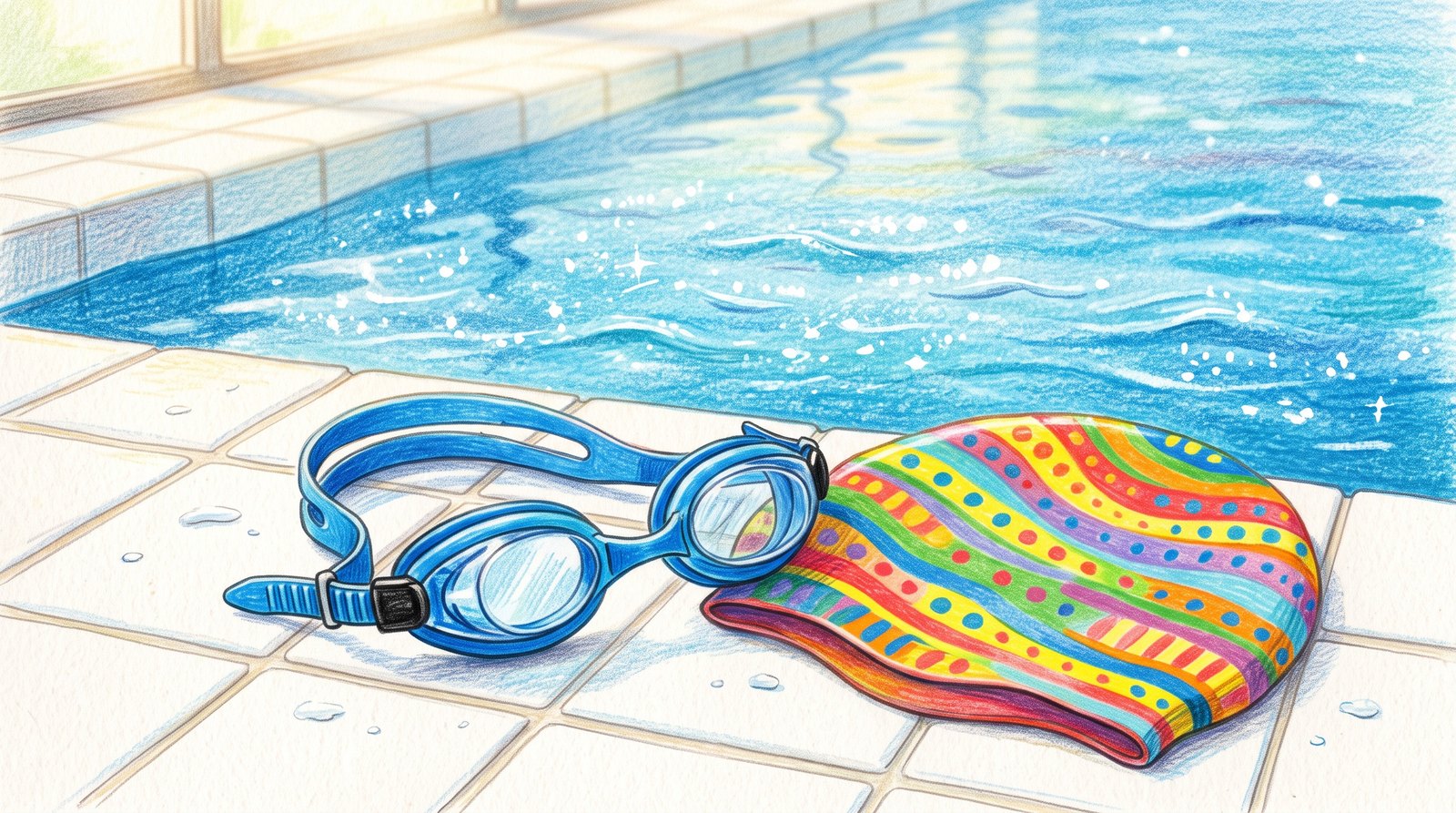
A pair of swim goggles with prescription lenses is often the simplest solution for children. The Oogziekenhuis calls a swim or diving mask with ground-in correction very handy, and the AAO recommends the same approach. You can buy them at an optician or online. Pay attention to three things: the strength per eye (not every provider can accommodate both eyes separately), the fit, because a leaking goggle lets water in exactly where you don’t want it, and whether your child can put them on and take them off independently.
Swim goggles without prescription also help a lot. They keep chlorine out and make underwater viewing possible, which aids water familiarization.
How to arrange it around swimming lessons
Tell at registration, not after three months
Swim schools like to know in advance if a student has poor vision. An instructor who knows a child sees little without glasses will stand differently, point differently, and check more often whether the exercise has been understood. In Swimmigo’s parent environment, a parent can leave a note when linking a child that only the linked swim instructor sees. A note like "wears glasses, sees little without glasses" fits perfectly here, without needing a separate message or a conversation in the changing room.
Let the information follow in the student profile
Swim schools with multiple instructors and substitutes face the same problem: knowledge about a student often resides in someone’s head. A short note in the student profile prevents having to explain it again with every change. The instructor can add such a note in the instructors’ environment, and parents see the note back in their child’s progress.
Rinse eyes and rest after the lesson
The AAO advises a few simple habits after swimming: rinse closed eyes with clean water, use artificial tears if needed, and drink enough. For children who swim twice a week, this is no luxury. Remove contacts immediately and then choose glasses.
What your child can learn about contacts
Whether contacts are an option depends on hygiene and responsibility, which varies per child. An optometrist or contact lens specialist assesses this together with you. What a child can definitely learn: wash hands before putting in lenses, never clean lenses with tap water, replace the case daily, and remove lenses when swimming, showering, or bathing. The Oogfonds lists these rules in ten tips.
Lost glasses or swim goggles in the pool
Expect it to happen once. Report it immediately at reception, as pool staff often have a lost and found box and know where glasses tend to be left behind. Write your child’s name on the strap of the swim goggles and bring a spare in the swim bag. This saves hassle on a day that is already busy.
For swim schools: a student with glasses is very common
What works in a group
A student who wears glasses requires little extra, as long as instructions are visible. Position the child so they can see your face and hands during explanations, demonstrate exercises instead of only naming them, and use short cues that can be followed from a distance. When jumping and doing exercises in deep water, it helps to check briefly if the child has understood the task before continuing.
Two questions at registration
Does your child see well without glasses? And do they use swim goggles or prescription swim goggles? These two questions yield the most benefit, and the answers should be recorded in the student profile. If a substitute or new colleague comes in, the information is immediately available.
Informing parents in their own language
Swim schools working with international families receive the same question in different languages. In Swimmigo, messages are stored in the recipient’s language and only translated upon display, in Dutch, English, German, French, and Spanish. Parents who only partially follow the conversation poolside receive the message about the swim goggles or next lesson in their own language.
The same basic rules apply in every water
Contacts out, glasses or swim goggles on
The advice comes from various countries and says the same thing. Thuisarts and the Oogfonds advise removing contacts during swimming, the CDC does so for the United States, and the AAO agrees. This applies in a swimming pool, lake, sea, and shower, because the parasite lives in water and moist soil, not just in chlorinated water.
Why this topic deserves more attention than it gets
Worldwide, at least 2.2 billion people live with some form of visual impairment, and for about one billion of them, the problem was preventable or treatable. Refractive error tops the list of causes. In swimming lessons, a second layer is added: a child who cannot see well in the water learns more slowly to judge where they are and what they can do. For parents, prescription swim goggles are a small adjustment with a noticeable effect. For swim schools, it is one question at registration.
That settles most of it. Your child keeps sight of the instructor, the cornea is not unnecessarily at risk, and the swim school knows what is going on. Parents who want to follow their child’s progress see in the app where they stand per skill.
Sources
- CBS: 62 percent of the population wears glasses, 2023
- Thuisarts: I wear contact lenses and have eye complaints, updated July 24, 2024
- Oogfonds: Acanthamoeba keratitis, symptoms and treatment, consulted October 2026
- Oogfonds: Contact lenses, 10 tips for safe wearing, consulted October 2026
- Oogziekenhuis Rotterdam: Is it wise to swim with your contact lenses in?, consulted October 2026
- Radboudumc: What is Acanthamoeba keratitis?, consulted October 2026
- CDC: Acanthamoeba Keratitis, updated June 20, 2025
- American Academy of Ophthalmology: What You Should Know About Swimming and Your Eyes, updated July 1, 2026
- WHO: Blindness and vision impairment, factsheet, updated February 10, 2026
Bob van Soest
As an expert in operating sports facilities (such as swimming pools) and developer of, among others, Swimmigo.com, I am passionately committed to making swimming lessons simpler, more fun and more insightful for parents, swimming instructors and everyone who wants to learn to swim.
Frequently Asked Questions
Related articles
![Swimmer's Ear in Children: How to Prevent Ear Pain After Swimming Lessons [2026]](/_next/image?url=https%3A%2F%2Fzvblogpostimages.s3.eu-west-3.amazonaws.com%2FAUTOMATISCH_UPLOAD%2F1_c46e581d096a.jpg&w=3840&q=75&dpl=dpl_FEcJLWFaZFj4CsT2F159aPzMcoRK)
Swimmer's Ear in Children: How to Prevent Ear Pain After Swimming Lessons [2026]
Swimmer's ear is an inflammation of the ear canal that often occurs after swimming. Here's how to recognize it in your child, prevent it, and treat it. [2026]
![Can My Child with Asthma Swim? How to Approach Swimming Lessons Safely [2026]](/_next/image?url=https%3A%2F%2Fzvblogpostimages.s3.eu-west-3.amazonaws.com%2FAUTOMATISCH_UPLOAD%2F1_f517784b370a.jpg&w=3840&q=75&dpl=dpl_FEcJLWFaZFj4CsT2F159aPzMcoRK)
Can My Child with Asthma Swim? How to Approach Swimming Lessons Safely [2026]
Can your child with asthma swim? Yes, usually. Here’s how to approach swimming lessons safely: doctor’s advice, medication, chlorine smell, and what the instructor needs to know [2026]
![Complete Overview of Swimming and Health for Children: How to Keep Your Child Healthy In and Around the Pool [2026]](/_next/image?url=https%3A%2F%2Fzvblogpostimages.s3.eu-west-3.amazonaws.com%2FAUTOMATISCH_UPLOAD%2F1_babb0737688b.jpg&w=3840&q=75&dpl=dpl_FEcJLWFaZFj4CsT2F159aPzMcoRK)
Complete Overview of Swimming and Health for Children: How to Keep Your Child Healthy In and Around the Pool [2026]
Swimming is healthy for children but also has risks: swimmer's ear, warts, chlorine smell, and stomach flu. Here's how to keep your child healthy in and around the pool [2026]
Discover Swimmigo
The all-in-one app for swimming lesson progress. For parents, swim schools, and adult swimmers.