SwimmingLessonsandEpilepsy:CanYourChildSwimandHowtoKeepItSafe?[2026]
![Swimming Lessons and Epilepsy: Can Your Child Swim and How to Keep It Safe? [2026]](/_next/image?url=https%3A%2F%2Fzvblogpostimages.s3.eu-west-3.amazonaws.com%2FAUTOMATISCH_UPLOAD%2F1_8f0ec440c776.jpg&w=3840&q=75&dpl=dpl_FEcJLWFaZFj4CsT2F159aPzMcoRK)
Summary
- A seizure in the water is dangerous, but swimming is possible for most children with epilepsy.
- A lifeguard does not count as one-on-one supervision: there must be someone who watches only your child.
- People with epilepsy have a 15 to 19 times higher risk of drowning than the general population.
- There is no law prohibiting swimming with epilepsy, so agree on arrangements beforehand with the swim school and pool.
- Keep investing in swimming skills: that is the basis of water safety, even with epilepsy.
The diagnosis of epilepsy rarely comes at a convenient time. Between check-ups with the neurologist, everyday life continues, including your child's swimming lessons. However, a new rule is added that you cannot leave to a group: never swim alone, and always have someone nearby who can intervene immediately. In a lesson with one instructor and a group of children, this is not so obvious.
Many parents therefore stop swimming lessons. Understandable, and unfortunate. Swimming skills are precisely what can make the difference between an accident in the water and just getting wet for a child with epilepsy. Below you will read what is possible, who takes which supervision responsibility, and what you should agree on before the first lesson starts.
What makes epilepsy different in the water
A seizure does not always give warning
With epilepsy, the brain occasionally malfunctions. How this looks varies per child: zoning out briefly, uncontrolled movements, or losing consciousness and falling. Some children feel a seizure coming and have time to get to the side, others do not. A seizure of a few seconds on dry land is unpleasant. In the water, it becomes an emergency, which is why the advice from EpilepsieNL is clear for seizures with loss of consciousness: do not swim alone, swim in a pool with supervision, and not in open water.
The drowning risk is 15 to 19 times higher
A study on drowning in people with epilepsy found a risk 15 to 19 times higher than in the general population. This figure shows why supervision is not a minor issue and why a child who learns to swim well gains so much.
There is no law prohibiting swimming
In the Netherlands, there is no rule determining who with epilepsy may enter the water (ZwembadBranche also describes this). The decision lies with you, your child, and the place where they swim. The pediatric neurological guidelines are concrete: never swim alone, and always have someone nearby who can swim, jump into the water immediately, and keep the head above water until your child is out of the pool. In case of doubt, the neurologist or epilepsy nurse is the right person to ask what is responsible in your situation.
Millions of children worldwide are affected
The World Health Organization estimates about 50 million people have epilepsy and lists drowning among preventable causes of death. Drowning is a major issue overall: the WHO counts around 300,000 drowning deaths annually, nearly a quarter of which are children under five years old. Swimming skills are one of the few drowning prevention measures that work in every country. That is why Swimmigo is available in five languages: parents and swim instructors in different countries should be able to read the same explanation.
Can your child with epilepsy take swimming lessons?
The answer depends on the seizures
Whether swimming lessons are possible depends on the type of seizures, how often they occur, whether your child feels them coming, and if there are triggers like lack of sleep or fever. A child who has been seizure-free for years has hardly any extra risk. A child with seizures involving loss of consciousness needs supervision within arm's reach and does not swim in open water. You make this decision with the healthcare provider, and the answer may change over time. If medication is reduced or increased, the risk assessment changes accordingly.
Why swimming lessons matter especially for these children
Exercise is not a trigger for most children with epilepsy. EpilepsieNL writes that the chance of a seizure during sports is small and that exertion often suppresses seizures. Sometimes a seizure occurs after sports, when the body calms down. Swimming also does something few other sports do: it practices exactly the moments that matter in an emergency, from keeping the head above water to climbing out at the side. You can see which skills are covered at each level on swimmigo.com/levels. Swimming also trains fitness and motor skills, exactly the things that make your child stronger outside the water, as described in the overview of swimming and children's health.
When a regular group is not suitable
A standard group lesson is not the right place for every child. For seizures with loss of consciousness, a pool with supervision is the starting point, and open water is excluded. Underwater swimming and diving are generally discouraged for people with epilepsy because help takes too long in those situations (Royal Life Saving). Some pools offer adapted lessons or one-on-one guidance, and a small group with a fixed instructor is often a better basis than a large group. If swimming lessons really do not work, options remain: practicing in shallow water with you present, practicing in a pool, and maintaining a fixed swimming time at a safe place for your child.
The supervision that matters
A lifeguard is not one-on-one supervision
A lifeguard watches the entire pool and cannot continuously watch one child. The pediatric neurological guidelines say it literally: someone who must watch multiple children at once is not sufficient supervision for a child with epilepsy. A lifeguard watches dozens of children simultaneously, and that is not unwillingness. It means the extra attention must come from somewhere else.
Who sits next to the pool then
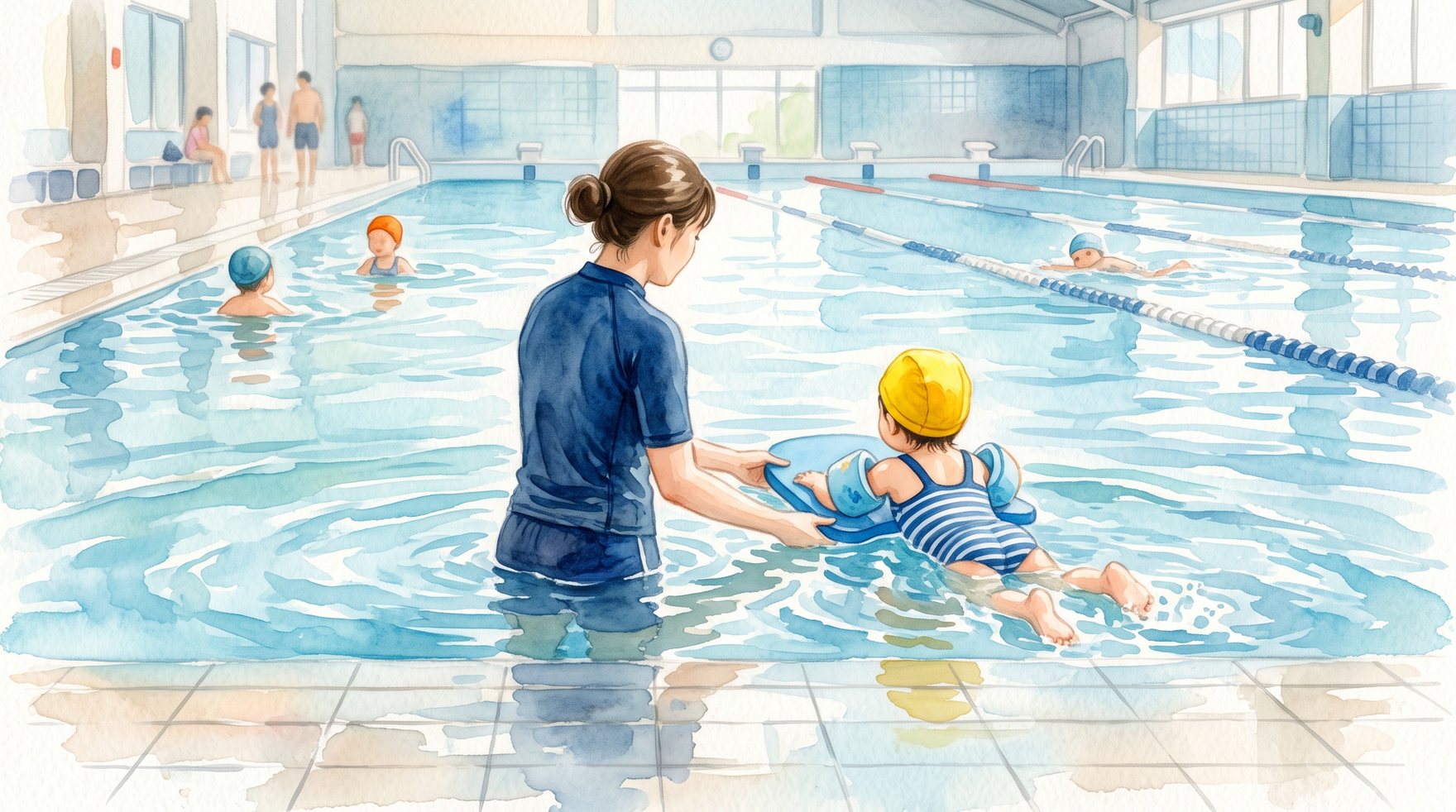
In practice, it comes down to one person who watches only your child. That person does not have to be in the water but must be able to swim, jump into the water immediately, and keep the head above water until your child is out. For a young or inexperienced swimmer, it is wise that someone accompanies them into the water. Who that is varies per family: a parent or caregiver, a grandparent, or an extra instructor freed up by the swim school for your child. Make that agreement beforehand, not on the day itself in the changing room.
Make your child easy to recognize
A distinctive swim cap or swimwear really helps. In a crowded pool with twenty blue caps, you won't spot your child; in an orange or yellow cap, you will. The pediatric neurological guidelines mention distinctive swimwear or a distinctive swim cap as a practical measure, and Royal Life Saving includes a colorful swim cap as a standard item on the safety checklist.
What to agree with the pool
Tell them at registration and repeat it at the reception. Pool staff and instructors should know what is going on and how to act. Also ask who supervises in the pool during the lesson and whether an extra companion is allowed. Record the agreement per period, not per season: a new instructor or a new lifeguard team means a new agreement.
A seizure in the water: what to do
First keep the head above water
The first seconds are about oxygen. Support your child, keep their head above water, and bring them to the side. Make sure your child does not go underwater or hit the edge or stairs. If it is not possible to get to the side immediately, keep the head above water and have someone else get help.
At the side: check breathing
At the side, check if your child is conscious and breathing well. If your child is not breathing, call 112 and start with five rescue breaths, followed by CPR. This is the procedure described by the Red Cross for drowning. If your child is breathing, lay them on their side, keep them warm, and wait for emergency services. A seizure lasting longer than five minutes or recurring without your child regaining consciousness is an emergency: call 112.
Emergency medication and timely medication
Some children have emergency medication that stops a long seizure. If it is in the swim bag or with the instructor, tell where it is and who may administer it. Also ensure regular medication is taken on time before your child enters the water. Consult the neurologist or epilepsy nurse if the schedule around swimming lessons needs adjustment.
What not to do
Do not hold your child during the seizure and do not try to stop the movements. Do not put anything in the mouth, not even a finger or spoon. Do not perform CPR in the water. Loosen tight clothing and keep the head free, as the Red Cross advises for a major seizure. After the seizure, your child is often tired or confused. Calmly explain what happened, keep them warm, and let them recover before going home.
What to agree with the swim school beforehand
A note in the swim bag works until the first substitute for the group arrives. It is better to put your agreements where the whole team can find them. These five points are enough.
| Topic | What to communicate | Why it helps |
|---|---|---|
| Type of seizures | Zoning out briefly, jerks in an arm or leg, or a seizure with loss of consciousness and falling. How often does it occur? | The instructor knows if your child should sit out briefly or if someone must be immediately present. |
| Preceding signals | What your child indicates before a seizure and what you as a parent observe. | Who recognizes the signals can get the child out of the water earlier. |
| Medication | Which medication is used, if emergency medication is in the swim bag, and who may administer it. | Searching for a box in an emergency wastes time. |
| Supervision during the lesson | Who accompanies, where that person sits, and whether they enter the water. | This makes clear beforehand who watches your child, instead of afterwards who was responsible. |
| Who to call | Your own number and that of the second parent or caregiver. | There is always someone reachable, even if you are in the water or on the way. |
Share what the instructor needs
You do not have to hand over a complete medical file. It is about four things: what a seizure looks like for your child, how long it lasts, what helps, and who to call. Write it in plain language, without abbreviations only doctors understand.
Agree who sits next to the pool
An agreement like "the instructor pays extra attention" is not feasible if that instructor has a whole group. Make it concrete: who sits next to the pool this lesson, how does that person recognize your child, and what does that person do if something happens. If no one is available, the agreement is that your child does not enter the water this lesson. A missed lesson is annoying, an unsafe lesson is worse.
Make sure a substitute also knows
Small swim schools often have multiple instructors, and during illness or vacation someone else leads the group. In the Swimmigo app, parents can provide health information and other points of attention when linking a student, visible only to the linked swim instructor. The instructor can in turn add a note per student, which parents see in the progress overview. Knowledge about your child does not have to travel via a note in the swim bag. Curious about what else is in the app for families? See the parent environment.
Privacy: you do not share a full file
Medical data are special personal data, and a swim school may not store or share them without permission. Share only what is necessary for safety during the lesson, and no more. Ask who can see it and if it will be deleted after some time. More about this is in the overview of the GDPR in swim schools.
For swim instructors and small swim schools
Ask at registration
Do not wait for a parent to tell you voluntarily, because that does not always happen. Ask at registration if there are medical points of attention you as an instructor should consider, and who will be present during the lesson. This way you know before the first child enters the water.
Put agreements in one place
A folder in the cupboard is close to the materials and far from the instructor who needs it. Effective agreements are where the lesson is prepared. In Swimmigo, you record what is going on per student, visible to the linked instructor. With team roles, you determine who may manage what: the owner, an administrator, or an instructor. Parents use Swimmigo for free, and swim schools and independent instructors choose a subscription with a 30-day free trial starting at the first linked student. What it looks like is on the page for instructors.
Small groups with familiar faces
Children with epilepsy benefit from a fixed instructor who learns to recognize a child's seizures and from a group that remains manageable. Changing instructors makes this harder, for the progress of all children and especially for a child with a medical condition. This is also the topic of the blog what changing instructors do to a child's progress.
Do not promise medical certainty you cannot provide
You cannot guarantee that nothing will ever happen in your pool. What you can promise is that you know who is in the group, that agreements are in place, and that someone can reach the child within seconds. Tell this exactly to parents. A swim school that promises nothing will ever go wrong loses trust the day it does.
Expectations you can adjust
My child is no longer allowed to swim
You often hear this, but it is not true. Swimming is not a forbidden sport for children with epilepsy. What changes is how you arrange supervision. EpilepsieNL writes that swimming is possible for most people with epilepsy, even with a severe form, as long as good precautions are taken.
There is a lifeguard present anyway
A lifeguard sees your child but does not watch your child continuously. Therefore, ask for supervision that fits your child, instead of extra attentiveness from someone who must watch the entire pool. Pools can make agreements about this, and some offer adapted lessons.
Then no swimming lessons at all
Stopping is the choice with the highest long-term cost. Children who never learn to swim have a greater risk their whole life, and this applies even more to a child with epilepsy. Rather look for a form that fits: a smaller group, an extra companion, an adapted lesson, or wait half a year and then start again. Swimming skills do not disappear because a child receives a diagnosis.
Conclusion
Epilepsy does not exclude swimming but changes how you arrange it. A child with epilepsy needs someone who watches only him or her, and a swim school that knows what is going on. Agree on this beforehand, repeat it with every team change, and maintain swimming skills. With these agreements in place, most children can continue swimming.
Sources
- EpilepsieNL: Swimming, consulted October 2026
- EpilepsieNL: Sports and exercise, consulted October 2026
- EpilepsieNL: Who gets epilepsy and at what age?, consulted October 2026
- Pediatric Neurology (J.H. Schieving): Guidelines for children with epilepsy, updated April 25, 2021
- Pediatric Neurology: What is epilepsy?, updated May 8, 2026
- Bell et al.: Drowning in people with epilepsy, how great is the risk?, 2008
- WHO: Epilepsy, factsheet, February 7, 2024
- WHO: Drowning, factsheet, May 1, 2026
- Red Cross: What to do during an epileptic seizure?, consulted October 2026
- Red Cross: What to do when someone is drowning?, consulted October 2026
- ZwembadBranche: Swimming with epilepsy, what to watch for?, consulted October 2026
- Royal Life Saving Society Australia: Epilepsy and drowning, how to stay safe, consulted October 2026
Bob van Soest
As an expert in operating sports facilities (such as swimming pools) and developer of, among others, Swimmigo.com, I am passionately committed to making swimming lessons simpler, more fun and more insightful for parents, swimming instructors and everyone who wants to learn to swim.
Frequently Asked Questions
Related articles
![Swimmer's Ear in Children: How to Prevent Ear Pain After Swimming Lessons [2026]](/_next/image?url=https%3A%2F%2Fzvblogpostimages.s3.eu-west-3.amazonaws.com%2FAUTOMATISCH_UPLOAD%2F1_c46e581d096a.jpg&w=3840&q=75&dpl=dpl_FEcJLWFaZFj4CsT2F159aPzMcoRK)
Swimmer's Ear in Children: How to Prevent Ear Pain After Swimming Lessons [2026]
Swimmer's ear is an inflammation of the ear canal that often occurs after swimming. Here's how to recognize it in your child, prevent it, and treat it. [2026]
![Can My Child with Asthma Swim? How to Approach Swimming Lessons Safely [2026]](/_next/image?url=https%3A%2F%2Fzvblogpostimages.s3.eu-west-3.amazonaws.com%2FAUTOMATISCH_UPLOAD%2F1_f517784b370a.jpg&w=3840&q=75&dpl=dpl_FEcJLWFaZFj4CsT2F159aPzMcoRK)
Can My Child with Asthma Swim? How to Approach Swimming Lessons Safely [2026]
Can your child with asthma swim? Yes, usually. Here’s how to approach swimming lessons safely: doctor’s advice, medication, chlorine smell, and what the instructor needs to know [2026]
![Complete Overview of Swimming and Health for Children: How to Keep Your Child Healthy In and Around the Pool [2026]](/_next/image?url=https%3A%2F%2Fzvblogpostimages.s3.eu-west-3.amazonaws.com%2FAUTOMATISCH_UPLOAD%2F1_babb0737688b.jpg&w=3840&q=75&dpl=dpl_FEcJLWFaZFj4CsT2F159aPzMcoRK)
Complete Overview of Swimming and Health for Children: How to Keep Your Child Healthy In and Around the Pool [2026]
Swimming is healthy for children but also has risks: swimmer's ear, warts, chlorine smell, and stomach flu. Here's how to keep your child healthy in and around the pool [2026]
Discover Swimmigo
The all-in-one app for swimming lesson progress. For parents, swim schools, and adult swimmers.