Swimmer's Warts in Children: Can Your Child Still Attend Swimming Lessons? [2026]
![Swimmer's Warts in Children: Can Your Child Still Attend Swimming Lessons? [2026]](/_next/image?url=https%3A%2F%2Fzvblogpostimages.s3.eu-west-3.amazonaws.com%2FAUTOMATISCH_UPLOAD%2F1_98a34c47c601.jpg&w=3840&q=75&dpl=dpl_3yq4PTEdembSqUcvY3jaZyirWYqr)
Summary
- Swimmer's warts are harmless, contagious bumps that mainly occur in young children and disappear on their own.
- Your child does not need to stay home: swimming lessons can continue, also according to Dutch general practitioner guidelines.
- Key measures: cover open warts with a waterproof plaster and never share towels.
- After 6 to 12 months, the warts usually disappear; treatment is often unnecessary and can cause scarring.
- Children with eczema are more susceptible, and see a doctor if warts are around the eyes or groin.
What Are Swimmer's Warts and How Do You Recognize Them?
Swimmer's warts, also known in the medical office as water warts or mollusca contagiosa, are small bumps on the skin caused by a virus. They mainly occur in children and are contagious but not dangerous. The Dutch Association for Dermatology and Venereology describes them as a harmless condition that usually disappears on its own.
How to Recognize Swimmer's Warts
The bumps are round and smooth, with a shiny, pearly white to skin-colored appearance. Often there is a small dimple in the center. They are usually 1 to 6 millimeters in size and mainly appear on the torso, neck, armpits, and behind the knees. They can itch but usually do not hurt, according to the American Academy of Pediatrics AAP on HealthyChildren.org.
Unsure if it really is swimmer's warts? A general practitioner usually recognizes them at a glance. Sometimes the doctor freezes a bump to make the dimple at the top visible; this is characteristic of a water wart.
The Name Is Only Partly Accurate
The virus is officially called molluscum contagiosum and is a poxvirus. Swimmer's warts are therefore not caused by the swimming pool itself. The name relates to the fact that the virus spreads more easily in moist environments: children who swim or bathe together infect each other quickly. In English, they are called molluscum contagiosum; in Australia, they are known as water warts.
Who Gets Them and How Long Do They Last?
Primarily children older than 1 year and younger than 10 years get swimmer's warts. After infection, it takes 2 weeks to 6 months before the bumps appear. Important to know: warts are not a sign of poor hygiene. Any child can get them, and most adults are immune because they encountered the virus in childhood.
The warts disappear on their own. One source mentions 6 to 12 months, another 6 to 18 months. In children, about half are gone within 12 months and two-thirds within 18 months, reports DermNet.
Can Your Child Attend Swimming Lessons with Swimmer's Warts?
This is the question parents ask most often, and the answer is short: yes. According to the guideline of the Dutch College of General Practitioners, a child with water warts does not need to stay home from school or the swimming pool.
The Short Answer: Yes
The Royal Children's Hospital in Melbourne states literally in its leaflet for parents: your child can attend swimming lessons with molluscum, provided the bumps are covered with a waterproof plaster. The British NHS also advises continuing normal activities; the chance of transmitting the virus during daily activities is small.
What Do the Dutch Guidelines Say?
The general practitioner website Thuisarts gives a practical rule: cover open warts before swimming with a waterproof plaster. Treatment is usually not necessary, and you can wait for the warts to disappear on their own.
The Same Rules Worldwide
Netherlands, Australia, New Zealand, the United Kingdom, and the United States: the same advice applies everywhere. Children continue to go to school and swimming lessons, open warts are covered, and towels are not shared. Because Swimmigo is available in five languages, parents worldwide receive the same explanation and can follow their child's progress.
When to Keep Your Child at Home
There are exceptions. See a doctor if the skin around the warts becomes painful, swollen, or red, if yellow crusts develop, or if the warts are around the eyes or in the genital area. Also, if the immune system is weakened, for example due to medication or illness, consultation is advisable. And a child with fever or another contagious infection stays home, as with any swimming lesson.
Swimmigo · Swim lesson app
Free for parents
Follow your child's swimming progress, see where you stand and report absences in the app.

How Do Swimmer's Warts Spread?
To prevent spreading, it helps to know how the virus travels. The answer is simple: through skin and through objects.
Direct Skin Contact and Scratching
The virus spreads from skin to skin, for example during play or sports. Scratching is especially risky: it transfers the virus to another spot on your child's body, and the bumps often appear in a row along a scratch.
Shared Items
Towels, washcloths, clothing, bath toys, and flotation devices can transmit the virus. Therefore: do not share towels, do not bathe together, and wash and dry bath toys after use.
Does Pool Water Play a Role?
The virus survives in moist environments, and swimming or bathing together increases the chance of transmission. Experts differ slightly on the role of the water itself: one institution states the virus can survive in warm water and spread via bath and pool water, another emphasizes that shared objects are mainly responsible. In practice, it makes little difference, as the measures are the same in all cases: cover warts, use your own towel, do not share.
How to Prevent Spreading In and Around the Pool
The rules are simple and require little effort. Go through them with your child, and swimming remains enjoyable for everyone.
Cover Open Warts
A waterproof plaster over open warts is the key measure. Dispose of used plasters at home, not at the pool. If the warts are still closed, covering is not always necessary but cannot hurt.
Always Use Your Own Towel
Every swimmer has their own towel, which is washed after use. The important thing is that no one else dries their skin with it. This also applies to flotation devices and swim bands: preferably do not share, or clean them well in between.
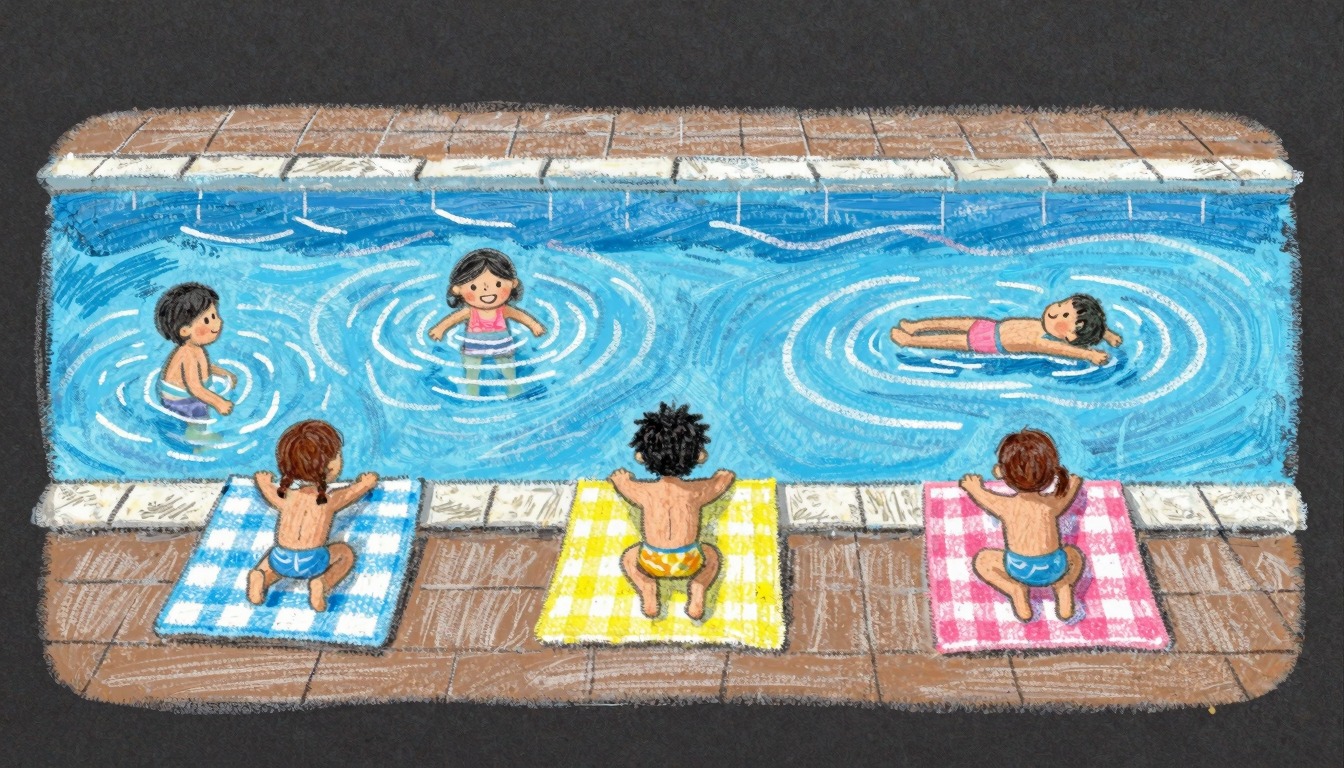
Shower and Dry in the Correct Order
Thuisarts advises drying the skin with open warts last, so the towel first dries the clean areas. Then wash your hands, especially if you touched the warts.
At Home: Bathing and Bath Toys
Are the warts open? Then do not let your child bathe with siblings in the same bath. Wash bath toys and let them dry well, as the virus survives in warm water. Clothing, washcloths, and bedding are not shared as long as the warts are present.
Treatment: Should You Have Warts Removed?
The temptation to remove the bumps is great, especially if they persist. But usually, this is not necessary and can sometimes backfire.
Patience Is the Best Treatment
In most children, swimmer's warts disappear on their own within 6 to 12 months. The warts then become red and inflamed before opening. This looks unpleasant but is actually a sign that the body is clearing the virus. A warm washcloth can help with painful bumps, suggests the American Academy of Pediatrics AAP.
Treatment Can Do More Harm Than Good
Freezing, burning, or scraping off is painful for young children and can cause scars or new warts. Dermatologists state there is no treatment that completely kills the virus. Time and patience usually work better than harsh methods in children.
When to See a Doctor
Visit the general practitioner if the warts are around the eyes or genital area, if the surrounding skin becomes inflamed, if your child has a weakened immune system, or if the warts have not disappeared after 18 months. Also, if you are unsure about the diagnosis, a check-up is reassuring.
Swimming Lessons Continue as Usual: How to Track Progress
Because your child can keep swimming, little changes in the lesson routine. The warts do not hurt, do not hinder learning, and the instructor does not need to do anything special.
How to Keep Track of What Happens in the Lesson
Especially with health issues lasting weeks, it is nice to see that your child is still making progress. With a free app like Swimmigo for Parents, you can see which skills your child masters at each level, from red to gold, and follow the seven levels and 86 skills. Because the app works in five languages, grandparents or other caregivers can also follow along. For swim instructors, the group continues as usual: no exclusion, but clear hygiene agreements.
Conclusion
Swimmer's warts are unpleasant to see but harmless and temporary. Your child can keep swimming: cover open warts with a waterproof plaster, do not share towels, and wash your hands. The same rules apply worldwide, and after 6 to 12 months, it is usually over. Meanwhile, keep track of progress so no swimming lessons are lost.
Swimmigo · Swim lesson app
Free for parents
Follow your child's swimming progress, see where you stand and report absences in the app.
Sources
- Thuisarts.nl (NHG): Water warts: causes and advice, consulted August 2026
- Thuisarts.nl (NHG): My child has water warts, what can I do?, consulted August 2026
- NVDV: Molluscum contagiosum (molluscum warts, water warts), published June 2026
- NHS: Molluscum contagiosum, reviewed May 2026
- Royal Children's Hospital Melbourne: Molluscum, reviewed September 2025
- DermNet: Molluscum contagiosum, revised August 2021
- AAP HealthyChildren.org: Molluscum Contagiosum in Children, consulted August 2026

Bob van Soest
As an expert in operating sports facilities (such as swimming pools) and developer of, among others, Swimmigo.com, I am passionately committed to making swimming lessons simpler, more fun and more insightful for parents, swimming instructors and everyone who wants to learn to swim.
Frequently Asked Questions
Related articles
![Swimmer's Ear in Children: How to Prevent Ear Pain After Swimming Lessons [2026]](/_next/image?url=https%3A%2F%2Fzvblogpostimages.s3.eu-west-3.amazonaws.com%2FAUTOMATISCH_UPLOAD%2F1_c46e581d096a.jpg&w=3840&q=75&dpl=dpl_3yq4PTEdembSqUcvY3jaZyirWYqr)
Swimmer's Ear in Children: How to Prevent Ear Pain After Swimming Lessons [2026]
Swimmer's ear is an inflammation of the ear canal that often occurs after swimming. Here's how to recognize it in your child, prevent it, and treat it. [2026]
![Can My Child with Asthma Swim? How to Approach Swimming Lessons Safely [2026]](/_next/image?url=https%3A%2F%2Fzvblogpostimages.s3.eu-west-3.amazonaws.com%2FAUTOMATISCH_UPLOAD%2F1_f517784b370a.jpg&w=3840&q=75&dpl=dpl_3yq4PTEdembSqUcvY3jaZyirWYqr)
Can My Child with Asthma Swim? How to Approach Swimming Lessons Safely [2026]
Can your child with asthma swim? Yes, usually. Here’s how to approach swimming lessons safely: doctor’s advice, medication, chlorine smell, and what the instructor needs to know [2026]
![Complete Overview of Swimming and Health for Children: How to Keep Your Child Healthy In and Around the Pool [2026]](/_next/image?url=https%3A%2F%2Fzvblogpostimages.s3.eu-west-3.amazonaws.com%2FAUTOMATISCH_UPLOAD%2F1_babb0737688b.jpg&w=3840&q=75&dpl=dpl_3yq4PTEdembSqUcvY3jaZyirWYqr)
Complete Overview of Swimming and Health for Children: How to Keep Your Child Healthy In and Around the Pool [2026]
Swimming is healthy for children but also has risks: swimmer's ear, warts, chlorine smell, and stomach flu. Here's how to keep your child healthy in and around the pool [2026]
Discover Swimmigo
The all-in-one app for swimming lesson progress. For parents, swim schools, and adult swimmers.