Stomach Flu or Diarrhea and Swimming Lessons: How Long Should Your Child Stay Home? [2026]

Summary
- A child with diarrhea should not enter the pool: wait until they have been symptom-free for 48 hours.
- For a confirmed cryptosporidium infection, wait two weeks after the last episode of diarrhea because the parasite survives for days in treated water.
- A swim diaper doesn't keep water out, so a child with diarrhea should not enter even a toddler pool.
- One loose stool isn't necessarily diarrhea; look for fever, cramps and how often it happens.
- After recovery, the first lesson is about fluids and pacing, not catching up.
A child with diarrhea should not go into a swimming pool, even in a swim diaper. The rule followed by swimming pools and health services is 48 hours completely free of symptoms. If a cryptosporidium infection has been confirmed, the wait is two weeks after the last episode of diarrhea.
Those two numbers cover most situations. The trickier cases are a single loose stool, vomiting without diarrhea, or a fever as well. Then there's the practical side: how to report an absence and what to tell the swim school if your child misses a few lessons.
The rule at a glance
When in doubt, remember: missing one lesson is never a problem, but contaminating a pool is.
| Situation | Swimming lesson? | Why |
|---|---|---|
| Ongoing diarrhea | No | Your child is contagious, and children swallow water while playing. |
| No diarrhea or vomiting for 48 hours | Yes | This is how long the British health service says to wait before returning to a swimming pool. |
| Confirmed cryptosporidium infection | No, not until 2 weeks after the last episode of diarrhea | The parasite survives for days in properly chlorinated water. |
| Vomiting only, symptom-free for 48 hours | Yes | The same waiting period applies, provided your child is eating and drinking normally again. |
| Fever or very unwell without diarrhea | No, until your child is fever-free and eating again | A lesson takes energy your child may not yet have, and a child who feels miserable won't learn much. |
| One loose stool, child otherwise feels well | Usually yes | One loose stool does not necessarily mean diarrhea. If in doubt, skip a lesson. |
Why 48 hours and not 24?
A stomach infection isn't over as soon as your child is happily running around again. Stool can still contain germs for days, even when it looks almost normal. The British health service therefore recommends waiting two days without diarrhea or vomiting, counting from the last episode.
What happens during those two days
The intestinal lining recovers and the amount of virus or bacteria in the stool decreases. During that time, a child can feel perfectly well and still infect others. That may not be a disaster for one family, but it can be for a pool with thirty children.
The same health service also advises keeping children home from school or childcare for two days. Sending a child to swimming lessons on the first day they are playing again doesn't allow for that same waiting period.
The exception to know about: cryptosporidium
For ordinary stomach flu, 48 hours is enough. Once a cryptosporidium infection has been confirmed, the waiting period is much longer: two weeks after the diarrhea has stopped completely. The American health service is explicit about this and specifies two weeks as the minimum.
How do you know if it's crypto? Often you don't, and that's the difficulty. The symptoms resemble ordinary stomach flu but last longer: watery diarrhea that continues for one to two weeks, with symptoms starting two to ten days after infection. If your child's diarrhea lasts more than a week, or everyone in the household gets sick in turn, it's sensible to see a doctor. A test can provide an answer.
What swimming pools do
Well-managed pools filter, disinfect and replace water according to set protocols, using WHO guidelines for swimming pools as an international basis. The system works, but it doesn't sterilize the water. Between a germ entering the water and chlorine neutralizing it, there is a window when other children can swallow it.
Swimmigo · Swim lesson app
Free for parents
Follow your child's swimming progress, see where you stand and report absences in the app.


One accident affects more children than you might think
Diarrhea is the most common illness associated with swimming water. The cause rarely originates in the water itself: children bring the germs into the pool.
Chlorine kills most germs, but not immediately
Chlorine and bromine kill most germs within a few minutes. Those few minutes are the problem: a child swimming near the site of an accident can swallow water during that time. Filtering and disinfection aren't separate processes, either. Leaves, sunscreen and body oils use up chlorine, leaving less available to do its job.
Crypto stays alive for days in properly treated water
Cryptosporidium is the exception that makes the risk clear. The parasite can survive for more than a week in water with the correct chlorine level. That's why the waiting period for crypto is two weeks rather than 48 hours, and why pool outbreaks are often larger than those caused by other germs.
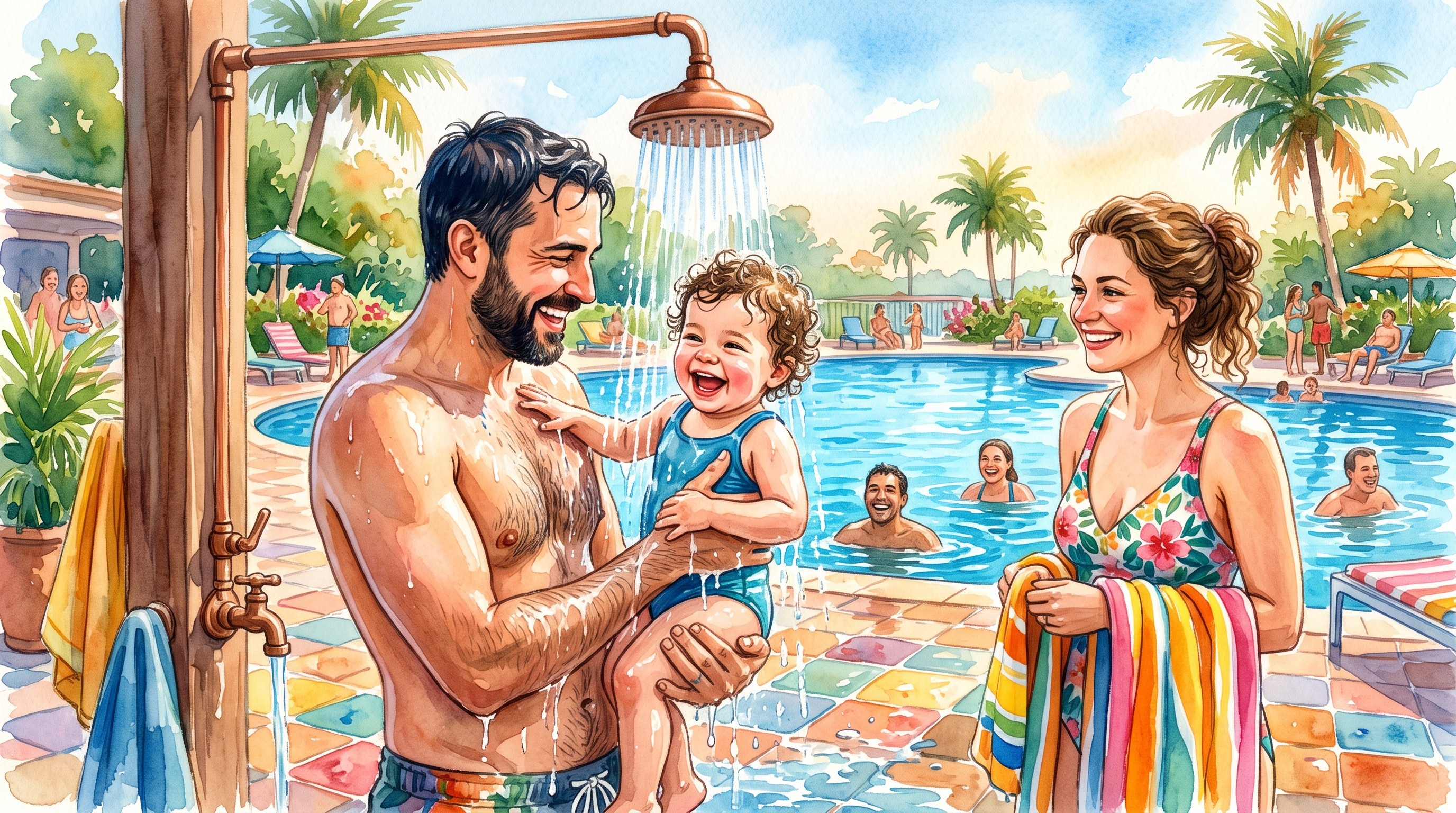
A swim diaper doesn't keep water out
A swim diaper is designed to contain solid stool, not to keep water out. Water flows straight through it, and if there is an accident, stool inside the diaper can enter the pool within minutes. That's why a child with diarrhea shouldn't swim in a diaper, even in a toddler pool.
The borderline cases
Not every loose stool is diarrhea, and not all diarrhea is contagious. The difference helps determine whether your child can attend.
One loose stool isn't diarrhea
Diarrhea means stools that are looser and more frequent than normal, usually with abdominal cramps and an urgent need to go, lasting a few days. One loose stool after a plate of fruit or an exciting morning doesn't fit that description. If it only happens once and your child feels well, they can usually attend.
Vomiting without diarrhea
The two-day symptom-free period also applies to vomiting on its own. A child who vomited in the morning and is running around and eating again in the afternoon hasn't recovered yet. If your child can't keep food or fluids down, they aren't drinking enough to get through a thirty-minute lesson in warm water comfortably.
Diarrhea related to nerves
Some children have bowel trouble around exciting or stressful moments: the first day of school, a birthday or a competition. This pattern repeats itself and isn't an infection. The difficult part is judging the difference on the morning itself. It helps to look at the whole picture: fever, abdominal cramps, how often it happens and whether your child otherwise feels well. If several signs are present, skip the lesson.
Returning from a trip with a stomach infection
After a trip to an area where stomach infections are common, a parasite is more likely. If diarrhea starts within two weeks of returning and persists, it's sensible to see a doctor before your child gets back in the pool. A longer waiting period applies to a confirmed parasitic infection, and it's better to know for sure than to guess.
Reporting absences and making up lessons
Missing a lesson is inconvenient, but it's not a disaster. What matters is that the school knows where your child is and why.
What to tell the swim school
A short message is enough: your child is sick with stomach flu or diarrhea, and you're reporting their absence for this lesson. There's no need for more detail. A swim school doesn't need a medical record, just a reason and an idea of when you'll return.
Ask about the absence policy before you need it
Every school has its own arrangements for reporting absences, make-up credits and continuing to pay for lessons. Ask when you enroll, not on the morning your child is sick in bed. Schools that use an app often have a set way to report an absence, which puts it straight on the instructor's class list.
A missed lesson doesn't mean lost skills
A child doesn't lose their skills after a few days of illness. Progress is recorded for each exercise, so you can see where they left off and what to focus on in the first lesson after recovery. What they may lose is their rhythm, and that usually returns after one or two lessons.
The first lesson back
Once the waiting period is over, your child can return. The first lesson back may feel different from the one before.
Expect a little less than before
After a few days of diarrhea, a child may tire more easily and get cold faster. They have lost fluids and energy, and the body cools down faster in water than on land. Let the instructor know your child has just recovered. A good instructor can adjust the activities without the child even noticing.
Drink before and after the lesson
Give your child water before the lesson, rather than juice or soda, and again afterward. After a stomach infection, replacing fluids is the first priority, and water is the simplest way to do that.
Handwashing, wiping and regular routines
Most germs spread through hands and bottoms, not through the pool. Wash hands after using the toilet and changing diapers, wipe bottoms thoroughly, and take toddlers to the toilet at regular times before they enter the pool. Making these habits part of your routine reduces the chance that the next stomach bug affects the whole pool.
For swim schools: policies that keep lessons healthy
A school can't tell by looking whether a child is contagious. What does work is a rule that applies to everyone, so nobody has to negotiate at the poolside.
Include the 48-hour rule in your house rules
One sentence at enrollment and on your practical information page is enough: a child with diarrhea or vomiting stays home until they have been symptom-free for 48 hours, and for two weeks in the case of a confirmed cryptosporidium infection. Parents then know what to expect and don't have to guess.
Record absences with a reason
Being sick isn't the same as being unavailable. Recording the reason helps you see patterns after a few months: a winter flu wave, a group in which many children fall sick close together, or one child who keeps appearing in the records. That's useful information when talking to parents.
Make showering before swimming a standard instruction
A one-minute shower before entering the water removes most soap residue, sweat and sunscreen, all of which use up chlorine prematurely. Make it a regular habit and post the instruction by the changing rooms. It takes a minute and helps keep water quality more stable.
Don't simply agree with the parent
It can be tempting to let a child participate when a parent says it isn't that bad. An instructor doesn't need to be a doctor, but does need to enforce the rule. That's not unfriendly: it's why other parents can feel confident letting their children swim with you.
Make-up lessons and expectations
Set out what happens when a lesson is missed in your terms and conditions. A make-up lesson or credit is a thoughtful option that helps retain parents, but make it clear that a contagious child cannot attend a make-up lesson. This prevents the illness from spreading through your groups during make-up sessions.
Keeping track
When a child is sick for a few days, the main thing is making sure the parent and school have the same information. Swimmigo keeps it all in one place. Parents can see their child's progress for each exercise and what was covered in the missed lesson. Schools can try the app for free with an unlimited demo before choosing a subscription. Absence reports, messages with read receipts and scores from the previous lesson are all in the same app, so nobody has to guess where a child left off. Parents pay nothing for the app, including when they follow their child's progress through the parent portal.
Want to read more about swimming while sick? See what to do when your child has a cold, or how water quality and hygiene are managed at the pool. For the full picture, read the guide to swimming and health.
Swimmigo · Swim lesson app
Free for parents
Follow your child's swimming progress, see where you stand and report absences in the app.
Sources
- NHS: Diarrhoea and vomiting, revised December 2023
- CDC Healthy Swimming: Preventing diarrheal illnesses, May 2025
- CDC: About Crypto infections, revised November 2026
- CDC: Preventing Crypto, 2025
- WHO: Guidelines for safe recreational water environments, Volume 2, swimming pools and similar environments

Bob van Soest
As an expert in operating sports facilities (such as swimming pools) and developer of, among others, Swimmigo.com, I am passionately committed to making swimming lessons simpler, more fun and more insightful for parents, swimming instructors and everyone who wants to learn to swim.
Frequently Asked Questions
Related articles
Swimmer's Ear in Children: How to Prevent Ear Pain After Swimming Lessons
Swimmer's ear is an inflammation of the ear canal that often occurs after swimming. Here's how to recognize it in your child, prevent it, and treat it. [2026]
Can My Child with Asthma Swim? How to Approach Swimming Lessons Safely
Can your child with asthma swim? Yes, usually. Here’s how to approach swimming lessons safely: doctor’s advice, medication, chlorine smell, and what the instructor needs to know [2026]
Complete overview of swimming and health for children: how to keep your child healthy in and around the pool
Swimming is healthy for children but also has risks: swimmer's ear, warts, chlorine smell, and stomach flu. Here's how to keep your child healthy in and around the pool [2026]
Discover Swimmigo
The all-in-one app for swimming lesson progress. For parents, swim schools, and adult swimmers.