How clean is the pool water? Water quality and hygiene during swimming lessons [2026]

Summary
- What you smell in the pool are chloramines, not the chlorine itself.
- Those compounds form from sweat, urine and skin cells, and they irritate eyes and airways.
- One minute of showering before the lesson is the cheapest measure against chlorine smell.
- Ask your swim school about combined chlorine and ventilation, those are the numbers that matter.
What you smell is not what you think
Your child comes out of the water, coughs in the car and has red eyes. The lobby smells of chlorine. Many parents draw one conclusion then: there must be a lot of chlorine in the water. Usually it is the other way around. The smell you notice mainly tells you what has happened to the chlorine, not how much is in the pool.
Chlorine does not smell like chlorine
A well-run pool hardly smells of anything. The familiar pool smell comes from chloramines, compounds that form when chlorine reacts with sweat, urine, skin cells, make-up and everything swimmers bring into the water (CDC, 2025). Those compounds irritate the eyes, the skin and the airways. The stronger the smell, the more of that material is in the water.
Why the air above the water says so much
Chloramines leave the water as a gas, most of all in indoor pools. They are heavier than air and stay just above the water surface, right where children swim and parents sit on the stands. Without enough fresh air a build-up happens there. In cold months less outside air is often brought in to save on heating. Not coincidentally parents complain most then about stinging eyes.
What a strong chlorine smell does and does not mean
A strong smell is not proof the water is dangerous, and a pool without a smell is not automatically clean. You only smell the part that has reacted. What you can conclude is this: if your child comes home with red eyes and a cough after every lesson, there is something to ask about. That could be the water, the ventilation, or both.
What ends up in the water during a lesson
Sweat and urine use up chlorine meant for germs
Chlorine has one job, kill germs. Anything that reacts with chlorine first takes it away from that job. Twenty children moving for half an hour bring sweat, saliva, sunscreen and skin cells into the water. The water does not become unsafe immediately, but disinfection does get used up. That is why it is extra important during busy times that not more is added than necessary.
Why a nappy has more effect than a full group
Swim nappies do not keep water out. At most they delay what is in them for a few minutes (CDC, 2025). In baby and toddler swimming that is the main reason to check nappies every hour and not to change them next to the pool. For a swim school that is part of the daily routine, not a detail in a brochure.
The germ that survives chlorine
Cryptosporidium, commonly called crypto, can survive in well-chlorinated water for more than seven days. The organism causes watery diarrhea that can last for weeks, and one accident in the water can contaminate an entire pool. Children with diarrhea should not be in the water, not even with a nappy on.
Swimmigo · Swim lesson app
Free for parents
Follow your child's swimming progress, see where you stand and report absences in the app.

What your child notices after the lesson
Red eyes and coughing
Red, itchy eyes and a cough are almost always blamed on chlorine. Usually they are caused by chloramines. Those irritate the eyes and airways, and in children with asthma they can trigger an attack (CDC, 2025). A child who rubs their eyes after every lesson is a sign to take seriously.
Is chlorinated water bad for the lungs?
Research has been done on people who spend many hours in indoor pools. Thirty-seven healthy volunteers cycled for two hours in pool air with a normal trichloramine value, and their lung function dropped slightly but measurably: the forced expiratory volume per second fell on average by 0.05 liters (Nordberg, BMJ Open, 2012). Among pool workers in that same study eye irritation occurred in 37 percent and nasal irritation in 29 percent.
That concerns people who work in such a hall day after day, not a thirty minute lesson once a week. Whether swimming at a young age causes asthma has not been proven: researchers call the link suggestive but not conclusive (Weisel, Environmental Health Perspectives, 2009). The practical conclusion is this: keep the air in the hall clean, and as a parent you do not need to worry about it.
Skin, eczema and sensitive children
Children with eczema often react to the combination of chlorine, chloramines and warm water. Showering before and after the lesson, drying well and applying moisturizer to dry areas usually helps a lot. If your child flares up every time, discuss it with your own doctor and with the swim school. Sometimes a quieter time slot or a different pool helps. More on that is in the article about eczema and swimming lessons.
What you can do, before and after the lesson
Shower before the lesson: one minute is enough
One minute under the shower removes most sweat, dirt and oils that would otherwise use up the chlorine (CDC, 2025). It is the cheapest measure there is and at the same time the least followed. Do it yourself as well, even if you only come to watch.
Use the toilet first, then get in the water
Have your child pee just before entering the water, even if they say they do not need to. For toddlers a scheduled toilet round per lesson is normal, not excessive. Parents who do this consistently notice it becomes a habit.
Do not swim with diarrhea
If your child has diarrhea they stay home. After a confirmed crypto infection you must wait two weeks after the last episode of diarrhea before your child may return to the water. That is a long time, and it is the only way to prevent a string of children becoming ill.
Rinse and change after the lesson
Showering after the lesson removes chlorine residues from the skin and hair. Use a towel reserved for swimming and rinse swimwear immediately. That way your child will not carry a pool smell the rest of the day and the skin will stay calmer.
What a swim school can do
The World Health Organization describes both the microbial and the chemical side of water quality in its guidelines for pools, including how to measure and adjust them (WHO, 2006). In practice it comes down to measuring, ventilating and making clear agreements.
Measure combined chlorine, not only free chlorine
Free chlorine shows how much disinfection is still available. Combined chlorine shows how much has already reacted, and that second number is the measure for chloramines. Most local health departments in the United States keep an upper limit of 0.4 ppm (CDC, 2025). A school that only logs free chlorine misses exactly the number parents smell.
Airflow is not a detail
Chloramines build up above the water. Supplying fresh air over the water surface and extracting polluted air is the core of the solution. A dehumidifier alone does not fix that, no matter how hard it runs. Schools that manage this well notice it immediately in the stands: fewer coughs, fewer complaints, less explanation afterwards.
Share rules with parents
House rules only work if parents know them. Put them where parents actually read: at registration, in the changing room and in the app you already use. A friendly reminder just before the lesson does more than a poster at the entrance, especially if you can see parents opened the message.
Five questions you may ask your swim school
You do not need to be a water expert to check whether a pool takes water quality seriously. Five questions usually give a quick picture.
- How often do you measure combined chlorine, and what upper limit do you use?
- What happens if that value is too high?
- Is the air in the hall refreshed with outside air, and does that also happen in winter?
- What filtration do you use, and is there UV or ozone in the system?
- How do you remind parents to shower before the lesson?
A swim school that can answer these questions calmly knows what it is doing. One that avoids or stays vague still has work to do.
What this means for the lesson itself
A healthy lesson is not the same as a sterile lesson
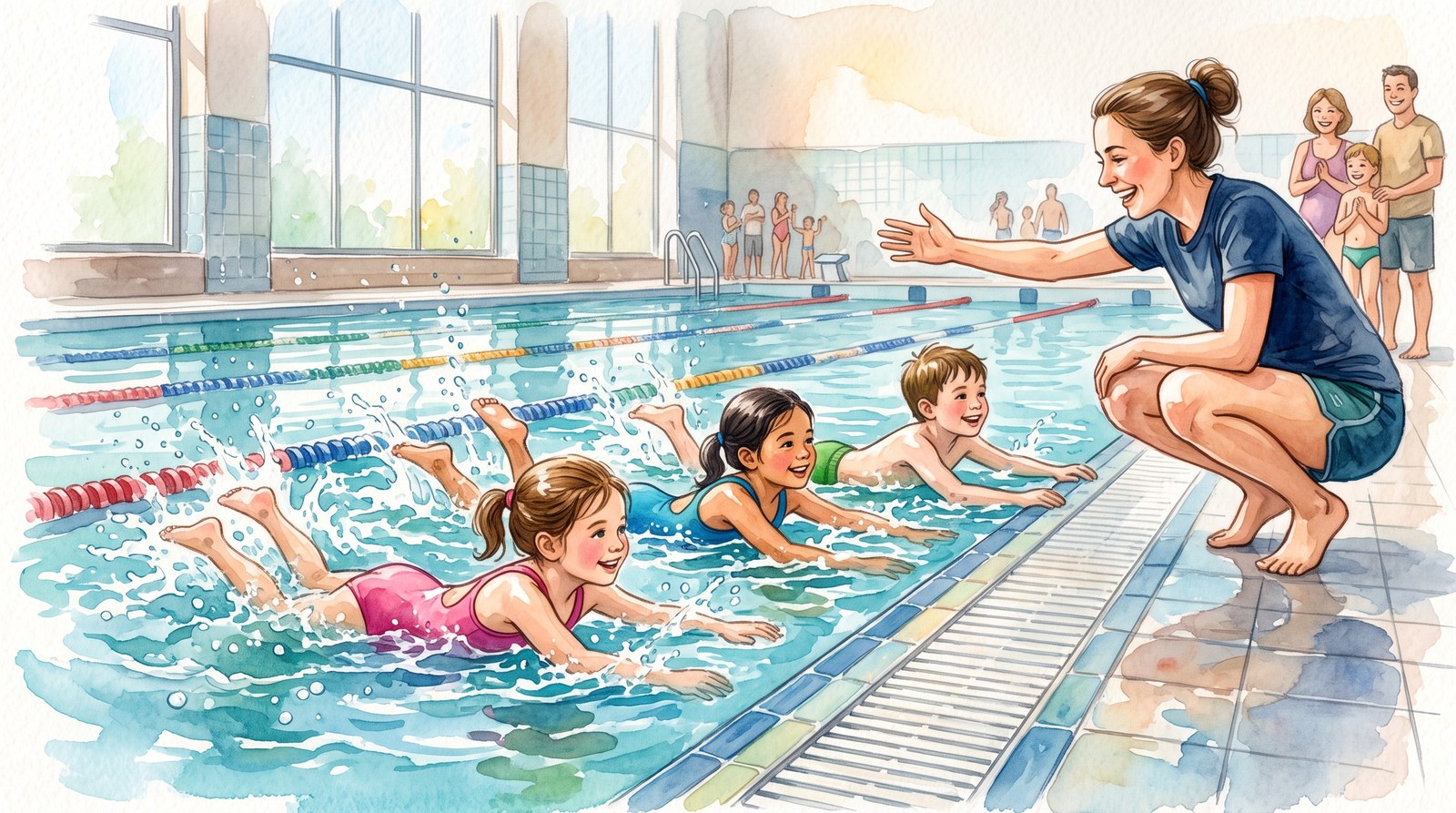
Swimming lessons are wet, busy and messy. Children cry, pee in the water and forget to shower. That is part of it. The difference is what the school does with the things you do not see: measuring, ventilating, explaining rules and adjusting when things go wrong. That is what separates a pool your child comes out of happy from one where they come out with red eyes every week.
If you as a parent want to follow what happens in the lesson, progress per skill and the instructor's notes are clearly available on the parent page. Swim schools that want to keep their agreements, levels and messages in one place find that on the page for swim schools and instructors. The levels and skills show what a child learns at each step.
Swimmigo · Swim lesson app
Free for parents
Follow your child's swimming progress, see where you stand and report absences in the app.
Sources
- CDC: Chloramines and Pool Operation, 23 June 2025
- CDC: Preventing Eye Irritation from Pool Chemicals, 28 May 2025
- CDC: Preventing Diarrheal Illnesses, 19 May 2025
- WHO: Guidelines for safe recreational water environments, Volume 2: swimming pools and similar environments, 2006
- Nordberg et al.: Lung function in volunteers before and after exposure to trichloramine in indoor pool environments, BMJ Open, 2012
- Weisel et al.: Childhood Asthma and Environmental Exposures at Swimming Pools, Environmental Health Perspectives, 2009
Bob van Soest
As an expert in operating sports facilities (such as swimming pools) and developer of, among others, Swimmigo.com, I am passionately committed to making swimming lessons simpler, more fun and more insightful for parents, swimming instructors and everyone who wants to learn to swim.
Frequently Asked Questions
Related articles
Swimmer's Ear in Children: How to Prevent Ear Pain After Swimming Lessons
Swimmer's ear is an inflammation of the ear canal that often occurs after swimming. Here's how to recognize it in your child, prevent it, and treat it. [2026]
Can My Child with Asthma Swim? How to Approach Swimming Lessons Safely
Can your child with asthma swim? Yes, usually. Here’s how to approach swimming lessons safely: doctor’s advice, medication, chlorine smell, and what the instructor needs to know [2026]
Complete overview of swimming and health for children: how to keep your child healthy in and around the pool
Swimming is healthy for children but also has risks: swimmer's ear, warts, chlorine smell, and stomach flu. Here's how to keep your child healthy in and around the pool [2026]
Discover Swimmigo
The all-in-one app for swimming lesson progress. For parents, swim schools, and adult swimmers.