Ear infections and swimming lessons: when can your child get back in the water? [2026]

Summary
- Keep your child home from swimming lessons while they have an ear infection; the NHS advises against swimming while the infection lasts.
- A middle ear infection is behind the eardrum, where pool water cannot reach it; swimming is almost never the cause.
- Most children are symptom-free within three to five days and can return, provided the eardrum is intact.
- With a ruptured eardrum or ear discharge, wait until a doctor has examined the ear before your child swims; healing often takes several weeks to two months.
- Report the absence, including the reason and date, in the app. Your child's progress stays on record and the lesson can be made up.
When your child has an ear infection, keep them home from swimming lessons, even if they otherwise seem reasonably well. The infection is behind the eardrum, where swimming water cannot reach it, but swimming with an active infection is unwise: the pain, fever and risk of a ruptured eardrum outweigh one missed lesson.
Most children are symptom-free within three to five days and can get back in the water. If fluid or pus is coming from the ear, or symptoms last longer, wait until a doctor has examined the eardrum before your child swims. It comes down to one question: is the infection gone and is the eardrum intact? As for cancelling and arranging a make-up lesson, that takes just one message.
Where an ear infection occurs, and why swimming water cannot reach it
The infection is behind the eardrum
A middle ear infection, medically known as otitis media, is an infection in the middle part of the ear. This lies between the eardrum and the inner ear and contains air and three tiny bones. During an infection, fluid builds up behind the eardrum and presses against it. That is what causes the pain. The National Institute on Deafness and Other Communication Disorders explains that the infection usually starts when bacteria travel from the nose or throat to the middle ear through the Eustachian tube after a cold or throat infection.
The ear canal, which water enters during swimming, is a dead end that stops at the eardrum. As long as the eardrum is intact, pool water stays on the outside. That is why swimming almost never causes a middle ear infection and does not make the infection worse where it is located.
Why children get them so often
Five out of six children have at least one ear infection before their third birthday, and it is the most common reason parents take a child to the doctor. This is partly due to a child's anatomy: the Eustachian tube is short and narrow, and the adenoids are relatively large. Fluid from the nose and throat cannot drain as easily and builds up behind the eardrum.
For most children, the infection settles within three days, although it sometimes takes a week. Antibiotics are not always needed; pain relief is often enough.
Swimmer's ear is different
These two infections are often confused, but they need different care. A middle ear infection is behind the eardrum and develops from within. Swimmer's ear affects the ear canal itself and can develop when water stays in the ear for too long. With swimmer's ear, pulling on the outer ear hurts; with a middle ear infection, the pain is deeper and often comes with a fever. Read more about treating and preventing it in the guide to swimmer's ear in children.
When can your child return to swimming lessons?
The rule of thumb: symptom-free, not just pain-free
The British National Health Service (NHS) is clear about swimming with an ear infection: do not swim while the infection lasts. In practice, that means no fever or pain, and your child is sleeping and eating normally again. Many swim schools ask children to be fever-free for 24 hours before returning to the pool. It is not a medical rule, but it is a cautious approach.
Wait longer than necessary and your child misses lessons they could have attended. Go back too early and they may be in a cold room with an ear that is still sensitive, only to leave the pool ten minutes later. Waiting another two or three days is better than a setback.
Fever and swimming do not mix
A fever means the body is working to fight illness. Swimming takes energy and concentration, and the body must regulate its temperature in water cooler than the skin. A child with a fever should not be in a lesson, however much they want to join in. Cancel the lesson and let them recover at home; they can make it up later.
A ruptured eardrum changes the rule
With some ear infections, the eardrum ruptures and pus or fluid drains from the ear. The pain often eases quickly because the pressure has been released, but the rule becomes stricter: do not swim or get the ear wet until the eardrum has healed. This usually takes several weeks to two months. Ask your doctor when your child can go back in the water, and tell the swim school so no one accidentally sends a child with a perforated eardrum into the pool.
Ear discharge or recurring infections
If fluid keeps coming from the ear, or your child has one ear infection after another, ask about a referral rather than trying to solve it yourself. Repeated middle ear infections may lead to a discussion about ear tubes, which change the guidance on swimming. Read more in the guide to ear tubes and swimming lessons.
| Situation | Swimming lessons? | Why |
|---|---|---|
| Ear infection with fever and pain | No | Your child is ill. An infection with a fever calls for rest, and the NHS advises against swimming during an ear infection. |
| Ear infection without fever, but with ongoing pain | No | The infection is still active. Swimming will not stop the pain or clean the ear. |
| Symptom-free with an intact eardrum | Yes | There is no open passage to the middle ear, so water stays in the ear canal. |
| Fluid behind the eardrum without an infection (glue ear) | Yes | Glue ear is not an infection and the eardrum is intact. Swimming does not change that. |
| Ruptured eardrum or ear discharge | No, until a doctor approves | A hole in the eardrum allows water to enter the middle ear. The hole usually heals within two months. |
| Ear tubes | Yes, in a treated pool | Research found no additional ear discharge associated with treated pool water, but did find an increased risk with natural water. |
What these situations mean in practice
The main question is whether there is an open passage to the middle ear. If the eardrum is intact and the infection has cleared, your child can swim as usual. If there is a hole or a tube, water can enter, so the type of water matters: research found no additional ear discharge associated with treated pool water, but did find an increased risk with natural water.
Ear tubes and earplugs: what really helps
What the guidelines say about ear tubes
Guidelines from the American professional association for ear, nose and throat specialists say that earplugs and headbands are not routinely needed for children with ear tubes, and that swimming and water sports do not need to be routinely discouraged. A study published in the association's journal in March 2026 shows where the difference lies: children with ear tubes who swam in treated pool water had no increased risk of ear discharge, while exposure to untreated or natural water clearly increased the chance of recurring discharge. The researchers do not consider their study definitive and call for more research, but the findings point in one direction: a chlorinated pool is not the culprit.
Earplugs to keep water out: less effective than you might think
Earplugs and a swim cap covering the ears can help prevent outer ear pain, and the NHS mentions them as a preventive measure for sensitive ears. They are not a perfect barrier, though: they can leak when a child turns or dives, or when a child picks them out. For a child with ear tubes, they are not the deciding factor in whether to swim. For a child with a ruptured eardrum, they are no substitute for a doctor's advice.
Drying ears after swimming
After swimming, have your child tilt their head to one side and gently pull on the earlobe. Most of the water will run out. Drying with a towel and letting the ears air-dry works better than picking at them. Cotton swabs, the corner of a towel and fingers do not belong in the ear canal. They push water and skin further in and can turn an irritated ear into an infected one.
What to tell the swim school
One message with three details
You do not need to send a medical file. Three things are enough: that your child will be absent, the reason in one line, and when you expect them to return. A message in the app links the cancellation to the right lesson straight away, and the instructor can see it before the group starts. Messages in Swimmigo have read receipts, so you know yours arrived and did not disappear into a crowded inbox.
Why your child does not lose their progress
A missed lesson does not mean a lost level. Each student's scores are saved by exercise, so the skills your child has mastered stay on record and the instructor can see where to continue at the next lesson. When you cancel, ask whether the lesson can be made up; many schools have a policy for this. In the Swimmigo app, parents can see what their child can do for each exercise, even during weeks when they are not swimming.
What the swimming instructor really needs to know
Two things are worth passing on: whether there is a hole or a tube in the eardrum, and whether a doctor has said the ear must stay dry. That information helps keep the lesson safe. The instructor does not need the rest of the medical details to teach the lesson well.
Swimmigo · Swim lesson app
Free for parents
Follow your child's swimming progress, see where you stand and report absences in the app.


For swimming instructors: a child with an ear infection in your group
What not to do
Do not improvise with ear drops, oil or a plug of cotton wool, and do not let a child with a fever join in, even briefly. That applies even if the child wants to swim and the parent says it is probably nothing serious. The first question is whether the child is healthy enough for the lesson today, not whether they happen to be standing by the pool.
Ease back into lessons
A child who has been out of the water for a week may not be right back where they left off. Start with short activities, let them get used to splashes and looking underwater again, and see whether they feel ready to dive. If all goes well, pick up the exercises where they left off. This is also a good time to update their scores, so parents can see that their progress is still there.
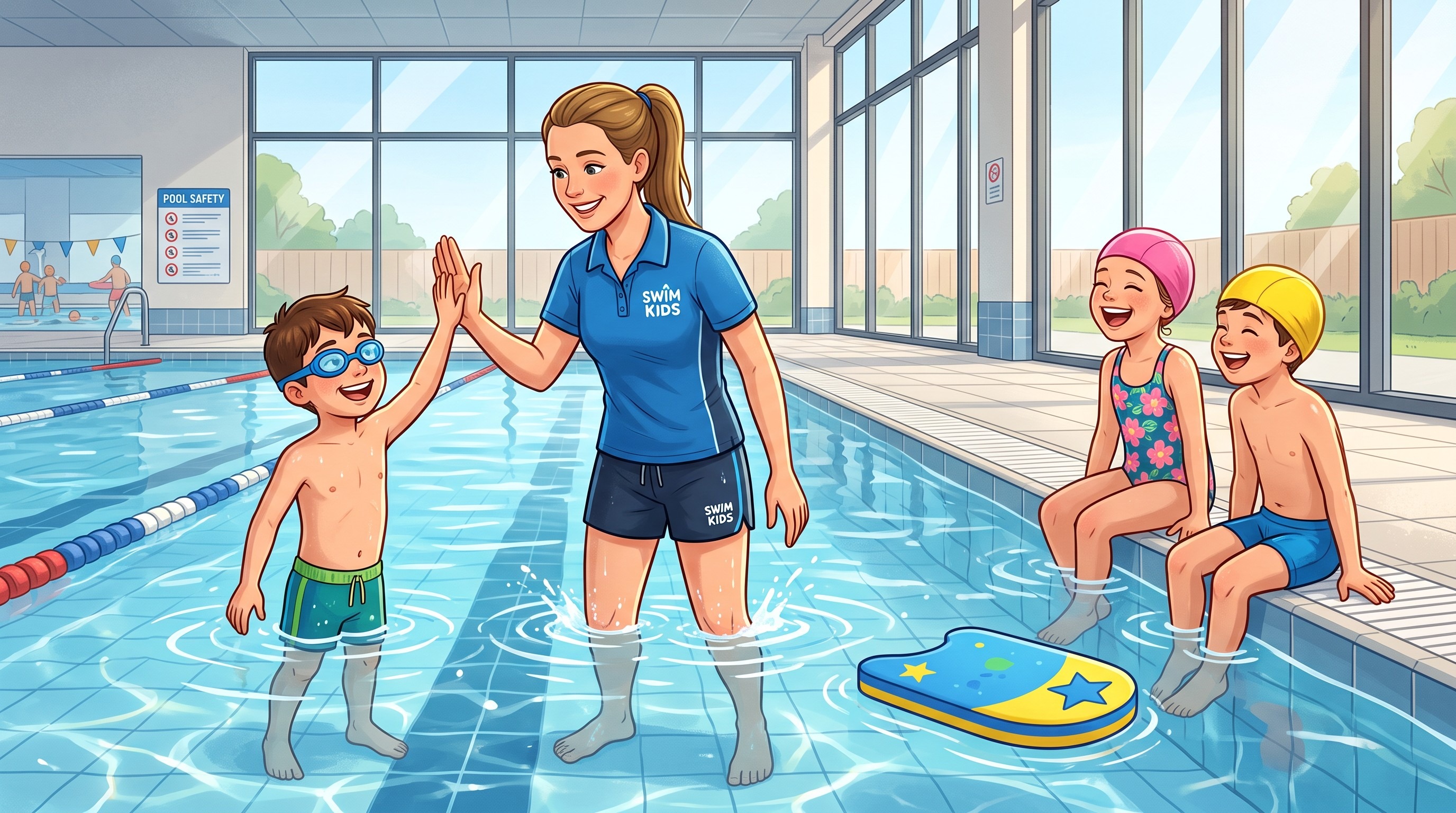
What to record in your administration
Record the absence with the reason in one word, the date and whether the lesson will be made up. That keeps the record accurate if a parent later asks why a lesson is missing, and lets the school see in its statistics which children are frequently absent due to illness. With lesson groups and a shared record, this takes one action instead of a separate note that nobody can find later.
Fewer ear infections and less ear pain
The basics that help
You cannot always prevent a middle ear infection, but a few things can reduce the risk. Keep vaccinations up to date, especially pneumococcal vaccines, and keep your child away from cigarette smoke. Pacifier use after the first birthday is discouraged, and bottle-feeding a baby while they lie flat on their back is also best avoided. This advice comes from the British guidance on middle ear infections in children.
Water in the ear after swimming
Ear pain after swimming more often comes from the outer ear than the middle ear. Dry your child's ears well and let them air-dry. If your child is prone to outer ear infections, use a swim cap or well-fitting earplugs. If your child touches their ear after every lesson, tell the instructor: sometimes the cause is the temperature or time spent underwater, and sometimes it is simply too much water in the ear canal.
When to seek help
Seek help if symptoms do not improve after two to three days, if pus or fluid comes from the ear, if the pain is severe, or if your child keeps getting ear infections. A child under twelve months with an ear infection should always see a doctor. If your child still has trouble hearing after an ear infection, have that checked too: fluid can remain behind the eardrum for months and muffle hearing.
Keeping track
An ear infection means a few days out of the pool, not a lost season. It helps when parents and the school have the same information: when your child was absent, where they left off in their exercises and when they will return. Swimmigo keeps it all in one app, with roles for owners, administrators and instructors so everyone sees the same lesson and reads the same notes. Swim schools can try the app free with an unlimited demo before choosing a subscription.
Swimming after an ear infection is a matter of timing. If your child is symptom-free and the eardrum is intact, they can return. If there is fever, pain, ear discharge or a hole in the eardrum, wait until the ear is ready for the water.
Swimmigo · Swim lesson app
Free for parents
Follow your child's swimming progress, see where you stand and report absences in the app.
Sources
- NHS: Ear infections, January 2025
- NHS: Perforated eardrum, April 2023
- NHS inform: Middle ear infection (otitis media), November 2026
- National Institute on Deafness and Other Communication Disorders: Ear infections in children, 2022
- American Academy of Otolaryngology: study on swimming with ear tubes, March 2026
- Tsang and James: Water precautions for prevention of infection in children with ventilation tubes, Paediatrics and Child Health, 2018
- American Academy of Pediatrics: Ear infections in children

Bob van Soest
As an expert in operating sports facilities (such as swimming pools) and developer of, among others, Swimmigo.com, I am passionately committed to making swimming lessons simpler, more fun and more insightful for parents, swimming instructors and everyone who wants to learn to swim.
Frequently Asked Questions
Related articles
Swimmer's Ear in Children: How to Prevent Ear Pain After Swimming Lessons
Swimmer's ear is an inflammation of the ear canal that often occurs after swimming. Here's how to recognize it in your child, prevent it, and treat it. [2026]
Can My Child with Asthma Swim? How to Approach Swimming Lessons Safely
Can your child with asthma swim? Yes, usually. Here’s how to approach swimming lessons safely: doctor’s advice, medication, chlorine smell, and what the instructor needs to know [2026]

Complete overview of swimming and health for children: how to keep your child healthy in and around the pool
Swimming is healthy for children but also has risks: swimmer's ear, warts, chlorine smell, and stomach flu. Here's how to keep your child healthy in and around the pool [2026]
Discover Swimmigo
The all-in-one app for swimming lesson progress. For parents, swim schools, and adult swimmers.