Swimwear and Swim Diapers for Your Child: What to Watch for at Swim Lessons? [2026]
![Swimwear and Swim Diapers for Your Child: What to Watch for at Swim Lessons? [2026]](/_next/image?url=https%3A%2F%2Fzvblogpostimages.s3.eu-west-3.amazonaws.com%2FAUTOMATISCH_UPLOAD%2F1_f4b1259c74bf.jpg&w=3840&q=75&dpl=dpl_FYHfHwSGqVCt1bkiNDyGQ1HPSntX)
Summary
- Swimwear that fits snugly and doesn’t shift keeps the lesson calm; loose clothing becomes heavy and slows down movement in the water.
- A swim diaper contains solid stool but is not waterproof, so check every hour and change outside the pool edge.
- A swim cap keeps hair out of the face and reduces resistance but must not pinch tightly along the hairline.
- Hair wet before swimming absorbs less chlorine; rinsing immediately after the lesson limits damage to hair and skin.
- In an outdoor pool, swimwear with UPF 50 protects better than a wet cotton shirt, which blocks almost no radiation.
The lesson starts in ten minutes, the bag is still empty, and your child has decided not to wear a swim cap today. Those ten minutes beforehand often determine how the lesson will go more than you think.
What a child wears for swimming does more than most parents realize. It’s about staying warm, being able to move freely, and what does and does not end up in the pool water. Below you’ll find what to watch for in each part: swimwear, swim diapers, swim caps, and how to care for hair and skin after the lesson.
What your child wears directs the lesson
Moving without resistance
Swimwear that doesn’t fit well will shift. A child notices that as something that resists: it pulls on the shoulders, water stays trapped in the fabric, or they are more focused on adjusting a strap than on the exercise. Clothing that fits snugly and doesn’t pinch anywhere is therefore the foundation for every lesson.
Staying warm in a heated pool
Children cool down faster in water than adults, even if the pool is around 28 degrees Celsius. A child shivering on the side participates less well. Those who get cold quickly can wear a swim shirt or a longer swimsuit, and a bathrobe on the side is not a luxury but a helpful tool.
What ends up in the water
Every swimmer leaves something behind in the pool: sweat, skin cells, urine, and soap residue. Chlorine is there to neutralize that, and the more that gets into the water, the harder the chlorine has to work. A one-minute shower removes most dirt, sweat, and oils that otherwise consume chlorine, according to the US health agency CDC.
Swimwear: swimsuit, swim shorts, or one-piece
Snug fit, not loose
Real swimwear is made from fabric that absorbs little water and follows the body. Too loose clothing balloons underwater and acts as a brake. When fitting, watch the shoulder straps and leg openings: they should not slip down when your child raises their arms. Clothing that fits snugly and doesn’t pinch anywhere gets in the way the least.
A swimsuit with a zipper for young children
For toddlers and preschoolers, a swimsuit with a front zipper is handy. Putting it on and taking it off takes little time, and a bathroom visit before the lesson doesn’t mean everything has to come off again. Just check that the zipper doesn’t rub against the chin.
Why a regular shirt or beach shorts don’t work
A cotton t-shirt soaks up water, becomes heavy, and sticks cold against the skin. Beach shorts have pockets, a lining, and sometimes a drawstring that traps water. The English swimming association Swim England prescribes that swimwear for lessons should be a swimsuit, swim trunks, or swim shorts, and that pools themselves may decide which clothing they allow or not.
Swimmigo · Swim lesson app
Free for parents
Follow your child's swimming progress, see where you stand and report absences in the app.

Swim diapers: what they do and don’t contain
A swim diaper is not a regular diaper
A swim diaper contains solid stool but is not waterproof. The CDC describes that a swim diaper can hold back pathogens like cryptosporidium for a few minutes before they enter the water, and no manufacturer claims that nothing leaks through. A swim diaper deliberately does not absorb water, because then it would fill up like a sponge.
Waterproof clothing over it
Many pools require the combination of a waterproof swim diaper or swim pants, with swimwear that fits tightly over it at the waist and leg openings. Two layers contain more than a loose diaper. Before the lesson, check that the top layer doesn’t open when your child squats or jumps.
Check every hour and change outside the pool edge
The CDC advises checking diapers about every hour and changing them in a changing area, not on the pool edge. This also reduces urine in the water, and urine is exactly what chlorine consumes.
When the swim diaper is no longer needed
Being potty trained is not a requirement to start swim lessons, and a child who just became potty trained sometimes has setbacks. Ask your swim school how they handle this and have your child use the toilet once more before the lesson. That helps more in practice than any tool.
Swim caps: when to wear and when not
Why pools require a cap
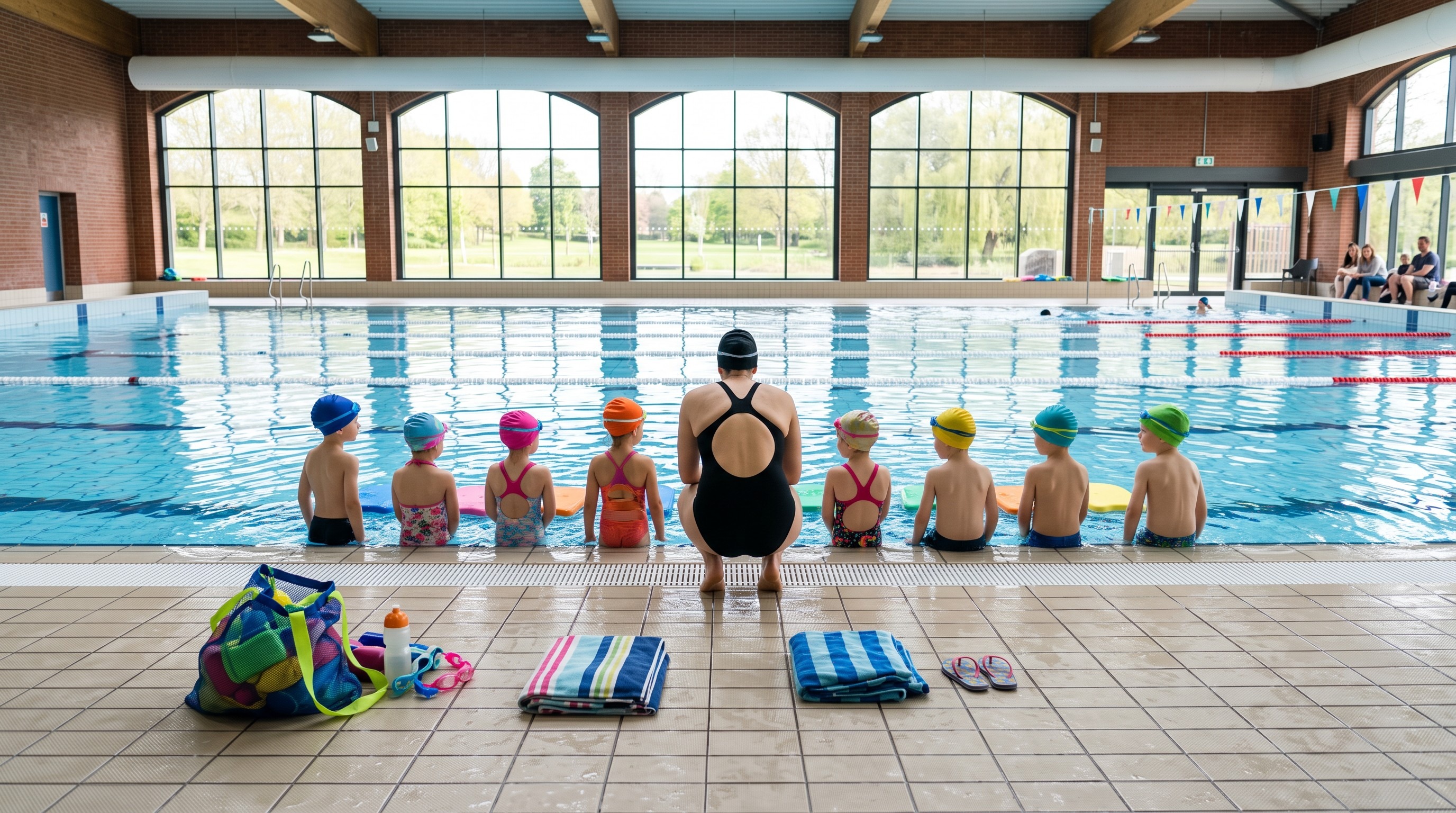
Loose hair gets into the water, filters, and drains, and some pools therefore require swim caps. For the lesson itself, a cap has another advantage: hair hanging in front of the eyes distracts during exercises. Swim England calls the cap useful for children with long hair because it keeps hair out of the face and reduces resistance in the water.
Long hair, braids, and curly hair
For long hair, a braid or low bun under the cap works best: the hair stays in place and the cap doesn’t have to pull as much. For curly hair or hair that has been treated, a cap that presses tightly along the hairline is uncomfortable. Choose a cap with a soft edge that fits loosely, and leave the braid underneath.
What to watch for when choosing
Silicone caps stay on better and keep more water out. Lycra caps fit looser and are more comfortable for children who still find wearing a cap intimidating. More important than the material is the size, because a cap that is too small slides up with every movement.
Sun in the outdoor pool
UPF clothing does more than sunscreen
In an outdoor pool, sunscreen is added. Swimwear with a UPF of 50 blocks about 98 percent of UV radiation, and that protection remains effective when the fabric is wet. A white cotton t-shirt is no substitute: dry it only reaches a UPF of about 7 and wet it drops to about 3, explains the Skin Cancer Foundation.
What else to bring
A hat with a brim of 7 to 8 centimeters shades the face, ears, and neck. Sunglasses with UV protection are essential once a child is no longer a baby. The American Academy of Pediatrics (AAP) advises seeking shade between 10 a.m. and 4 p.m. and reapplying sunscreen every two hours, also after swimming.
Safety and hygiene at the pool edge
Showering before swimming
A one-minute rinse removes most sweat and dirt that would otherwise enter the pool water. That leaves more chlorine available for its intended purpose.
Not swimming with diarrhea
A child with diarrhea should not be in the water, even with a swim diaper. The CDC is clear: anyone with diarrhea stays out. After an infection with cryptosporidium, a parasite resistant to chlorine, the rule is to wait two weeks after diarrhea has completely stopped.
Jewelry and shoes
Earrings, necklaces, and rings can catch on clothing or equipment and are easily lost in the water. Street shoes leave sand and dirt on the pool edge, where everyone walks barefoot. So change shoes at the entrance and keep loose items in a bag or locker.
What your swim school asks
Rules differ per pool and per country. One pool requires a swim cap, another does not allow loose swim shorts, and yet another requires a waterproof diaper until a child is three. Check with your own school before the first lesson so you won’t be surprised at the entrance.
| What | Purpose | What to watch for |
|---|---|---|
| Swimsuit or one-piece | Stays in place during movement in the water | Fits now, not for growth; straps and leg openings must not slip down |
| Swim shorts | For children who prefer shorts | Real swim shorts, not beach shorts with pockets and lining |
| Swim diaper | Contains solid stool during swimming | Not waterproof; check every hour and change outside the pool edge |
| Swimwear over the diaper | Second layer for children not yet potty trained | Fits at waist and leg openings, otherwise leaks still occur |
| Swim cap | Keeps hair out of face, reduces resistance, less chlorine in hair | Must not pinch along hairline; watch the size |
| Swim shirt with UPF | Warmth and sun protection in an outdoor pool | UPF 50+; a wet cotton shirt offers almost no protection |
Hair and skin after the lesson
Wet hair before entering the pool
Hair that is already wet absorbs less chlorinated water. A dermatologist from the University of Alabama advises wetting hair before swimming and applying a leave-in conditioner or a bit of oil so the pool water has less grip on the hair fiber.
Rinse and wash immediately
Chlorine removes natural oils from hair, making it dry, rough, and brittle. Rinsing immediately with fresh water limits that damage, and a mild or swimmer’s shampoo removes chlorine. A clarifying shampoo can be used occasionally but not after every lesson, as it also dries out hair.
Green tint and chlorine smell
Blond hair that turns green does so not from chlorine but from copper in the water, which penetrates more easily when hair becomes porous due to chlorine. The familiar pool smell mainly comes from chloramines, formed when chlorine reacts with sweat, urine, and skin cells. Adding extra chlorine does not help; better rinsing does.
The changing room without struggle
A fixed routine works better than rushing
Children like to do the same routine in the same order: empty bag, undress, shower, put on swim cap, go to the pool edge. Write that order down at home once and repeat it before every lesson. A child who knows what’s coming protests less.
Wet clothes separately
A separate bag for wet items prevents the rest of the bag from getting soaked. Rinse swimwear briefly at home with lukewarm water and let it air dry; that keeps the fabric looking good longer than a tumble dryer.
How many sets do you need
Two sets of swimwear and two towels are enough for most families: one set your child wears, the other dries. Never leave wet swimwear in the bag until the next lesson, as the fabric will start to smell and straps will stretch out.
Summary
The clothing and gear for swim lessons take a few minutes upfront and help determine whether the lesson runs smoothly. Choose swimwear that fits snugly, a cap that doesn’t pinch, and for a child not yet potty trained, a waterproof swim diaper with clothing over it. Rinse before swimming and rinse hair and skin after swimming to keep your child warm and comfortable in the water.
Read more about swim lesson gear in the overview of swim aids and flotation devices and in the article about swim bands and false security. Those who want to know how dressing and showering go smoothly can read how your child learns it independently. Parents who want to follow their child’s swim lesson progress without being there themselves can find progress per level at swimmigo.com/parents and in the levels and skills.
Swimmigo · Swim lesson app
Free for parents
Follow your child's swimming progress, see where you stand and report absences in the app.
Sources
- CDC: Tips for Using Swim Diapers, updated May 8, 2024
- CDC: Preventing Diarrheal Illnesses, updated May 19, 2025
- Swim England: Parents and Pupils, School Swimming Guidance
- University of Alabama at Birmingham: How to protect skin and hair from chlorine and salt water, June 25, 2026
- Cleveland Clinic: Protect Your Hair From Chlorine the Next Time You Go Swimming, August 12, 2026
- The Skin Cancer Foundation: Sun Protective Clothing, updated August 2025
- HealthyChildren.org (American Academy of Pediatrics): Sun Safety, updated August 9, 2024
Bob van Soest
As an expert in operating sports facilities (such as swimming pools) and developer of, among others, Swimmigo.com, I am passionately committed to making swimming lessons simpler, more fun and more insightful for parents, swimming instructors and everyone who wants to learn to swim.
Frequently Asked Questions
Related articles
![Complete Overview of Swimming Aids and Buoyancy Devices: Safe Choices for Every Age [2026]](/_next/image?url=https%3A%2F%2Fzvblogpostimages.s3.eu-west-3.amazonaws.com%2FAUTOMATISCH_UPLOAD%2F1_5ec9b9ca0b61.jpg&w=3840&q=75&dpl=dpl_FYHfHwSGqVCt1bkiNDyGQ1HPSntX)
Complete Overview of Swimming Aids and Buoyancy Devices: Safe Choices for Every Age [2026]
Swim wings, puddle jumper, or life jacket? Discover which swimming aids are safe for your child, by age and swimming level, and which ones to skip.
![Are Swim Bands Safe for Your Child? How to Avoid False Security [2026]](/_next/image?url=https%3A%2F%2Fzvblogpostimages.s3.eu-west-3.amazonaws.com%2FAUTOMATISCH_UPLOAD%2F1_93d697265278.jpg&w=3840&q=75&dpl=dpl_FYHfHwSGqVCt1bkiNDyGQ1HPSntX)
Are Swim Bands Safe for Your Child? How to Avoid False Security [2026]
Are swim bands safe for your child? Swim wings and swim bands differ greatly. How to avoid false security and keep your child safe in the water [2026]
Discover Swimmigo
The all-in-one app for swimming lesson progress. For parents, swim schools, and adult swimmers.