Trial lesson and open day at your swim school: how to fill groups without an advertising budget [2026]

Summary
- A trial lesson or open day lets parents see the water, the instructor and the group, and that convinces more than a flyer.
- The introduction is also your intake: you immediately see what level a child starts at and whether the group becomes too full.
- Twenty minutes with water familiarization, one exercise that succeeds and something to practice at home is enough.
- Send a message within two days with day, time, start date and group size, otherwise interest fades.
- Record at registration how the family found you, so after three months you know which channel actually brings pupils.
A spot opened up in your Tuesday group. You post it on social media, hang a flyer at reception and wait. Two weeks later the spot is still empty. That same week a parent calls asking if they can come and watch once before signing up.
There is the difference. Parents compare swim schools on price, distance and what they find online, but they usually decide only after one visit. They want to see the water, hear the instructor and know how their child reacts to the group. A trial lesson or open day gives them that, and gives you half an hour to show how you work, without needing an advertising budget.
Why an introduction yields more than a flyer
A flyer tells people you exist. A lesson shows how you teach. For a parent with a four-year-old, that is the only proof that matters, because swim lessons are a decision for years.
Parents judge the lesson, not the print
During an introduction parents ask the questions left on your website: who really stands in front of the group, how many children are there, what happens if my child is afraid. In twenty minutes in the water they see the answer. Who gives the lesson and how big the group is, differs per provider, and that is exactly why a parent wants to experience it rather than read about it.
The trial lesson doubles as your intake
The World Health Organization calls teaching school-aged children to swim a proven way to prevent drowning, but adds a condition: it must be done with a safely tested lesson program, a safe practice location, screening and selection of participants, and a pupil-instructor ratio set up for safety. That screening is precisely the moment of the trial lesson. You see if a child fits this group, if they should start a level lower, and whether the group becomes too full with this one added.
What a trial lesson does not solve
An introduction does not fix an inconvenient lesson time. If your lessons are good but Tuesday at four is impossible for working parents, a free trial lesson will not help. So first check whether your offering itself is right before you start recruiting. And do not count on one trial lesson if the group has been full for months: then you are selling a waiting list, not a lesson.
Three formats, and when to choose each
You do not have to organize an open day right away. There are three workable formats, each with its own cost in time and space.
Join an existing group
The child joins one lesson with a group that is already running. Advantage: the parent sees the real lesson, with the real group dynamics and the real instructor. Disadvantage: the instructor's attention is split and a shy child immediately stands out in a full pool. This works well for children from about six years old who are already somewhat comfortable in the water.
A standalone introduction lesson with a parent present
Twenty to thirty minutes in a quiet pool, one child, one parent on the side. This format works for toddlers, for anxious children and for children who recently had a bad experience. You pay for an hour of pool time or half an hour of lesson time, but you see more in one lesson than in three phone calls.
An open day with time slots
An afternoon when several families come by, with fifteen minutes per child and a fixed time slot per family. This works around the start of a new season or when you open a new location. The pitfall is crowding: too many children in the water at once makes supervision difficult and the introduction superficial. Use prior registration and a maximum per block.
An online introduction for families who live further away
For adults and for children who already swim and are only switching schools, a video call with intake is sufficient. You discuss level, expectations and the schedule, and you ask about the previous swim school. For young children it does not work: they have to get in the water to show anything.
Swimmigo · For swim schools
Run your swim school fully digital
Students, schedules, absences and parent communication in one app, with your own rates and branding.


How to structure the twenty-minute trial lesson
Twenty minutes is short. The structure that wastes the least is simple: get comfortable, learn one thing, and give something to take home.
Start with water familiarization, not technique
The first minute the child sits on the edge with their feet in the water. Then splash together, sit on the step, get the head wet. What you see in those minutes tells you more about the starting level than any form ever will. A child who dares to get their face wet can be brought further than a child who only walks with a board, even if they are the same age.
Choose one exercise that will definitely succeed
You learn to swim by playing and repeating. Choose one exercise that this child will achieve today: three seconds of floating, from the edge to the instructor, looking under water for a ring. Let it succeed, name it out loud and move on. A success the child feels themselves is your best sales argument, because the parent sees their child's face the moment it happens.
Give the child something to take home
Give a small task to practice at home in the bath or shower. That one thing ensures the child wants to return next time, and it gives the parent a reason to have a short follow-up contact with you after the lesson.
What you record immediately
The notes you make during the trial lesson become your registration conversation later. Do it during the lesson, not in the evening, because then you will have forgotten half.
Level and skills, not impressions
Note at which level the child starts and which skills are already in place. If you work with seven levels and a fixed set of skills, you can record in a few taps on your phone what the child can and cannot do. A score of 0 to 6 per exercise tells a parent more than the remark that the child "more or less follows along".
Notes you can show the parent later
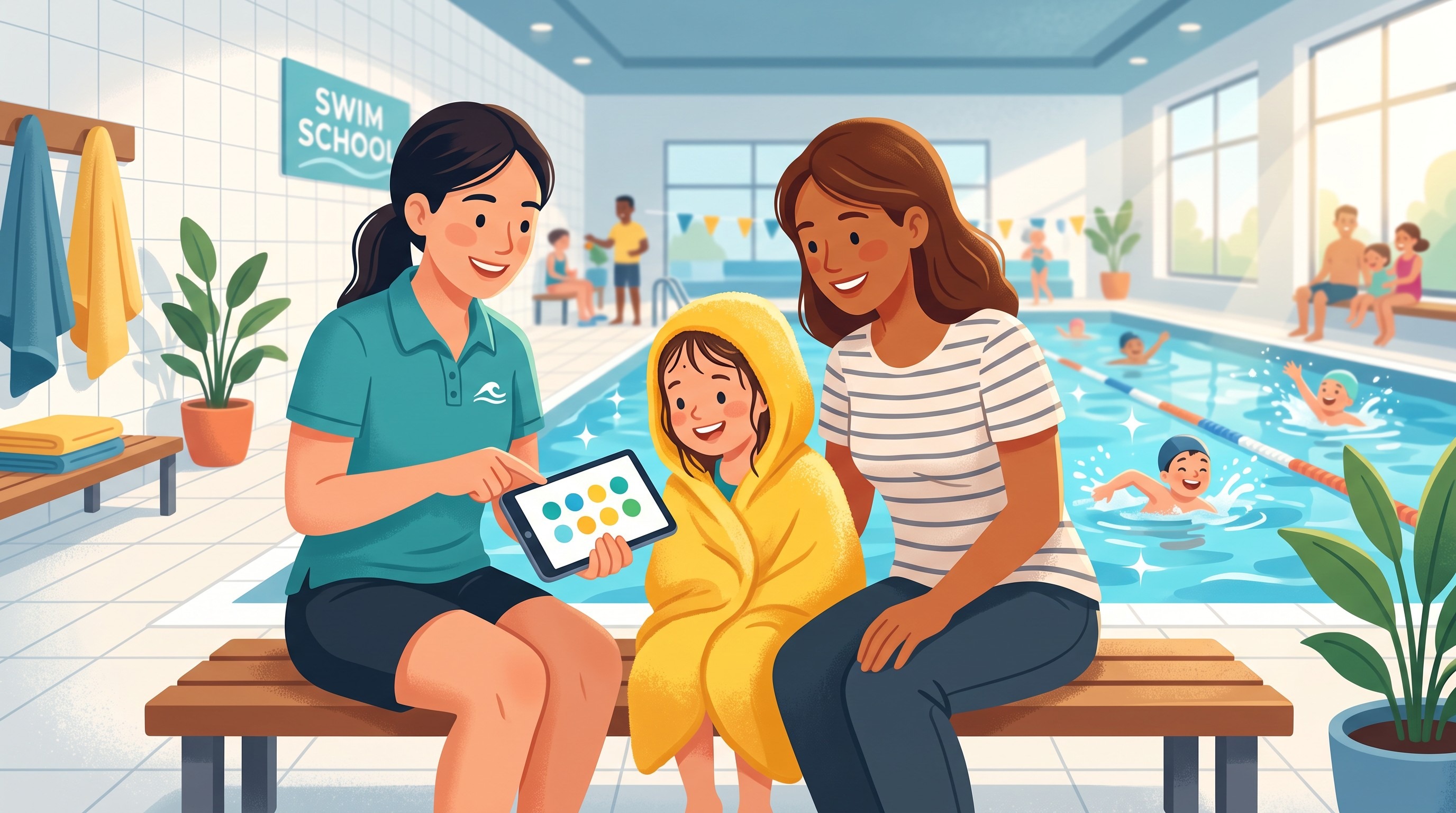
Two lines are enough: what went well, what is the next step. Parents who get that immediately after the lesson understand what they are buying. They see you are paying attention, that you have a plan and that their child is not just a number in a group of twenty.
Photos, data and consent
If you take photos or videos during an open day, ask permission in advance and record what you will use them for. Also agree where the child's data will be stored, who can view it and when you will delete it. Children who do not continue should not remain in your administration. Privacy rules differ per country, so check what applies in your area if in doubt.
Safety and supervision during an open day
An open day is not a regular lesson. Parents walk around, children wait on the side and someone holds a form in their hand. That is when things go wrong if nobody is in charge.
Put your ratio on paper
The WHO names a pupil-instructor ratio set up for safety as a fixed condition for swim lessons. Providers differ in group sizes, so determine for yourself how many children per supervisor are allowed in the water and write that down. Do not improvise that on the day.
Decide who watches which child
During an introduction parents are present, but they are distracted: they take photos, they talk to each other, they watch their own child. Appoint one person who only supervises and does not also teach or fill in forms. For an open day with multiple blocks that is a role in itself, not an extra task.
What to do if a child is afraid
Stop, sit on the edge and try again later at a quieter moment. Pushing results in a child who cries and a parent who does not return. A child who only dips their toes today and leaves feeling good is a better customer than a child who leaves the changing room in tears.
Follow-up: where it usually goes wrong
The lesson went well, the parent nods, says "I'll let you know" and disappears. After two weeks you hear nothing. Usually the lesson went fine. There was simply nothing concrete on the table.
Within two days a message with a concrete spot
Send a message within two days with day, time, start date and group size. A vague promise that you "will let them know" makes the parent keep looking. A concrete spot on a concrete day makes it easy to say yes, and that is exactly what you want.
What to include in that message
Stick to five things: the level the child starts at, the group with day and time, the start date, how the subscription works, and what the child needs to bring. Also state what happens if it does not click, because that is the question parents do not dare to ask. Clarity about stopping costs you nothing and builds trust.
Hold a place, instead of a waiting list
Reserving a spot for a week for a family that just had a trial lesson results in more registrations than putting a name on a waiting list of ten. You lose nothing that week if the group still has space, and you prevent the parent from signing elsewhere in the meantime.
From introduction to registration without retyping
If the trial lesson data is already in an app, enrolling is a matter of linking the same pupil to a group. No lost notes, no double entry, and the parent immediately receives the same information you have. That works more calmly than a folder of forms you retype in the evening. How registration, planning and payments come together in one app is covered in the overview about swim lesson booking software.
Measure which channels actually deliver pupils
You do not have to be a marketer to know what works. You just have to keep track of where your pupils come from, otherwise you keep leafleting because you always did.
Ask one question at registration
"How did you find us?" is enough. Make it a required field in your registration form, with a few fixed answers: word of mouth, search engine, social media, flyer, passing by, other. After twenty registrations you see a pattern that you cannot get from intuition.
QR code on flyer, window and reception
A QR code that links directly to your sign-up form or demo makes a leaflet measurable. Put one where parents wait, put one on the flyer that goes home and ask every calling parent how they found you. That way you know within a month which channel does something.
Check three numbers after three months
How many trial lessons did you give, what share enrolled afterwards, and where did those families come from. You do not need more to decide whether to continue trial lessons, keep them free, and whether that one flyer in the hall was worth it.
What it costs and what it yields
A trial lesson costs you time: half an hour of lesson, fifteen minutes preparation, fifteen minutes follow-up. In an existing pool hour it costs no extra rental. Compare that to what a pupil brings you over a year, including the chance that a family with two children brings in both.
The more expensive option is the open day with its own pool hour and extra supervision. That pays off mainly if you want to reach many families at once, for example when opening a new location. For a sole proprietor joining an existing group is almost always the cheapest start.
For parents: what to look for in a trial lesson
Parents request a trial lesson usually because they want to know whether it clicks. There are three things you can check in those twenty minutes.
Ask who teaches the lesson and how many children there are
Who stands in front of the group and how big that group is, largely determines what your child learns. Just ask: is the instructor trained for swim lessons, how many children are in the group and is someone supervising nearby for larger groups. Providers may handle that differently, so the answer is information you will not find on a website.
See whether progress is recorded
A good swim school records per child what they can do and what the next step is. Ask during the trial lesson how that is done and whether you can view it as a parent. If you only get a story after the lesson and no notes, expect few updates later.
Ask what happens after the trial lesson
What does it cost, when does the group start, how do you cancel, and what if your child still refuses after three lessons. Providers who are clear about that before you sign are usually clear when things go wrong. If the answer feels vague, that is your answer.
How to set it up in Swimmigo
Swimmigo is made for independent swim teachers and small swim schools, so the pieces you need for an introduction are all there.
- Groups and swipe: linking a child to a group and updating level takes seconds, even during the lesson.
- Seven levels with 86 skills and a score of 0 to 6 per exercise, so you can show where the child stands after the trial lesson.
- Messages with read receipts, in five languages, so your follow-up does not get lost in a full inbox.
- Marketing Toolkit with flyers, social media templates, a diploma maker and QR linking, which makes sign-up for your trial lesson measurable.
- Lesson payments are optional: your own lesson packages, iDEAL, credit card or PayPal, the money goes directly to your account and the transparent fee is 7.5 percent.
- Certificates and diplomas from level 5, plus statistics and School Pulse to see which groups fill up and which do not.
Parents use Swimmigo for free. As a swim school you start with an unlimited free demo, then a 30-day free trial follows and you choose the Solo or School subscription via the App Store or Google Play. More about the school side is on the instructor page, a full overview of the features is on the features page, and what parents see is on the parent page.
Conclusion
An empty spot in your group fills with a child who has stood once in your water. Twenty minutes of trial lesson, one exercise that succeeds and a message within two days with a concrete spot do the rest. What you record about level and skills turns that trial lesson into an intake, and that saves you hours of administration later.
Start small: invite two families to join an existing pool hour and see what happens. Those who keep follow-up tight only need to choose which format to expand afterwards.
Swimmigo · For swim schools
Run your swim school fully digital
Students, schedules, absences and parent communication in one app, with your own rates and branding.
Sources
- WHO: Drowning fact sheet, 1 May 2026
- CDC: Preventing Drowning, accessed October 2026
- Brenner et al.: Association Between Swimming Lessons and Drowning in Childhood, Archives of Pediatrics and Adolescent Medicine, 2009
- Swim England: Learn to Swim Framework Stages 1 to 7, 2017
- Swim England: Learn to Swim Programme, accessed October 2026
- Bookeo: Swim School Marketing Guide That Actually Works, October 2025
Bob van Soest
As an expert in operating sports facilities (such as swimming pools) and developer of, among others, Swimmigo.com, I am passionately committed to making swimming lessons simpler, more fun and more insightful for parents, swimming instructors and everyone who wants to learn to swim.
Frequently Asked Questions
Related articles

Effectively Managing Swimming Lesson Groups and Progress
Practical tips for organizing and tracking swimming lesson groups and student progress. A tracking system ensures better group division and clarity.
Swimming School or Swimming Instructor: Manage It All in the Swimmigo App
Progress, lesson planning, lesson payments, marketing, diplomas, and parent communication: manage all this with the Swimmigo app for swimming schools and instructors.
Starting Your Own Swim School: How to Do It Without Expensive Systems
Want to start your own swim school? Here’s how to approach it: the real costs, the steps from day one, and how to start professionally without costly systems.
Discover Swimmigo
The all-in-one app for swimming lesson progress. For parents, swim schools, and adult swimmers.