Starting your own swim school: from the first pool slot to full classes [2026]

Summary
- Secure a few pool hours first, a building and a team can come later.
- Keep beginners to a maximum of six per instructor when you are in the water.
- Record temperature, water quality and cancellation terms in the rental agreement.
- Sell a place in a group per month instead of single lessons.
- Track progress per skill from the first pupil.
Starting a swim school costs less money than most teachers expect, and more time than they hope. You do not need a building, your own pool or a team at the start. What you do need: a few hours of pool time per week, a qualification your insurer accepts and a place where you track each pupil's progress.
The first six months are fairly predictable. The first pupils come via family, neighbours and a post in the local app. After that growth stalls, rarely from lack of demand, usually because no one can find you and because you do not have a good answer to the question every parent asks: how is my child doing?
Those who first write a twenty page plan and only then look for pool time usually discover the slots are already taken. The order that follows here is the one that costs the least money.
Is there room for another swim school?
In most regions, yes, but not at every hour and not for every target group. Swimming lessons are a local market, parents pick what is within a fifteen minute drive and where their child is not in a group of twenty.
How to check if your area is already full
Find all swim schools within a fifteen minute drive and call them with a simple question: how long is the waiting list for a six year old beginner? A wait of months means there is space. A school that can place you immediately has spare capacity, and then price becomes your only differentiator.
Then ask the pools themselves which slots are empty. Reception staff know that better than the marketing department. Also ask about pools you might not think of: therapy pools at care organisations, hotel pools, school pools that are empty in the evening and association pools that are unused on weekday daytime.
What parents weigh when they can choose
When choosing a swim school, distance, a time that fits the school run and whether their child keeps the same instructor count more than price per lesson. After that comes the group size: four to six children is more attractive to many parents than twelve, even if the lesson costs more per child.
That is where a starter has room: small groups, fixed times and parents who can see what happens in the lesson. You cannot build a pool and you will not win a price war, but on those three points you beat a large school.
Swimmigo · For swim schools
Run your swim school fully digital
Students, schedules, absences and parent communication in one app, with your own rates and branding.


Step 1: define your offer before you look for pool time
Your offer determines what pool you need. Baby swimming requires warmer water than a training for advanced swimmers, and adults come in the evening while children come after school.
Choose one target group for your first classes
Four to seven year old beginners is the largest group and therefore the busiest market. If you start there, you compete with every school in the area. Other target groups are quieter: baby and toddler with a parent, adult beginners, children who already swim but want to improve technique, or children with a disability who benefit from a small group.
Choose what fits your qualification, your experience and the pool you can rent. An instructor with training in baby and toddler swimming and a pool at 31 degrees has a better start than someone who immediately targets advanced swimmers.
Choose group size based on supervision
Maximum group size depends on age, level and whether you are in the water. The British professional association STA lists maximums in its Code of Practice. Those are upper limits, not targets, a risk assessment can require a lower number.
| Learner type | Maximum per instructor | What is required |
|---|---|---|
| Baby and toddler with parent | 12 pairs | Parent is in the water |
| Children aged 3 to 4 | 6 | Parent stands at the pool edge |
| Beginners, instructor in the water | 6 | Supervision from the poolside |
| Beginners, instructor on the poolside | 12 | Own swim safety coverage |
| Advanced swimmers | 20 | Instructor not in the water |
| Children with a disability | 1 to 4 | Depends on care needs |
Six beginners with the instructor in the water feels tight as soon as two children are afraid. You can take twelve pupils with supervision from the poolside, but in practice you are no longer teaching, you are keeping an eye on them. For your first groups six is the realistic limit.
Lesson length and frequency
For beginners aged four to seven, thirty minutes is enough. After that attention drops and the lesson becomes more expensive without more learning. Older children and adults benefit more from forty five minutes.
Plan two lessons back to back with ten minutes changeover time. That is the cheapest way to serve more pupils in the same pool hour. Do not start with three lessons per week per child, one fixed lesson is what most families can maintain, and it keeps your schedule free enough to grow.
Step 2: rent pool time without surprises
Pool time is the biggest bottleneck and the largest cost item. What you put in the agreement determines whether you later have disputes about water quality, temperature or liability.
What must be in the rental agreement
Put at least these points in writing: which hours and lanes you rent, whether changeover time is included, who opens and closes the building, where you may store equipment, what temperature the water should have, who manages and measures water quality, and how you can cancel. Also arrange who is liable if something happens during your lesson.
Ask for the pool's emergency plan and the arrangements for malfunctions. A heating failure on Saturday morning means no lesson, and then you want to know whether you get those hours back or lose them.
Water quality and temperature: who does what
According to the STA, management of pool water is the responsibility of the pool operator, unless the rental agreement explicitly places that with the renter. Put that point explicitly in your contract, otherwise you as a small renter are left with a problem you cannot solve.
For a teaching pool the STA names 29 to 31 degrees as guidance, and 30 to 32 degrees for young children and swimmers with a disability. Ask for the logbooks from recent months. A pool that is consistently at 27 degrees is not a disaster for trained swimmers and is a problem for toddlers who are shivering.
Why you should never be alone in the pool
The STA is clear about lone working: a swim instructor should not give lessons alone in a pool. If something happens to you, someone must be able to start the emergency plan and take over the group. There is also child safety: you should never be alone with one child.
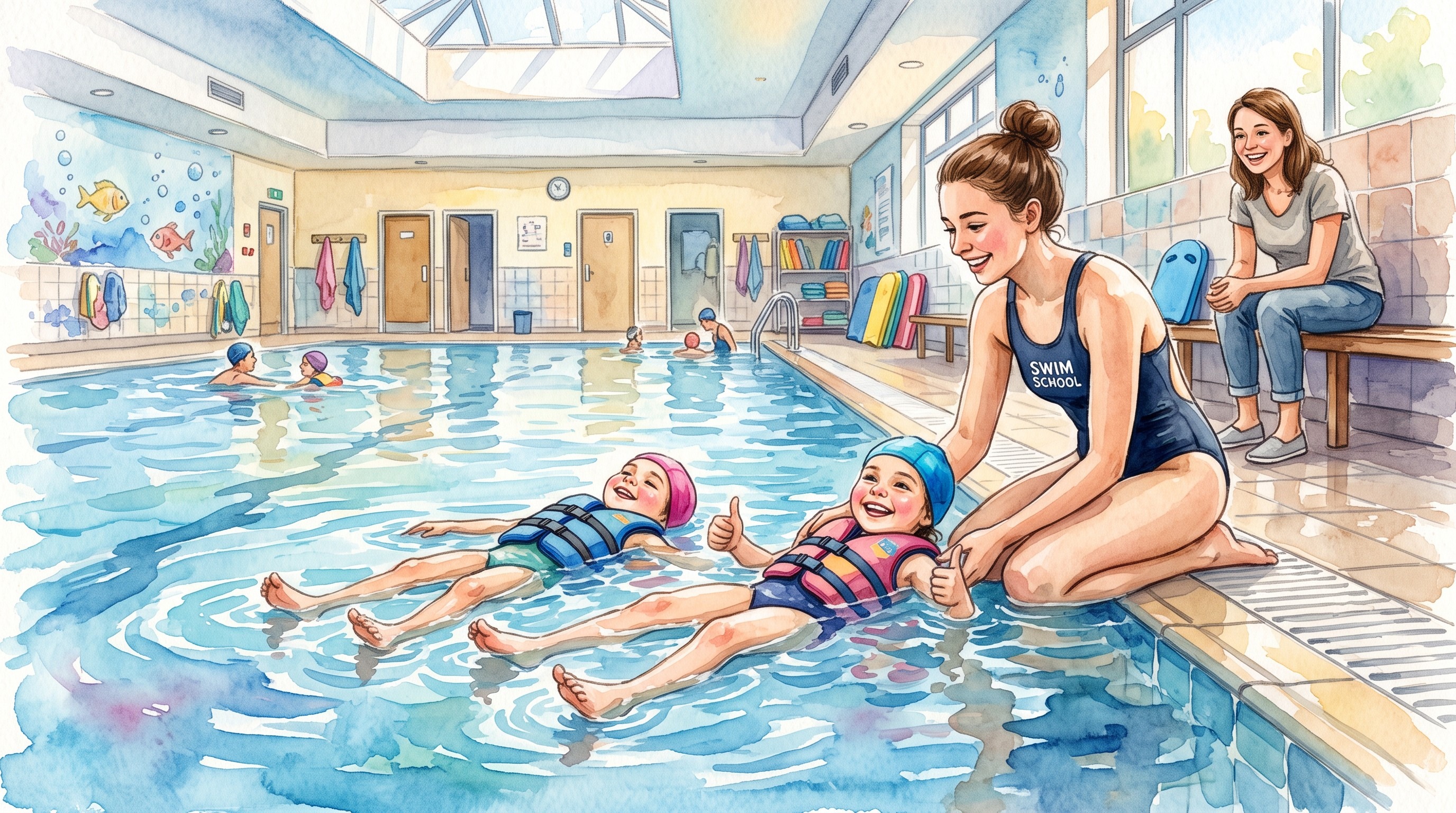
In practice that means a second person during your lesson, or a pool with its own supervision that takes that role. Arrange that before you enrol your first pupil, even if it is a quiet slot on Sunday morning.
Step 3: qualifications, insurance and safety documents
What you exactly need differs by country and sometimes by region. The logic is the same everywhere: you must be able to show you are qualified, that you can give aid and that you are insured for teaching.
What paperwork an insurer expects
An accredited qualification for teaching swimming, a valid first aid certificate and a recent child-handling training. Large organisations such as the American Red Cross and the British STA have their own training routes, and in many countries one of those routes is the standard insurers look at. Ask your insurer which proofs they accept before taking out a policy.
Note the difference between insurance for supervision and insurance for teaching. Someone with only a lifeguard qualification is not automatically covered for giving swimming lessons.
An emergency plan per pool, not one plan for everything
Each pool has a normal operating plan and an emergency plan. The STA expects instructors to read and follow them at every pool where they teach. For you as a starter that means: walk the exit route at each new pool, find the alarm button, the AED and the rescue equipment, and know who calls the emergency services.
Practice the plan once per quarter with the people who are present then. A plan that only sits in a folder does not work at the moment it is needed.
Keep your competence up to date
Refresher training is not a formality. The STA advises at least one point per year and mentions fifty teaching hours as one point, child-handling training should be repeated every three years. Schedule that in your calendar before it fills with lessons.
Step 4: price your lessons so you do not have to stunt
Most starters price based on what the neighbour charges and find out after three months they work full time for a side job. Calculate backwards from your costs.
Calculate back from your fixed costs
Add up your monthly costs: pool rental, insurance, travel, equipment, your administration and the income you personally need. Divide that by the number of lesson hours you can realistically give each month, not by the number of hours you hope to give.
Then divide that hourly rate by the number of pupils per group. Six pupils in a thirty minute lesson means two groups per hour. That shows immediately what a pupil must generate per month, and whether the price of the nearby school is achievable with your group size.
Choose a monthly fee instead of single lessons
A fixed monthly fee makes revenue predictable and keeps admin small. It also makes the conversation easier after a missed lesson: you do not sell single tickets but a place in a group, with clear rules about make-ups and cancellations.
Announce a price increase well in advance, with a reason and a date. Parents accept an increase fine if they see it coming.
Step 5: your first pupils without an advertising budget
Start with people who are already waiting
Schools with a waiting list will refer you if you ask politely, especially if you have a slot they do not serve. Also use the local app, the notice board at the pool, the nearby childcare and the sports club where you are a member.
In every conversation say exactly what you do and for whom. "Swimming lessons for children aged four to seven, Wednesday at four, groups of six" is useful. "I teach swimming" does not generate sign-ups.
A trial lesson that measures something
Use the trial lesson mainly to determine entry level. Let the child settle for ten minutes, see if they dare get their face wet and whether they will float on their back. Based on that you place them in a group.
Reviews and referrals
The best moment to ask for a review is on the day of the diploma. Parents are proud then, and they have just had months with you. One link in a message is enough, a ten question form gets no replies.
Step 6: track progress from the first pupil
Why a notebook catches up with you after fifteen pupils
At five pupils you remember everything. At fifteen you do not, and then the real work starts: a parent asks why her daughter still does not start backstroke, a colleague takes over a group, a child moves up a level and you no longer recall the date.
Levels and skills as a common language
A curriculum with fixed levels and skills solves that. Swim England works with seven stages for children around four to eleven years old, and at the end of stage 7 a child should be able to swim 25 metres in the four strokes. The same organisation recommends recording the start date of each stage per swimmer.
Swimmigo uses seven levels with 86 skills and a score of 0 to 6 per exercise. That is more granular than one grade per level, and it makes visible that a child progresses even if they are not finished. Certificates are attached to the levels: Bronze for 1 to 5, Silver for 6, Gold for 7.
Parents who can view progress ask different questions
Once parents can see progress themselves, most questions at the poolside disappear. A notification at a level promotion does more for the relationship than a newsletter at the end of the season.
Step 7: administration, communication and fees in one place
What you should record per pupil at minimum
Name, date of birth, parents' contact details, an emergency number, medical points such as asthma or epilepsy, the level, attendance and payments. Also record whether you may use photos, that is often requested for the diploma.
Lesson payments: what parents expect
Parents expect a payment link, not cash in an envelope. In Swimmigo you create your own lesson packages and parents pay via iDEAL, credit card or PayPal, with money going directly to your account via Stripe. The fee is 7.5 percent per transaction and is visible in the overview.
Note: Stripe payments for lessons do not work in every country. Check that before promising a payment method to parents. The app itself, with scheduling, progress and communication, does work everywhere.
Communication that does not create extra work
Choose one channel. Parents who receive messages via the app, WhatsApp, email and a note in the bag get mixed messages and miss half. Messages with read receipts reduce disputes, and notifications in the parents' language reduce explanations. Swimmigo supports five languages.
Step 8: grow without doubling yourself
Hire your first instructor
Hire someone when three groups are consistently full and you no longer have time for administration. Whoever joins must use the same levels and definitions immediately, otherwise a parent gets a different story from each instructor.
Swimmigo works with three roles: owner, manager and instructor. The instructor sees their own groups and fills in scores, the manager handles scheduling and the owner keeps the overview.
A second pool hour or a second location
Fill your current hours to about eighty percent before you open a second pool. Each location means extra travel time, its own emergency plan and its own set of agreements with the pool operator. Two half full groups at two locations cost more than one full group at one place.
What you do not need to arrange
Your own building, your own till and a website with a member portal are unnecessary expenses for most starting schools. A working schedule, a shared curriculum and a payment link cover almost everything in the first year. The rest comes in the second year, once you know which groups remain active.
Mistakes starters make most often
- Writing a business plan before securing a pool.
- Accepting a group of twelve to recoup pool rental.
- Not arranging a second person during lessons.
- Keeping progress in your head and only writing things down when complaints arise.
- Selling lessons individually and asking for money every month.
- Starting with three locations and ending with three half full groups.
- Choosing a price that only works with fully filled groups.
What the first year realistically requires
Expect one to two hours of administration per week with twenty pupils, and more travel time than you think. The first months mainly go to calling pools, trial lessons and getting your paperwork in order.
You do not need an expensive system to start. Swimmigo has a free demo without limits on the number of pupils, then a thirty day free trial and a Solo or School subscription that you take out via the App Store or Google Play. Parents always use the app for free.
Start with one pool hour, six children and a place where you note what each child can do. Schedule one meeting with a pool and one trial lesson this week. Once that first group is full, you know exactly what a second hour will bring.
Swimmigo · For swim schools
Run your swim school fully digital
Students, schedules, absences and parent communication in one app, with your own rates and branding.

Bob van Soest
As an expert in operating sports facilities (such as swimming pools) and developer of, among others, Swimmigo.com, I am passionately committed to making swimming lessons simpler, more fun and more insightful for parents, swimming instructors and everyone who wants to learn to swim.
Frequently Asked Questions
Related articles

Effectively managing swim lesson groups and progress
Practical tips for organizing and tracking swim lesson groups and student progress. A tracking system provides better group allocation and clarity.

Swimming School or Swimming Instructor: Manage It All in the Swimmigo App
Progress, lesson planning, lesson payments, marketing, diplomas, and parent communication: manage all this with the Swimmigo app for swimming schools and instructors.
Starting your own swim school: how to do it without expensive systems
Want to start your own swim school? How to approach it: the real costs, the steps from day one, and how to start professionally without costly systems.
Discover Swimmigo
The all-in-one app for swimming lesson progress. For parents, swim schools, and adult swimmers.