OrganizingtheSwimmingTestDayatYourSwimSchool:PlaybookforDiplomaDay[2026]
![Organizing the Swimming Test Day at Your Swim School: Playbook for Diploma Day [2026]](/_next/image?url=https%3A%2F%2Fzvblogpostimages.s3.eu-west-3.amazonaws.com%2FAUTOMATISCH_UPLOAD%2F1_c7837fc05b68.jpg&w=3840&q=75&dpl=dpl_DqUHNtsMUTtGEGNaUbbB2t9YQZM4)
Summary
- Arrange a diploma day six to eight weeks in advance. Date, pool, and examiner take priority over the invitation.
- In the Netherlands, anyone can give swimming lessons and issue a diploma. The national swimming diploma may only be issued by a license holder of the National Council for Swimming Safety.
- At diploma swimming of a license holder, a certified examiner is always present, and the pool must meet fixed requirements, including a minimum depth of 1.80 meters.
- Five swimming test fees from the sector: 10, 12.50, 33.50, 45, and 57.50 euros. The median is 33.50 euros per child.
- Record which trials each student has completed. Without that administration, diploma day is a guess and the conversation with parents becomes difficult.
A diploma day is the culmination of a months-long journey
On diploma day, everything a swim school has worked on all year comes together. A child enters the water with clothes on, treads water, swims to the edge, and climbs out independently. Parents remember that afternoon for a lifetime. For the school, it’s a day with an examiner, a schedule that fits, clothing requirements, invitations, and diplomas that must be ready on time.
In practice, that day is often only arranged once the first student is ready. Then it turns out the pool is booked, the examiner is fully scheduled, and invitations fall in the last school week. So plan six to eight weeks ahead once you know which students are in scope.
Netherlands: anyone can give swimming lessons, but not everyone can issue the national diploma
In the Netherlands, anyone may offer swimming lessons and issue a swimming diploma. This is not legally regulated: in 1984, the government transferred this task to the National Council for Swimming Safety. The national swimming diploma, the Zwem-ABC, may only be issued by a swim lesson provider with the National Swimming Diplomas License. This license requires an on-site audit, certified instructors with a VOG (certificate of conduct), a documented teaching method, and independent control.
This distinction is exactly what parents inquire about when they call: will I get the real diploma? The answer depends on your license, not the name of your school. There is still a legislative proposal before the House of Representatives, the Swimming Skills Act (36.473), which regulates a nationally established swimming diploma and instructor diploma. Until that law takes effect, the system remains as it is.
What is expected of the examiner
At the diploma swimming of a license holder, a certified examiner is present. They assess whether a child is ready to take the test and whether they pass the trials. The examiner themselves takes an exam every four years, and the National Council for Swimming Safety reviews the reports. There are spot checks and periodically a council representative attends the diploma swimming.
If you plan a diploma day, you simultaneously reserve two things: the pool and the examiner. The last to call swims at the least favorable time.
Pool requirements
A license holder does not allow diploma swimming everywhere. There are conditions related to safety: a minimum depth of 1.80 meters for certain skills and a water surface of at least 160 m², of which at least 40 m² is at 1.80 meters deep. These requirements have a reason. Children must experience during the exam what it feels like to swim in a large and deep pool so they won’t panic during their first visit to a recreational pool after their diploma. Small instructional pools are therefore excluded from official diploma swimming.
Outside the Netherlands: different names, the same milestone
Every country calls that day differently. In one country a child earns badges, in another a certificate, and in yet another a test in open water. The moment itself is the same everywhere: a child shows what they can do and the people who have seen them learn are present.
Why this milestone matters is clear from the numbers. Drowning is the third leading cause of death worldwide among children aged 5 to 14, and an estimated 300,000 people die annually from drowning, nearly a quarter of whom are under 5 years old (WHO, Drowning). The Netherlands is not exempt from this reality: in 2024, 14 percent of children aged 6 to 12 had no swimming diploma at all, rising to 33 percent in the lowest income group versus 5 percent in the highest group (Mulier Institute, Swimming Skills 2024). The CBS also shows that the risk of drowning is significantly higher among children not born in the Netherlands (CBS, 2026).
For a swim school, this means two things. What you test on diploma day is more than a skill for summer vacation, and multilingual communication is not a luxury. If a parent does not understand the invitation for diploma day, a child misses the day they have worked toward for months.
Standard exam program or custom program
Each diploma has a standard exam program. Additionally, a provider may use their own custom program as long as the level is equivalent and the National Council for Swimming Safety approves it in advance. This flexibility is practical if your method differs from average, for example with more play forms or a longer water acclimatization phase. For planning, this means one thing: the trial list of your variant must be ready and approved before the day begins.
The playbook, step by step
The order below follows dependencies. The pool and examiner are usually the limiting factors, so they come before the invitation.
| When | What to arrange | Why in this order |
|---|---|---|
| 8 to 6 weeks ahead | Fix date, block schedule, and pool | Pool space and examiners are scarce. Everything else depends on this date. |
| 5 weeks ahead | Determine per student who participates | Based on completed skills, not feelings. This also tells you how many blocks you need. |
| 4 weeks ahead | Confirm examiner and choose program | Standard or custom program determines which trials and materials you need. |
| 3 weeks ahead | Invite parents with all information in one message | Parents need to arrange work swaps, babysitters, and clothing. |
| 2 to 1 week ahead | Practice with clothes on, check clothing, send schedule to team | So no one shows up with shoes without soles or shorts that are too short. |
| Day before | Prepare diplomas, certificates, and materials | Something is always missing on the day itself. Prepared materials reduce stress in the water. |
| The day itself | Arrival, trials, awarding, photos | The awarding happens while parents are still in the building, not a week later. |
| Week after | Record results, keep data, transition to next level | There is no national register. Your administration is the only proof of what a child has done. |
Step 1: set the date and fix it in the annual planning
Two or three diploma moments per year work better than one big moment. You keep the waiting list moving and the pool is not fully booked at once, so parents don’t have to wait months for a spot. Do not plan the moments immediately after a long holiday: children who have not been in the water for three weeks often need one or two lessons to get back to their old level.
Put the dates in your annual planning and share them early with parents. Those who know the date months in advance can request time off instead of canceling.
Step 2: determine per student who is ready
This is the step where guessing happens most often. “They’ll probably make it” is not a criterion, and a child who takes the test unprepared has a bad experience that lasts for months.
Work with progress per student: which skills are completed, which are still open, and how long has a child been stuck at the same point? In the Swimmigo app, you track 7 levels and 86 skills with a score per exercise, so you see per student which exercise is not yet at level. School Pulse counts students ready for the next level and signals who has been stagnant for more than twelve weeks. That is exactly the group you look at before diploma swimming.
Two rules proven in practice: invite only students who can demonstrably perform the trials, and discuss doubtful cases with parents beforehand instead of surprising them on the day itself.
Step 3: reserve the pool and the examiner
Fix both and put the agreements on paper: from what time to what time, which pool sections you use, where the materials are, and who receives the examiner. Also ask about the pool’s conditions: is the public allowed in the stands, how many people fit, and when do the changing rooms open? These are the questions you need answers to for the invitation.
Step 4: invite parents with one complete message
An invitation is only complete if parents have no further questions after reading it. That means: date, arrival time, start time, end time, location, which entrance, where they can sit, what clothing their child wears, what to bring, whether someone may swim along, how photos are taken, when the awarding is, and whether siblings are welcome.
One message in one channel works better than an email, a note, and a group app mixed. In the app, parents can find the invitation again, and you see if the message has been read. That saves a series of phone calls in the last week.
Step 5: divide the day into blocks
Count on about an hour per group of five or six children, including changing. Children who have to wait long become nervous, and nervous children swim below their level. Arrange the blocks so parents are not all in the changing room at the same time.
Plan deliberate space for showering and dressing after the trials. At many schools, one parent or caregiver may help with dressing afterward to keep the changing rooms calm. Include that in the invitation so you don’t have to explain it on the day.
The day itself: from arrival to awarding
How to build the program
Start with a short explanation before the children enter the water: what will happen, who is watching, and that there are chances if something doesn’t succeed immediately. Children who know what to expect swim calmer and show more of their ability.
Then let the trials be swum in a fixed order, with the heaviest part not last. Swimming with clothes on requires the most energy, so that should be early in the block. Finish with the awarding while parents are still in the building, and ensure someone keeps the diplomas in the correct order. Nothing is more awkward than searching for a name while thirty people watch.
Clothing requirements and practicing with clothes on
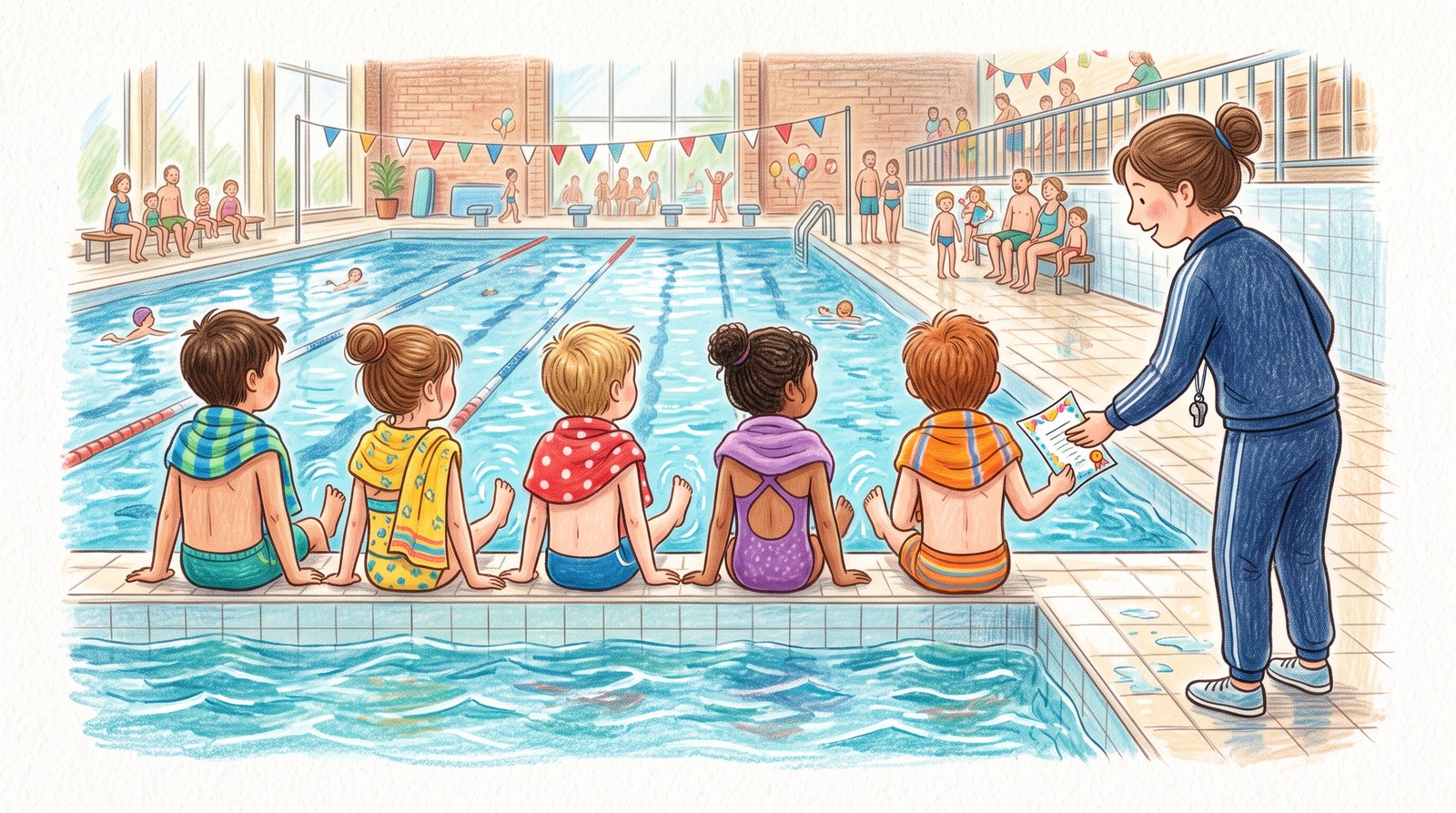
The clothing requirements are not a formality. Children must be able to tread water, swim, and climb out of the water with clothes on, as that is one of the trials for diploma A. Shoes without a real sole are not allowed, nor are pajama pants.
| Component | What the child wears | Attention point |
|---|---|---|
| Swimwear | The usual swimwear the child uses during lessons | No new swimwear on the day itself, it fits and swims differently. |
| Shirt or blouse | Long-sleeved shirt or blouse | Short sleeves are not enough and cause discussion during assessment. |
| Pants or skirt | Long pants, dress, or skirt down to the ankles | A long legging is allowed. Pajama pants are not. |
| Shoes | Plastic, leather, or sports shoes | Shoes without a real sole, like surf shoes, are not allowed. |
| Practice | The same clothing as during the last lessons | Have the child swim at least once in the diploma clothing before it counts. |
Include the clothing requirements literally in the invitation, with exceptions. Parents look for this, and otherwise the reception gets questions on the day itself.
If a trial fails: chances, conversation, and expectations
Some schools work with a maximum of three chances per trial. Pool bv SPORT describes this approach: if a trial fails twice, the swim instructor talks with the parents and the child continues the program. At the awarding, the child then receives a swimming certificate instead of a diploma. After the regular program, when the hall is empty, the trial is tested once more calmly. If successful then, the certificate is exchanged for the diploma. If not, the certificate remains with the child and agreements are made about the follow-up.
Whatever you choose, record the agreement beforehand and decide who talks to parents if it goes wrong. A child should not hear at the poolside that they have failed.
Awarding and celebration without chaos
The awarding is the highlight of the day for parents. Keep it short and predictable: name by name, diploma presented, moment for a photo, move on. A mascot or a small ritual works well and costs almost nothing, as long as it comes after the trials and not during.
Take group photos only with permission per child. If you use a consent form at registration, you don’t have to arrange anything on the day. Do not publish a photo with a child who does not want to be photographed.
After the day: proof, administration, and the next group
What a diploma is and isn’t
The national swimming diploma has authenticity features, including a silver hologram and a unique number. There is no national register showing who has obtained which diploma. Diplomas are issued once, so if one is lost, there is no central authority to reissue it. Swim schools keep their diploma holders’ data for a few years themselves.
For you, this means: record the results of each diploma day in your own administration, with date, diploma, and trials completed. That is the proof you can show later, and the basis for a good conversation if a parent requests data after moving or switching.
Swimming certificates for children who do not yet obtain the diploma
Besides the diploma, there are Swimming Certificates A, B, and C. These are intended for children for whom the diploma is (temporarily) not achievable, for example due to a temporary or permanent disability or because the trajectory takes longer. A certificate is a step toward swimming safety and often the difference for parents between giving up and continuing.
Own certificates and diplomas for your own levels
Apart from the national diploma, you can make your own milestones visible as a school. In Swimmigo, a student receives a certificate per fully completed level, and at levels 5, 6, and 7 a personalized diploma with name and date in Bronze, Silver, or Gold style. The diploma maker in the app works with your logo, brand colors, and signature, and you print or share the result digitally. That is exactly what parents want to share with family on such a day.
Be honest about what it is: a certificate from your school, not a national exam diploma. Tell parents that as well, because a diploma that does not meet expectations causes trouble later.
The group after
What happens to the children who just received their diploma? Place them immediately in the correct follow-up group or on the waiting list for the next level, and inform parents when they may start. Diploma day is the moment when parents are most involved with your school, and thus the moment when they easily accept a follow-up trajectory.
See also the difference between a recognized diploma and your swim school’s own diploma.
What a diploma day costs and how to communicate it
What providers charge in practice
| Provider | Amount | For what | Source |
|---|---|---|---|
| Municipal pools Amsterdam, offer for Stadspas holders | 10 euros | Swimming test, besides 30.95 euros registration fee | Stadspas Amsterdam, 2026 |
| Zwemclub Zeist | 12.50 euros per diploma | Swimming test, besides 10 euros registration fee | Zwemclub Zeist, rates 2026 |
| Sportbedrijf Zaanstad, De Slag | 33.50 euros | Swimming test, separate from monthly lesson card | Sportbedrijf Zaanstad, rates 2026 |
| Zwemschool Kablau | 45 euros | Swimming test including diploma party, besides 60 euros registration fee | Zwemschool Kablau, price list 2026 |
| Zwemles op maat | 57.50 euros | Trial swim and diploma swim combined | Zwemles op maat, rates 2026 |
| Zwemschool Anita Hogervorst | 31 euros trial swim and 61 euros diploma costs | Two separate items around the swimming test | Zwemschool Anita Hogervorst, rates 2026 |
Five of these six providers charge a fee for the swimming test itself: 10, 12.50, 33.50, 45, and 57.50 euros. The median is 33.50 euros per child. Note that the amounts do not mean the same: one includes the diploma party, another is a separate item besides the trial swim. So compare not only the amount but also what is included.
Where your own costs lie
On the school side, the money is mainly in time and space. Instructor hours, pool rental outside regular lesson times, the examiner, materials, refreshments, diplomas and certificates, and the hours spent inviting, scheduling, and administration. Calculate that and choose consciously how to cover it: in the lesson fee or as a separate item for the diploma swim.
For the administration around it, an app is often enough: the Swimmigo Solo subscription is 9.99 euros per month and the School subscription 59.99 euros per month, both with unlimited students and one fixed monthly fee. Parents use Swimmigo for free, and the 30-day trial period starts as soon as your first student is linked. If you enable lesson payments, you create a one-time package for the diploma swim in the app, and parents pay via iDEAL, credit card, or PayPal. A transparent fee of 7.5 percent applies per transaction. More about this is on the page for swim schools and instructors.
No surprises afterward
Put everything related to the diploma swim before registration in your terms and conditions and on your pricing page: what is included, which costs come later, and what happens if a child fails. A parent who only hears the amount at the invitation feels poorly treated, even if the amount is market conform. Clarity beforehand costs you one paragraph and saves discussion on the day itself.
Communication around diploma day
Who you inform when
Work with three moments. First the announcement with the date so parents can plan. Then the final invitation with all practical details, three weeks ahead. And finally a short reminder in the last week, with only what they need to bring. Sending the same detailed message three times is not read.
The conversation if it doesn’t work out
Not every child passes on the first attempt, and that is no surprise for the instructor who sees the child every week. Prepare that conversation: what has the child shown, which trial failed, what is the plan for the next period, and what does that mean for costs. Parents need facts and a next step at such a moment, not just comfort.
Everything in one channel
Inviting, reminding, answering questions, and discussing results: if that runs through four channels, you lose overview and parents miss messages. With messages in the app, including read receipts and notifications in the parent’s language, it stays together and you can check in the last week who has not yet seen the invitation. Swimmigo is available in five languages, which helps at schools where not all parents read Dutch.
Conclusion
Organizing a diploma day is not arranging an exam, it is putting a whole day of dependencies in the right order: first the pool and examiner, then the student list, then the invitation and the playbook. If you arrange it six to eight weeks ahead, you keep space on the day itself for the moment parents come for. What you record in your administration that week is the only proof of all trials completed.
Discover also
- Complete overview of swim lesson planning and software for swim schools
- Recognized swimming diploma or your swim school’s own diploma
- Hidden costs of swimming lessons: what every parent should know
- Failed the swimming diploma: how to help your child pass the retake
- Swimmigo for parents, for swim schools and the student tracking system.
Sources
- National Council for Swimming Safety: Zwem-ABC and other National Swimming Diplomas, consulted September 2026
- All about swimming lessons: National Swimming Diplomas License, requirements for examiner and pool, consulted September 2026
- All about swimming lessons: requirements and clothing rules National Swimming Diploma A, consulted September 2026
- bv SPORT: diploma swimming for diploma A, chances per trial and diploma party, consulted September 2026
- Senate: legislative proposal Swimming Skills Act (36.473), still under consideration by the House of Representatives, consulted September 2026
- Mulier Institute: Swimming Skills 2024, share of children with and without swimming diploma, factsheet 2025
- CBS: higher risk of drowning among children not born in the Netherlands, 2026
- WHO: Drowning, fact sheet, May 2026
- Stadspas Amsterdam: swimming lessons for adults, diploma test costs, 2026
- Zwemclub Zeist: rates 2026, amount per diploma for swimming test, 2026
- Sportbedrijf Zaanstad: De Slag swimming diploma A, swimming test rates 2026, 2026
- Zwemschool Kablau: price list 2026, swimming test and diploma party, 2026
- Zwemles op maat: rates trial swim and diploma swim, 2026
- Zwemschool Anita Hogervorst: rates trial swim and diploma costs, 2026
Bob van Soest
As an expert in operating sports facilities (such as swimming pools) and developer of, among others, Swimmigo.com, I am passionately committed to making swimming lessons simpler, more fun and more insightful for parents, swimming instructors and everyone who wants to learn to swim.
Frequently Asked Questions
Related articles

Effectively Managing Swimming Lesson Groups and Progress
Practical tips for organizing and monitoring swimming lesson groups and student progress. A tracking system ensures better group division and clarity.
![Starting Your Own Swim School: How to Do It Without Expensive Systems [2026]](/_next/image?url=https%3A%2F%2Fzvblogpostimages.s3.eu-west-3.amazonaws.com%2FAUTOMATISCH_UPLOAD%2F1_88df978a4a0c.jpg&w=3840&q=75&dpl=dpl_DqUHNtsMUTtGEGNaUbbB2t9YQZM4)
Starting Your Own Swim School: How to Do It Without Expensive Systems [2026]
Want to start your own swim school? Here’s how: the real costs, the steps from day one, and how to start professionally without costly systems.
![Finding and Retaining Swimming Instructors for Your Small Swim School [2026]](/_next/image?url=https%3A%2F%2Fzvblogpostimages.s3.eu-west-3.amazonaws.com%2FAUTOMATISCH_UPLOAD%2F1_204133ecca52.jpg&w=3840&q=75&dpl=dpl_DqUHNtsMUTtGEGNaUbbB2t9YQZM4)
Finding and Retaining Swimming Instructors for Your Small Swim School [2026]
Pools and swim schools face a structural shortage of swimming instructors. Here’s how to find new instructors for your small swim school and keep them on board.
Discover Swimmigo
The all-in-one app for swimming lesson progress. For parents, swim schools, and adult swimmers.