How many children can one swim instructor teach safely? How to arrange supervision [2026]

Summary
- There is no legal maximum number of children per swim instructor; your safe number comes from your own risk assessment.
- If you are in the water yourself, guidelines name 6 children as the maximum.
- If you teach from the poolside with a rescue qualification, 12 beginners and 20 advanced students are the starting points.
- A separate lifeguard or an own carer per child increases your number; working alone, cloudy water and a shared pool decrease it.
- Record per pool what your limit is and practise what you do if you fall below it.
There is no legal maximum number of children per swim instructor. How many you can safely manage depends on three things: whether you are in the water or teaching from the poolside, whether someone else is watching the pool, and whether you can see every child at every moment. The international guidelines therefore arrive at a handful of numbers: 6 children if you enter the water, 12 beginners if you teach from the poolside and are qualified to perform rescues, and 4 for the youngest beginners. Everything between those numbers is a case-by-case decision for each pool.
The short answer
There is no legal maximum
No law states a number of children per instructor. What does exist is the duty to organise your lesson safely. The British guideline Safe Supervision says in the introduction that each pool must make its own assessment and that the resulting ratio should be part of that pool's operating procedures. The British health and safety body HSE writes in HSG179 that there is no optimal or maximum ratio. The number follows from the swimming ability of the children, how they respond to the instructor, their age in relation to the pool depth and the temperature of the water.
That sounds vague, but it is practical. You do not need a fixed number to know if your situation is correct. Three questions are enough. Can I see every child? Can I reach them within a few seconds? And who retrieves a child from the water at the moment I am busy with someone else?
Two numbers you must keep separate
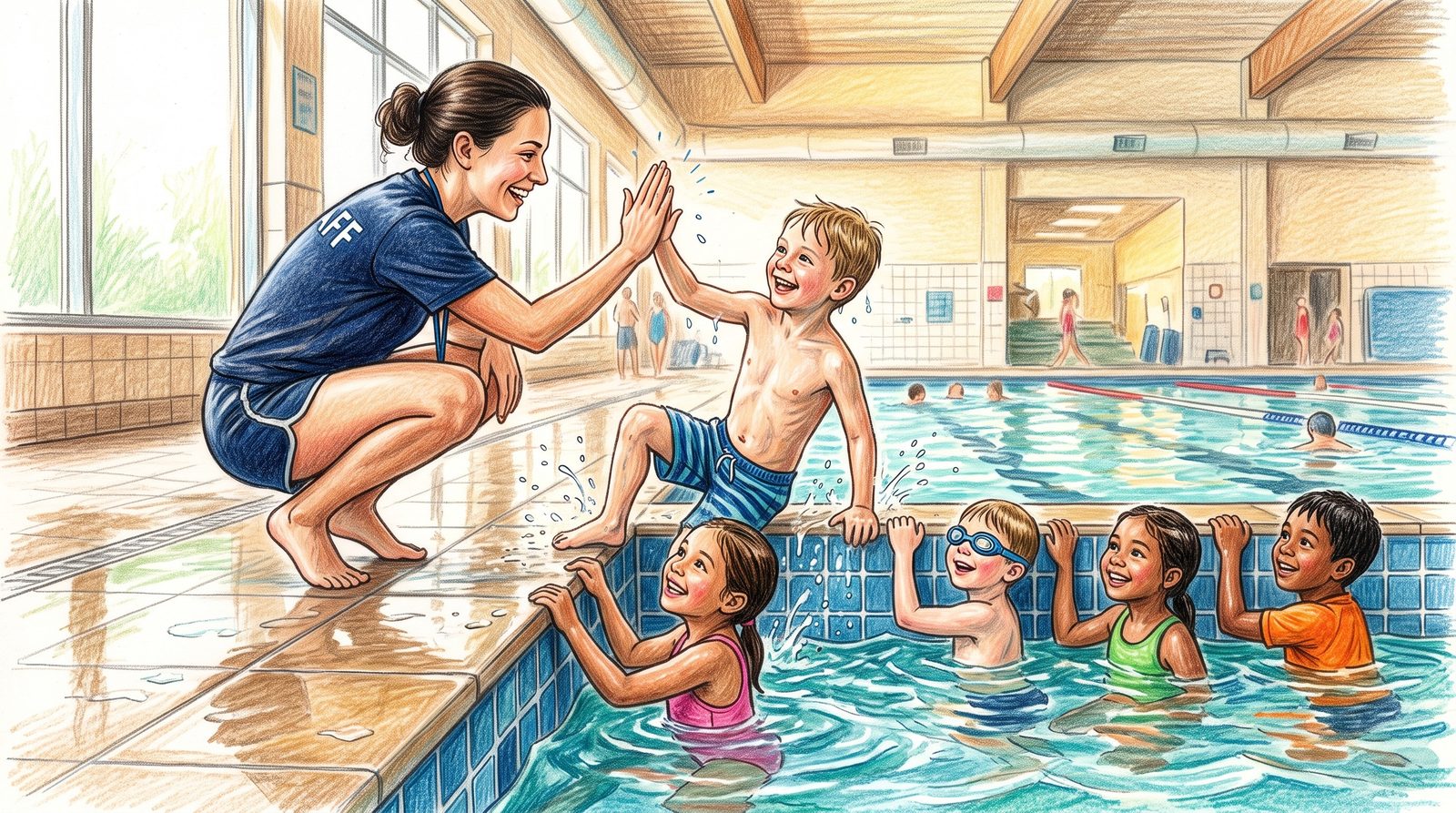
Confusion almost always arises because two situations are mixed together: teaching from the poolside and teaching in the water. From the side you are mainly a supervisor and you can have more children in the group. In the water you are focused on one child and you lose overview of the rest.
The guidelines are explicit about that. Safe Supervision names 12 beginners per instructor, but only if that instructor holds a rescue qualification and watches the lesson from the poolside. The Swimming Teachers' Association gives 6 children as a hard maximum once you are in the water yourself. Both numbers are correct, each for a different situation.
Swimmigo · For swim schools
Run your swim school fully digital
Students, schedules, absences and parent communication in one app, with your own rates and branding.


Why this is more than a number on paper
What the figures say about drowning
The World Health Organization records about 300,000 drowning deaths annually. Children under five account for almost a quarter of those. Drowning is the fourth leading cause of death for children aged 1 to 4 years, and the third for children aged 5 to 14 years. The global mortality rate has fallen by 38 percent since 2000, from 6.1 to 3.8 per 100,000 people.
For this topic it is more interesting what the WHO writes about prevention. Swimming lessons for school-age children are listed as an evidence-based measure, with a condition that is quoted literally: the lessons must be set up safely, with a tested method, a safe practice location, participant screening and a ratio between pupils and instructors that is based on safety. That ratio is therefore on the same level as the content of the lesson.
Why beginners are the most vulnerable
A child who is just learning to float has no reserve. They cannot roll over, cannot call for help, and often cannot even get upright in the water. For that group every second you do not watch matters. Once a child can independently swim 10 metres, they can briefly save themselves and cling to the side. That is why the guidelines differ by skill level and not by age alone. What group size then does to a child's progress is discussed in the impact of group size on swim lesson progress.
Guidelines side by side
The numbers below come from two sources that complement each other. Safe Supervision (2024) was produced jointly by Swim England, Scottish Swimming, Swim Wales, Swim Ireland, RLSS UK, CIMSPA, RoSPA and STA. Water Safety USA is the American counterpart and is stricter for very young beginners.
| Situation | Children per instructor | Source of the number |
|---|---|---|
| Parent and child together in the water, one parent per child | 12 pairs | Safe Supervision, 2024 |
| Toddlers aged 3 to 4 years | 6 | Safe Supervision, 2024 |
| Beginners from 4 years who cannot swim 10 metres independently, with a rescue-qualified instructor on the poolside | 12 | Safe Supervision, 2024 |
| Children who can swim 10 metres independently | 20 | Safe Supervision, 2024 |
| Children with a disability or long-term condition | case by case, never above the group guideline | Safe Supervision, 2024 |
| Young beginners without a parent in the water | 4, and never more than 6 | Water Safety USA |
| Teaching from within the water | maximum 6 | STA |
Why the numbers vary so much
The difference between 6 and 12 is not a matter of opinion. The 12 applies to an instructor with a rescue qualification who supervises from the poolside over a lane that is only theirs. The 6 applies to an instructor who is in the water. And the 4 from Water Safety USA concerns the very youngest, without a parent in the water, who are just getting familiar with the water.
Put those three together and the logic becomes clear: the more of your attention goes to teaching, the fewer children you can supervise at once.
What guideline means here
None of these sources is a law that applies in every country. In most countries the duty is more general: you must be able to demonstrate safe working, and the details depend on your pool operator, your insurer and your governing body. Check with your own association, your pool manager and your insurer what applies to you. The numbers above are the starting point for your own assessment.
STA adds a practical point: those who teach above their maximum fall outside the insurance cover linked to the qualification. That makes the ratio also a business question.
What raises your ratio
Safe Supervision names four factors that increase the number of children per instructor. They have the same effect, namely an extra pair of eyes or a calmer situation.
A separate lifeguard who watches only your lesson area
A lifeguard whose sole task is to watch your lesson area changes your position. You teach, they watch. That is the situation in which 12 beginners is realistic.
An extra helper in the water
An assistant or trainee in the water helps with guidance. For safety that person does not count, and I will return to that further on.
Shallow water where you can reach everywhere
In water where children can stand and you can reach every exercise within a few steps, the margin is greater than in a pool that becomes deep after three metres.
An own carer per child
In a parent-and-child lesson each child has an adult in the water. That adult holds the child, the instructor runs the lesson. That is why twelve pairs can be in one lesson in that format.
What lowers your ratio
The same guideline lists the factors that reduce your number. For a small swim school these will be the most familiar points, because they are exactly the things you do not control when you rent pool time.
A lesson area without a clear boundary
If it is not clear where your lesson ends, it is not clear what you are responsible for. A lane rope or an agreed corner of the pool does more than most people expect.
A pool shared with another activity
Lane swimmers, another club or a toddler hour next to your lesson: you must keep them in mind as well, and that comes at the expense of your own group.
Cloudy water, a sloping floor or slippery tiles
Water in which you can no longer see a child clearly at one and a half metres depth is a reason to reduce your group size. The same applies to a sloping floor and to tiles that have become slippery, because that is exactly where a child slips when entering.
Working alone without a second qualified person
This is the core issue for many self-employed instructors. If you are the only person at the pool who can perform a rescue, there is no one watching at the moment you are busy with one child. Safe Supervision calls that lone working and lists it among the factors that reduce your ratio.
How to calculate your own limit
With the factors above you can determine a number for each pool. Two habits prevent you from fooling yourself.
Calculate with your weakest child, not with the average
A group of eight in which six children swim independently and two do not, is for safety a group with two beginners. Your supervision depends on the children with the least reserve, not on the easiest ones.
Calculate using the worst circumstance of the day
Is your colleague not present, is the water warmer than usual or is there a party of lane swimmers next to you? Then that situation applies, not the nice Tuesday morning with an empty pool. Write down the lower limit and stick to it on days when it is busy and you would like to add one more child.
Supervision from the poolside or from within the water
What you gain by staying on the poolside
From the poolside you see the whole group in one glance, and you see what happens before a child realises it themselves. Safe Supervision states plainly: teaching from the poolside is the best position to oversee the group and to give feedback. That is safer and it is also better teaching, because you can see in six children at once whether the hips are sinking or the arms are going too far out.
What you lose when you enter the water
In the water you can hold a child, correct and reassure. That is the advantage. The cost is that you can have your back to the group, your ears are underwater and you can be three metres from a child at the moment something goes wrong. There is another reason to stay on the poolside more often, because explanations and corrections are less necessary than many instructors think, as described in less correcting, safer swimmers. Techniques to keep a whole group engaged at once are in how to keep the whole group involved and safe.
Lines of sight, zones and the 20 second rule
Divide your pool into zones
RLSS UK advises dividing a pool into zones when there are multiple supervisors, with one fixed person per zone. For a small school with one instructor that still translates: choose your lesson area deliberately, note where the windows and the poolside are, and make sure from your fixed spot you can see the corners.
The 20 second rule in practice
The British guideline uses a handy second number: a supervisor must be able to reach the furthest corner of their zone within 20 seconds. Check that yourself in your pool. If it takes longer, your zone is too large or your group is spread too far.
Count your group at every transition
Counting sounds trivial until you forget once. Count when entering the water, after every exercise where children go under, and when exiting. With an app in which you swipe through the group and see who is not yet ticked off, counting takes almost no time.
Helpers, trainees and parents do not count
Many swim schools make this mistake. A trainee, a helping parent or an assistant without a rescue qualification is valuable, but does not count as supervision. Safe Supervision is strict on this: someone without a rescue qualification cannot judge whether a child is in trouble and therefore may not be included as a control measure in your risk assessment.
What you can ask of a trainee
Guide, hand over equipment, help a child at the poolside and keep the group together. That is real help and it improves your lesson. Your ratio number does not change because of it.
Free play is no longer a lesson
Another detail you rarely hear: once you schedule a block of free play within the lesson, the situation changes. The guideline calls free play an unstructured activity, and an instructor with a rescue qualification for lessons is not the right person for that. If you do want free play, a separate assessment is needed or a real lifeguard.
How to record your ratio at your swim school
One ratio per pool, not one for the whole school
The same school can have two different limits in two pools. A shallow pool with lots of daylight and a dedicated lesson area tolerates more children than a deep pool you share with lane swimmers. Write it down per pool, with the reason. That is one A4 page and it is the document you refer to when a parent asks why group A is larger than group B.
Include it in your emergency plan and practise it
Your ratio is an agreement, not an intention. Put it in your operating procedures alongside the role division in an incident, as described in the emergency plan for your swim school, and practise quarterly what you do if you are understaffed. An instructor who suddenly finds themself alone because a colleague is ill must know within two minutes what to do: reduce the group, arrange a second qualified person or cancel the lesson.
Make it visible to your team and to parents
Your team must know the same limit, otherwise the agreement stays on paper. In Swimmigo you can see per group who is enrolled, the level of each child and who is teaching, so you immediately see if a group exceeds your own limit. The owner, manager and instructor roles clarify who may adjust the limit and who implements it. On the page for swim schools you can see how that works, from demo to Solo or School subscription, and what the pupil tracking system does in that. If you want to get more pupils out of the same pool hours, the overview on getting more pupils from the same pool hours helps you see where there is room without exceeding your limit.
What parents can ask at registration
This article looks at the swim school's side, but parents ask the same question in plain language: how many children are in my child's lesson? Water Safety USA says a program should be able to answer that question, including the reason behind the ratio. Five questions to ask:
- How many children are in the group, and does that change by level?
- Is the instructor in the water or on the poolside?
- Is someone else supervising during the lesson?
- May I come and watch, and where should I stand?
- What happens if the group becomes larger than the agreement?
A school that answers these questions easily has usually thought it through. If the answer stays vague, that is information in itself. Parents who want to follow progress without sitting at the poolside every lesson have enough from the parent app with level, skills and notifications per step. See what parents can view.
Conclusion
The number of children per instructor is not set in any law. It is the result of your own assessment: where you stand, who is watching and how well you can see each child. Six children in the water, twelve beginners from the poolside with a rescue qualification and four for the youngest beginners are the numbers international guidelines arrive at. Write down what applies to your pool, practise with your team what you do if you fall below that, and make it visible. Those who have this in order can grow without compromising safety.
Swimmigo · For swim schools
Run your swim school fully digital
Students, schedules, absences and parent communication in one app, with your own rates and branding.
Sources
- WHO: Drowning, fact sheet, updated 1 May 2026
- Swim England, Scottish Swimming, Swim Wales, Swim Ireland, RLSS UK, CIMSPA, RoSPA and STA: Safe Supervision of Programmed Swimming Lessons and Training Sessions in Swimming Pools, 2024
- HSE: Managing health and safety in swimming pools (HSG179)
- STA: Information on teaching in the water
- Water Safety USA: What to look for in a learn to swim program
- RLSS UK: Determining lifeguard supervision arrangements (GS020)
- WHO: Preventing drowning, practical guidance for basic swimming and water safety skills, 2022

Bob van Soest
As an expert in operating sports facilities (such as swimming pools) and developer of, among others, Swimmigo.com, I am passionately committed to making swimming lessons simpler, more fun and more insightful for parents, swimming instructors and everyone who wants to learn to swim.
Frequently Asked Questions
Related articles
Effectively managing swim lesson groups and progress
Practical tips for organizing and tracking swim lesson groups and student progress. A tracking system provides better group allocation and clarity.
Swimming School or Swimming Instructor: Manage It All in the Swimmigo App
Progress, lesson planning, lesson payments, marketing, diplomas, and parent communication: manage all this with the Swimmigo app for swimming schools and instructors.
Starting Your Own Swim School: How to Do It Without Expensive Systems
Want to start your own swim school? Here’s how to approach it: the real costs, the steps from day one, and how to start professionally without costly systems.
Discover Swimmigo
The all-in-one app for swimming lesson progress. For parents, swim schools, and adult swimmers.