EmergencyPlanforYourSwimSchool:WhoDoesWhatWhenSomethingHappens?[2026]
![Emergency Plan for Your Swim School: Who Does What When Something Happens? [2026]](/_next/image?url=https%3A%2F%2Fzvblogpostimages.s3.eu-west-3.amazonaws.com%2FAUTOMATISCH_UPLOAD%2F1_e517856278ad.jpg&w=3840&q=75&dpl=dpl_EbfgvsmDLnqEGtT47YJuvCzbaNy2)
Summary
- An emergency plan is one A4 per pool situation with names, not a folder nobody reads
- Since the Environmental Act, the government requires a risk analysis, a management plan, and a logbook in which you note accidents
- The international rescue chain has five steps: prevent, recognize, provide flotation device, get out of the water, and provide care
- The Red Cross gives first five rescue breaths, then thirty chest compressions alternated with two rescue breaths in drowning
- If you rent pool hours, specify in the agreement who supervises during your hour
Almost every swim school has a folder in the cabinet with an emergency plan. Most instructors have never fully read it, and that is exactly the problem. At the moment a child disappears underwater, there is no time to search for a folder. What counts is whether your team knows who pulls the child out of the water and who calls 112.
The question is how to make such a plan that works in practice, even if you teach with two instructors in a rented pool. What the government requires from you, how the international rescue chain is structured, who gets which role, and how to keep the plan alive when your team changes.
What is legally expected of you
Since the Environmental Act came into effect on January 1, 2024, the rules for swimming pools and bathing water basins are in chapter 15 of the Decree on Environmental Activities. These rules replaced the old Bathing Facilities Act. Ondernemersplein summarizes what is required of a swimming pool: a risk analysis for visitors who swim or bathe, a management plan with the measures you take, and a logbook in which you record how you implement that. The safety rules include the presence of first aid, water depth, materials used, and supervision of visitors.
The logbook is not a formality
In that logbook, you also note accidents, with the measures you take to prevent recurrence. You keep it for at least two years. For a small swim school, this paperwork yields the most benefit because it is exactly what you can show if a parent asks weeks later about something that happened during the lesson.
Who is responsible for what when you rent pool hours
The obligations from chapter 15 of the Decree on Environmental Activities lie with the party providing the opportunity to swim, usually the pool or operator. If you rent an hour in that pool as a swim school, your own lesson, supervision during that hour, and agreements with parents remain your responsibility. Therefore, specify in the rental or usage agreement who fulfills the supervisory role during your hour, who grabs the rescue equipment, and who calls 112. A quarter of an hour during which two parties think the other is watching is the most dangerous gap you can have.
The quality mark as a ready-made checklist
Stichting Zwembadkeur awards the Safe & Clean Quality Mark to pools that meet the legal requirements and, on top of that, industry requirements for hygiene, water quality, and safety. If your pool has it, you have a useful checklist in hand. If you teach yourself, you can go through the same points for your own hour.

The five steps of the rescue chain
Rescue organizations worldwide work with the same model: the drowning chain of survival from the International Life Saving Federation. Five links: prevent, recognize emergency, provide a flotation device, get out of the water, and provide care. Different rules and diplomas apply in the Netherlands, Germany, or Spain, but this chain is the same everywhere. Each of these five steps should have a name in your plan.
1. Prevent
Prevention starts with things that sound boring but yield a lot: a group size that fits the pool, children without a diploma in the shallow area, agreements about walking along the wet tile edge, and a fixed place where bags and belongings are stored so no one trips. Count your group at the beginning and end of the lesson. A child left behind in the changing room is not a swimming incident, but it costs you fifteen minutes of panic.
2. Recognize emergency
Drowning looks different on television than in reality. There is usually no splashing and no shouting. A child in trouble sinks upright with the head just above water and has no breath left to call out. It makes hardly any noise and does not wave. Therefore, instructors must look at behavior, not noise: a child silently staring at the edge, no longer moving with the group, or shivering with blue lips asks for a check. We previously wrote about silent drowning and what is true about it.
3. Provide a flotation device
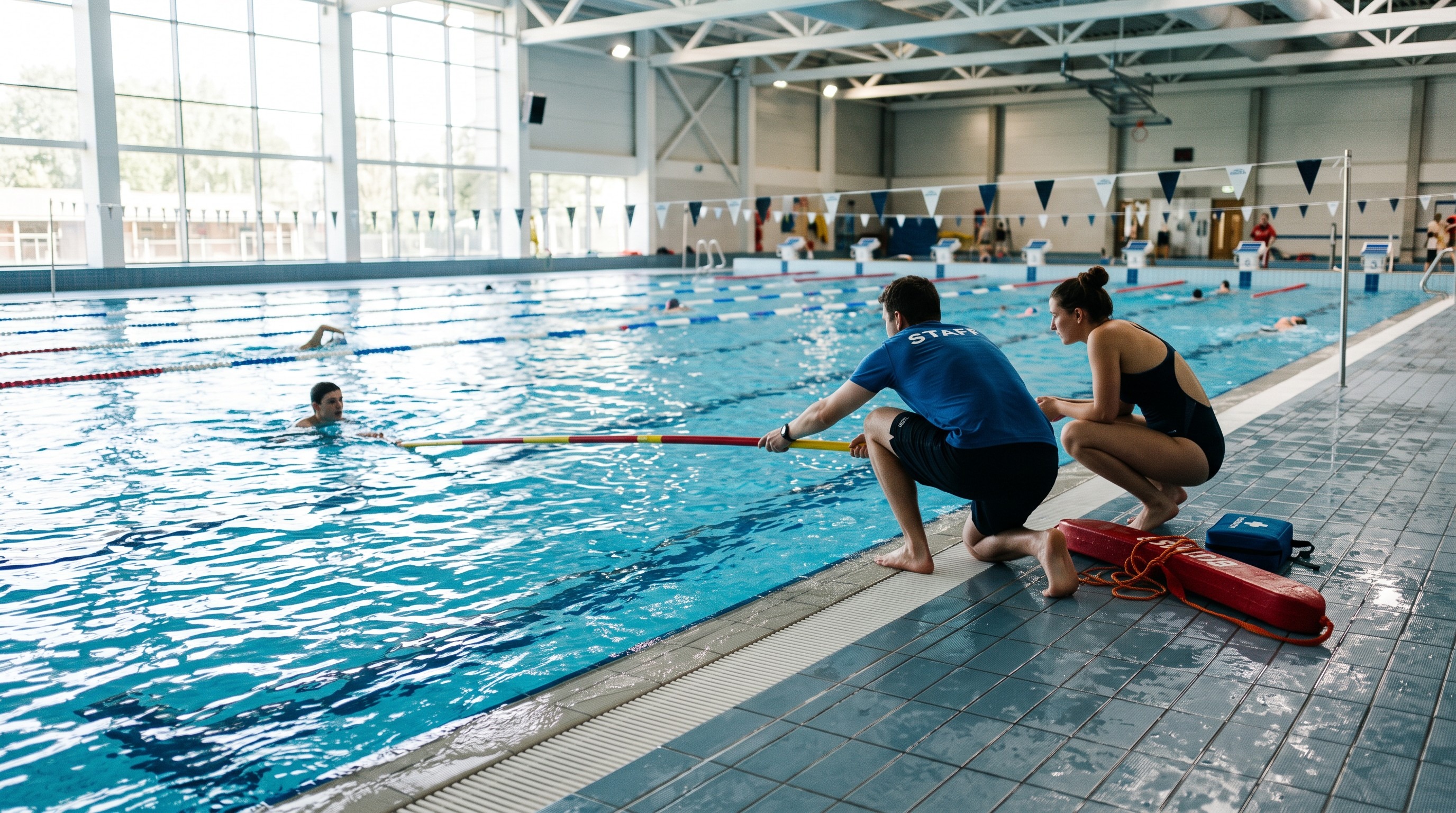
A child that stays above water keeps breathing. Therefore, never skip this step, even if the child is close by. A lifebuoy, a floating stick, or a long rescue hook does the work your arms should do. Place them within two steps of your fixed teaching spot and teach every instructor how to throw and hand them over. Check at the start of the lesson if they are still hanging and intact.
4. Get out of the water
Only enter the water yourself if it really cannot be helped and if you are trained for it, because a panicking child grabs anything nearby and can pull an adult down. With two adults, lifting is easier and someone can stay with the group. Agree in advance where the rest of the group goes if something happens, so you are not standing with a row of watching children at the edge while providing help.
5. Provide care
The Red Cross is clear about the order in drowning: first give five rescue breaths, then continue with thirty chest compressions alternated with two rescue breaths, while someone else calls 112 and fetches the AED. The greatest chance of survival after cardiac arrest lies in the first minutes. The survival rate after resuscitation attempts in the Netherlands is around twenty percent, according to the guidelines of the Dutch Resuscitation Council. Of those who survive cardiac arrest, eighty to ninety percent return home within a year. Consult with the emergency dispatch center whether a child who has been underwater should be seen, even if they appear lively shortly after.
What is in your emergency plan
An emergency plan for a small swim school is not a twenty-page book. One A4 per pool situation is enough, provided the role distribution is included. Put names in it, not job titles.
| Role | Who does it | What that person does |
|---|---|---|
| First rescuer | the instructor who sees the child | grabs the flotation device, pulls the child out of the water, and immediately starts first aid |
| Group care | the instructor or lifeguard closest to the edge | removes the rest of the group from the victim and keeps them together in a fixed place |
| Alerting | whoever is first free | calls 112, states the address, entrance, and AED location, and sends someone to the door to receive help |
| Contacting parents | the manager or a colleague at the side | looks up the parents' phone number and calls immediately, without informing others first |
| Recording | the same person, immediately after | notes date, time, who was present, and what actions were taken in the logbook |
One card per pool situation
Teaching six preschoolers in the shallow pool requires a different role distribution than lane swimming in a large pool. Make a short card per situation showing the group, the pool, the number of adults, and who the first rescuer is. Hang that card at the pool entrance, not in an office. For a lesson with one instructor and no lifeguard present, it is wise to think in advance who among the present parents can serve as a second pair of hands, although that does not replace your own supervision.
Where things hang
Take a round with your team through the pool and mark on the card where the lifebuoy, rescue hook, AED, and a phone hang. Repeat the same round at every first lesson after a move or renovation, because these kinds of places change without notice. Also note when a device is missing or broken, so it is no longer a surprise when you need it.
What parents know beforehand
Ask for a number that is always reachable during registration, and repeat that question once a year. Tell parents at the start what happens if something goes wrong: that you or a colleague intervene, that someone calls 112, and that the school contacts the parents first. That is information that costs trust if you only give it afterward. That every child is different in the water is shown by the figures: fourteen percent of children between six and twelve years have no swimming diploma, according to the Mulier Institute. Worldwide, there are about three hundred thousand drowning deaths per year, and for children aged one to four years, drowning is the fourth leading cause of death, reports the World Health Organization. In the Netherlands, one hundred residents drowned in 2025, and children born outside Europe have a much higher risk, according to CBS figures. That is why the first two links of the chain weigh so heavily.
Practice: how to keep the plan alive
A plan you write once and never touch again is a plan your team does not know. Practicing does not have to take a study day.
Four scenarios you can practice
- A child sinks upright at the shallow end while the instructor participates with the group.
- A child panics in the deep end and grabs a classmate.
- A child slips on the wet tile edge and remains lying down.
- An instructor is injured and can no longer enter the water themselves.
Choose one scenario at a time, so you do not have to discuss everything at once. Do it without children present, so you do not have to reassure anyone and can calmly discuss what went wrong.
Fifteen minutes per quarter
Fifteen minutes of practice with the whole team, four times a year, is feasible for most small swim schools and keeps agreements sharp. Have someone keep track of time, because the time between the moment something goes wrong and the moment help arrives is the measure by which your plan is judged. Bathing facilities have to deal annually with evacuation drills and related plans, and the same lesson applies: you only see what goes wrong when you actually do it once.
What you adjust after each practice
Briefly note what stood out. Was the second rescuer in the wrong place, did someone not find the AED, did alerting take too long? These are the points that improve your plan, and they belong in the same folder as the role distribution. Do not mention a practice that went wrong to parents at the next lesson, but solve it internally.
After an incident: recording and communicating
Even if it ends well, work remains. Not because something went wrong, but because you want to be able to show what you did and because parents and the team benefit from it.
What you put in the logbook
Note date and time, which lesson and which pool, who was present, what happened, and what you did. Write facts, not conclusions about fault. Also include which measure you take, because that part makes your logbook useful if you want to look something up later. Keep it for at least two years.
Informing parents
Call the parents of the child yourself as soon as you can hand over first aid to someone else. Tell what happened and what you did. Do not share information about other children, even if parents ask later; this is the same principle as with student data and consent under the GDPR. Also record who you informed and at what time.
Debriefing with the team
Talk with each other within a few days, not immediately after the event when adrenaline is still high. Ask what went well before looking at points for improvement, and only then adjust your role distribution if necessary. For an instructor who saw a child disappear underwater, such an event is intense, even if it ends well. Allow space for that conversation, just as you would for the workload of the profession.
For parents: what to look for in a swim school
If you are looking for a swim school, the answers to a few questions say more than the number of stars on the website. Ask if there is a plan with a role distribution, if the instructors are trained in first aid, if someone is always supervising at the side, and how the school reaches you if something happens. A school that answers these questions without hesitation knows how it works. If you get no answer to these questions, that is a reason to look further. Also confirm that your phone number is correct, because a number that no longer works costs time that is not available.
What the app does and does not do
Swimmigo is not there to replace an emergency plan. First aid training, supervision, and a practiced team remain human work. What the app does do is make the information ready at the moment you need it. You can see per lesson who is absent, you can reach the parents of an entire group at once via a message with read confirmation, and the activity logbook shows who changed what. Notifications and messages are available in five languages, so families who speak a different language at home receive the same information as the rest. More about this is on the page for instructors, and parents can see on the parent side how progress per exercise is tracked.
Conclusion
An emergency plan only lives if your team knows it and practices it occasionally. Put on one A4 who pulls the child out of the water, who calls 112, who cares for the group, and who informs the parents, and hang that at the pool instead of in a cabinet. Repeat it for fifteen minutes every quarter with your whole team and record after each incident what happened and what you adjust. Once the plan is correct, you can calmly show it to parents as well.
Sources
- Ondernemersplein (Dutch Government): rules for hygiene and safety of swimming locations, 2026
- Information Point Living Environment: providing opportunity for swimming and bathing, chapter 15 Decree on Environmental Activities, 2026
- Red Cross: what to do if someone is drowning, 2026
- Dutch Resuscitation Council: survival chance after resuscitation and quality of life, 2025
- Heart Foundation: the 6-minute zone and why quick help matters, 2026
- International Life Saving Federation: creating a drowning chain of survival, 2014
- World Health Organization: drowning, fact sheet, September 2026
- CBS: higher risk of drowning among children not born in the Netherlands, July 2026
- Dutch Rescue Brigade: higher drowning risk in specific groups, 2026
- Stichting Zwembadkeur: applying for Safe & Clean Quality Mark, 2026
- NIBHV: drafting and practicing evacuation plans, 2026
Bob van Soest
As an expert in operating sports facilities (such as swimming pools) and developer of, among others, Swimmigo.com, I am passionately committed to making swimming lessons simpler, more fun and more insightful for parents, swimming instructors and everyone who wants to learn to swim.
Frequently Asked Questions
Related articles

Effectively Managing Swimming Lesson Groups and Progress
Practical tips for organizing and monitoring swimming lesson groups and student progress. A tracking system ensures better group division and clarity.
![Starting Your Own Swim School: How to Do It Without Expensive Systems [2026]](/_next/image?url=https%3A%2F%2Fzvblogpostimages.s3.eu-west-3.amazonaws.com%2FAUTOMATISCH_UPLOAD%2F1_88df978a4a0c.jpg&w=3840&q=75&dpl=dpl_EbfgvsmDLnqEGtT47YJuvCzbaNy2)
Starting Your Own Swim School: How to Do It Without Expensive Systems [2026]
Want to start your own swim school? Here’s how: the real costs, the steps from day one, and how to start professionally without costly systems.
![Finding and Retaining Swimming Instructors for Your Small Swim School [2026]](/_next/image?url=https%3A%2F%2Fzvblogpostimages.s3.eu-west-3.amazonaws.com%2FAUTOMATISCH_UPLOAD%2F1_204133ecca52.jpg&w=3840&q=75&dpl=dpl_EbfgvsmDLnqEGtT47YJuvCzbaNy2)
Finding and Retaining Swimming Instructors for Your Small Swim School [2026]
Pools and swim schools face a structural shortage of swimming instructors. Here’s how to find new instructors for your small swim school and keep them on board.
Discover Swimmigo
The all-in-one app for swimming lesson progress. For parents, swim schools, and adult swimmers.