Children'sPartyattheSwimmingPool:HowtoSetItUpasaSwimSchool[2026]
![Children's Party at the Swimming Pool: How to Set It Up as a Swim School [2026]](/_next/image?url=https%3A%2F%2Fzvblogpostimages.s3.eu-west-3.amazonaws.com%2FAUTOMATISCH_UPLOAD%2F1_466a92014cd9.jpg&w=3840&q=75&dpl=dpl_FEcJLWFaZFj4CsT2F159aPzMcoRK)
Summary
- Parties fill pool hours you already rent, without extra instructor
- Charge per child or per entire block and use the median as a benchmark
- Supervision is your biggest risk: record supervisor numbers clearly
- An online calendar with free blocks prevents double bookings
- A party is also a gentle introduction to your swim school
A birthday party at the swimming pool is popular and hard to find. Pools are full, parents look for an outing where the whole group has fun at the same time, and rain does not spoil the fun. As a small swim school, you have exactly what is needed for this: a pool, an hour, and people who know how to keep a group of children engaged in the water.
Yet many swim schools leave this opportunity unused. Saturday afternoons are rented but remain empty, while there is plenty of demand outside your lessons. In this overview, you will read how to turn children's parties into an additional offering: which formats work, what you can charge, how to keep it safe, and how to organize it without your administration getting out of control.
Why children's parties fit your swim school
You already rent those hours anyway
Most small swim schools rent pool hours in blocks. Those hours are your biggest fixed cost and at the same time your biggest scarcity. On Saturdays and Sundays, gaps often remain: half an hour between two groups, a block that does not fill up, an afternoon when the recreational pool is empty. A children's party fills exactly that type of gap, and no extra instructor is needed that you do not have.
The difference with an extra lesson group is that you do not need new student intake to start. Parents bring the group themselves, usually ten to twenty children at once.
What parents are looking for
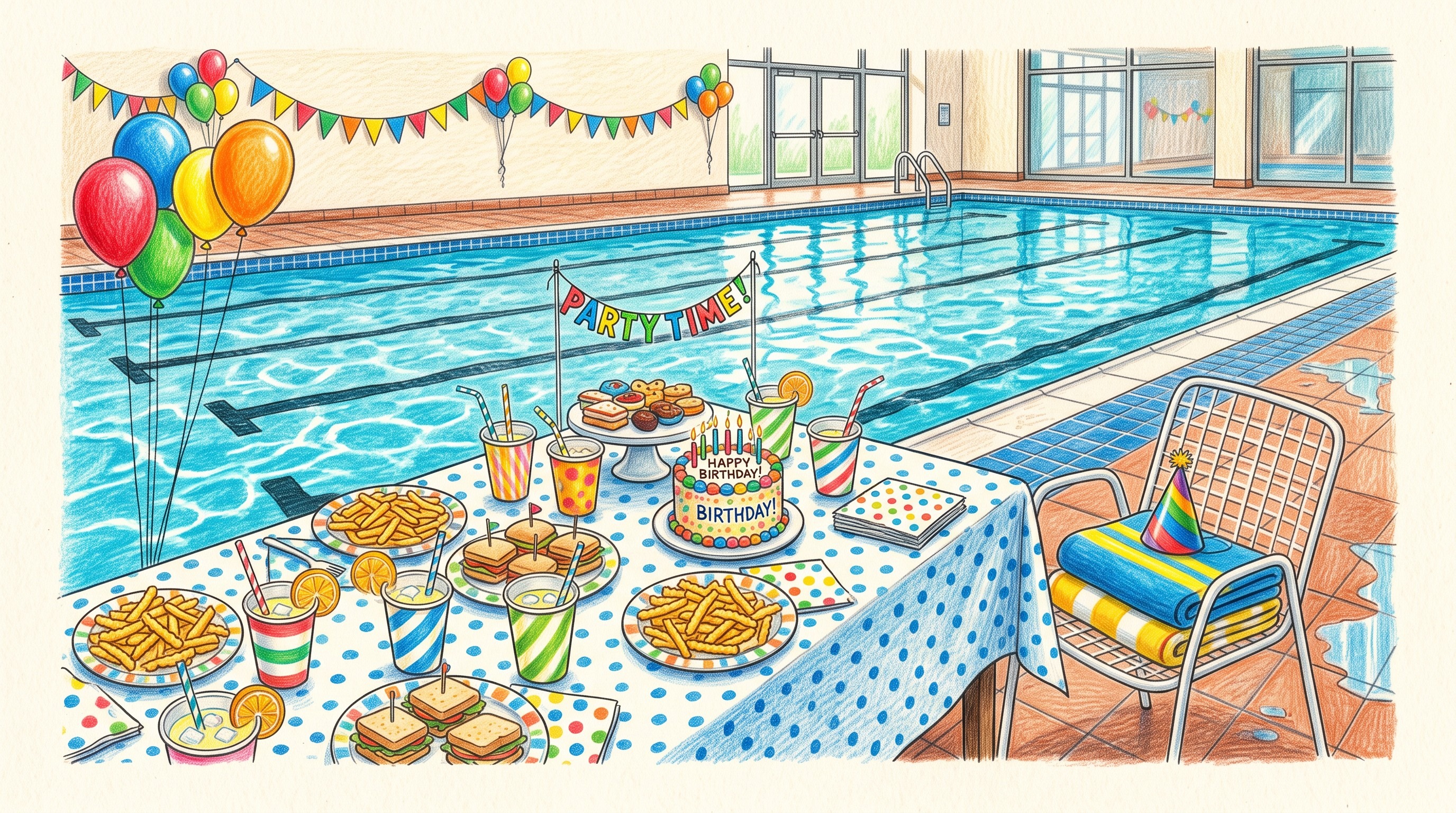
A swimming party solves three things for parents at once: it is indoors, so it goes ahead in bad weather, no candy wrappers are left in the living room, and the children are active for two hours instead of being on a screen. That is why pools with a party offer are almost always fully booked on Saturday afternoons.
In many countries, a party at the swimming pool is as common as a bowling alley or playground. Because there is water everywhere children go, the demand for a supervised party remains greater than the supply.
What a party earns you
A fully booked party requires no extra lesson preparation and no extra instructor. You use materials that are already there: mats, rings, a slide, possibly an inflatable course. Costs remain limited to food, drinks, and a gift for the birthday child. In the table further on, you can see what pools in the Netherlands charge, so you can base your own rate on that.

From one hour to a package that parents understand
Choose a format that fits your pool
There are more variants than the standard swimming party. A disco swimming party with music and lights works well for upper primary school children. Survival and obstacle parties with inflatable equipment attract children who like climbing and roughhousing. Mermaid swimming or shark swimming is popular with children from the B diploma onwards, because they practice with a tail or fin. A party with only free play and a table full of food is the simplest and most requested variant.
Check what materials you already have before choosing a format that you first need to purchase. An offer that you cannot execute as soon as two bookings fall in the same weekend is more annoying than a somewhat smaller offer.
Determine the duration and timing
Most pools work with one and a half to three hours: one or two hours in the water, then eating. Saturday afternoon and Sunday are the most popular blocks, and there is hardly any demand for weekday afternoons. Set your time slots so that your own lessons do not fall within them, and leave space between two parties for changing and tidying up.
Food, drinks, and the treat
Food is half the work and half the experience. Fries with a snack and unlimited lemonade is the most chosen menu, with a water ice pop as a finisher. If you want to offer parents a healthier option, fruit, popcorn, and a bottle of water work well, although children rarely choose that variant themselves. Ensure a fixed allergy procedure: ask at booking what cannot be eaten and record that in a place where the kitchen or catering staff can see it.
What you can charge for a children's party
Rates vary considerably depending on what is included and whether a pool is reserved especially for your group. The amounts below come from the public rates of Dutch pools in 2026 and are per child unless otherwise stated.
| Provider | What you get | Rate |
|---|---|---|
| The Utrecht pools | swimming with snack or healthy choice | €13.50 to €15.50 per child |
| Sportbedrijf Rotterdam | swimming party within the program | €17.45 per child |
| Zwembad Meekenesch, Lichtenvoorde | two-hour survival party, from ten children | €18.00 per child |
| Zwembad De Stok, Roosendaal | complete package, birthday child swims free | €18.80 per child |
| Sportbedrijf Rotterdam | disco party | €18.95 per child |
| Sportbedrijf Rotterdam | swimming party outside the program | €20.45 per child |
| Median of rates per child | half of providers are below, half above | €18.00 per child |
| Zwembad Meekenesch, Lichtenvoorde | accompanying parent, including food | €10.50 per person |
| Sportbedrijf Rotterdam | parent package with coffee, tea, and a sandwich | €8.95 per person |
| The Utrecht pools | half pool rental per hour, swimming only | €72.55 per hour |
Per child or per entire block
Both pricing models have an advantage. Per child is easy to explain and scales with group size. A fixed amount for the entire block gives parents certainty and protects you when fewer children come than expected. If you work with small groups, include a minimum number of children in your terms so the block pays for itself.
What to charge for supervisors
Almost every pool requires a paying supervisor per party, and some also charge for that adult's package. Make that amount visible in your offer, because a surprise at the cash desk causes trouble at reception. Children without a diploma often pay the same rate as the rest, even if they swim with flotation aids.
Why the median and not the average
Use the median rather than the average when determining your own rate. One high outlier, for example a pool rented at a high price, pulls the average up and gives a picture that does not match what parents encounter in practice. The median shows the rate where half of the providers are below and half above.
Safety and supervision: where it usually goes wrong
A party is not a lesson. Children swim around who do not know each other, the group is larger than you are used to, and food and music divide attention. That is exactly why supervision is the part you tighten up beforehand.
What the law requires
Pools fall under the Law on hygiene and safety of bathing establishments and swimming facilities. This law concerns water quality, safety, and supervision in the facility. If you rent a pool as a swim school, it matters who fills the supervisory role at that moment: the pool itself or you as the organizer of the activity. Record this per activity in the rental agreement so there is never a moment when two parties think the other is watching.
How many supervisors per child
Pools apply fixed ratios, and these are stricter than parents expect. At one provider, an adult aged 24 or older supervises a maximum of five children, of whom at most two without a swimming diploma. Another requires at least one supervisor in swimwear with sufficient swimming skills per two children without an A diploma. Adopt such a rule in your own terms and immediately state the number of supervisors parents must bring in your booking form.
Diploma, flotation aids, and the deep pool
Many pools only allow children without a diploma with flotation aids, under one-on-one supervision of an adult with a diploma. Others require at least the A diploma and a minimum age. Link such a requirement to what a child can really do, not just what is on the invitation. A child who cannot yet stay afloat by kicking should not be in the deep end without supervision.
What is happening in the Netherlands
In the Netherlands, one hundred residents drowned in 2025, and children born outside Europe have a much higher risk than children with a Dutch background, according to CBS figures. At the same time, fourteen percent of children between six and twelve years have no swimming diploma at all, according to the Mulier Institute. A party group is therefore not always a group of experienced swimmers.
Why this matters worldwide
Drowning is one of the leading causes of death among young children worldwide. According to the World Health Organization, about three hundred thousand deaths occur annually, and children under five years account for nearly a quarter of these. In the one to four years age group, drowning is even the fourth leading cause of death. These figures cover all water combined, from pools and ditches to lakes. Whether you organize a party in the Netherlands, Germany, or Spain, the same basic rules apply.
Space in your schedule
Which time slot fits your pool hours
Parties thrive on weekend afternoons. Saturday between twelve and four and Sunday morning are the blocks parents want to book; weekdays hardly fill. Look at the hours you currently rent and do not fully use, and arrange the party blocks around them. Two parties back-to-back on one afternoon work better than one party in the middle of your lesson day, because then you set up and clean up only once.
A calendar that updates itself
Once you work with fixed blocks, you do not want double bookings. A calendar where parents choose a free block themselves saves dozens of messages and prevents two parties on the same Saturday. Such a calendar can exist alongside your lesson schedule so that parents already attending your lessons see the same environment as new families.
Booking, paying, and confirming
Reserving without endless emailing
At many pools, reserving is a phone call or email to reception. That works until it gets busy and something goes wrong: a double booking, a forgotten allergy, a parent who thought the table was already reserved. A form with fixed fields (date, time slot, number of children, accompanying supervisors, food preferences) removes most manual work.
A deposit that protects you
Request a deposit at booking and the rest on arrival or shortly before. A party canceled last minute leaves you with purchased groceries and a blocked hour. Record in your terms what happens with cancellations within a week, and keep that rule short enough to explain on the phone.
Confirmation and changes
After booking, send a confirmation with all agreements in one place: time, number of children, accompanying supervisors, menu, and address. Parents forward that email to other parents, so include everything a supervisor needs to know. If you receive a change, only the number of children needs to change without redoing the entire conversation.
Photos and videos: arrange permission in advance
At a party, filming and photographing happen, by you and by parents. Make clear at booking what you do with images: whether you share photos, where, and how parents can object. Also record that parents only share photos of other children with permission. It is the same consideration as with lesson photos, and it is easier to arrange this at booking than to have to call about it afterward.
The party as a gentle introduction to your school
A party connects you with families you do not yet know. Not every child who comes to celebrate is already taking swimming lessons, and not every parent knows what else you offer besides lessons. Place something about your offer where parents wait, and ensure the supervisor running the party knows what your school offers further. For parents who are already customers, a party is an extra reason to see their child in the water. Notifications and messages are available in five languages so families who speak another language at home get the same information as the rest.
What parents should watch for
If you are looking for a place for a party yourself, a few things make a difference. Ask how many supervisors must come along and whether children with and without diplomas count separately. Check if food and drinks are included or if you bring something yourself. See if there is a maximum number of children and whether you have the pool and table exclusively or swim among other visitors. Finally, ask what time you may start setting up, because a party rarely starts exactly when swimming begins.
Conclusion
Children's parties are not a sideline of your swim school but a logical use of hours you already rent. You have the pool, the materials, and the people, and parents provide the group. Start with one format you can execute well, put safety requirements in black and white, and charge a rate you can explain. From there, the offer grows with demand.
If you want to know how other swim schools handle their offer and communication, visit the page for instructors or read how parents track their child's progress. An overview of everything in the app can be found on the features page, and subscriptions are on the pricing overview.
Sources
- Law on hygiene and safety of bathing establishments and swimming facilities, full text, 2026
- RIVM: Swimming pools, hygiene and safety, 2026
- Zwembadbranche: supervision during swimming, four basic rules, 2026
- Reddingsbrigade Nederland: safety in pools, 2026
- The Utrecht pools: children's party at the pool, rates and supervision, 2026
- Sportbedrijf Rotterdam: swimming party, rates and program, 2026
- Zwembad Meekenesch: survival children's party, rates, 2026
- Sportfondsen De Stok: swimming party, rates and supervision rules, 2026
- Zwembad De Witte Brug: children's parties, supervision requirements, 2026
- World Health Organization: Drowning, fact sheet, September 2026
- CBS: higher risk of drowning among children not born in the Netherlands, 2026
- Mulier Institute: swimming skills of children in the Netherlands, 2024
Bob van Soest
As an expert in operating sports facilities (such as swimming pools) and developer of, among others, Swimmigo.com, I am passionately committed to making swimming lessons simpler, more fun and more insightful for parents, swimming instructors and everyone who wants to learn to swim.
Frequently Asked Questions
Related articles
Effectively Managing Swimming Lesson Groups and Progress
Practical tips for organizing and monitoring swimming lesson groups and student progress. A tracking system ensures better group division and clarity.
![Starting Your Own Swim School: How to Do It Without Expensive Systems [2026]](/_next/image?url=https%3A%2F%2Fzvblogpostimages.s3.eu-west-3.amazonaws.com%2FAUTOMATISCH_UPLOAD%2F1_88df978a4a0c.jpg&w=3840&q=75&dpl=dpl_FEcJLWFaZFj4CsT2F159aPzMcoRK)
Starting Your Own Swim School: How to Do It Without Expensive Systems [2026]
Want to start your own swim school? Here’s how: the real costs, the steps from day one, and how to start professionally without costly systems.
![Finding and Retaining Swimming Instructors for Your Small Swim School [2026]](/_next/image?url=https%3A%2F%2Fzvblogpostimages.s3.eu-west-3.amazonaws.com%2FAUTOMATISCH_UPLOAD%2F1_204133ecca52.jpg&w=3840&q=75&dpl=dpl_FEcJLWFaZFj4CsT2F159aPzMcoRK)
Finding and Retaining Swimming Instructors for Your Small Swim School [2026]
Pools and swim schools face a structural shortage of swimming instructors. Here’s how to find new instructors for your small swim school and keep them on board.
Discover Swimmigo
The all-in-one app for swimming lesson progress. For parents, swim schools, and adult swimmers.