A new instructor for your swim school: finding, onboarding and retaining [2026]

Summary
- First calculate whether you can fill the hours of a second instructor with two full groups, otherwise recruiting costs more than it yields.
- Almost two thirds of lesson providers in the United Kingdom could not grow due to the instructor shortage, and vacancies remain open.
- A new instructor needs four weeks: shadowing, co-teaching, teaching with you at poolside, then independent.
- Handover fails when knowledge lives in one head. Record per child the level, focus points and agreements with parents before the change.
Why so many swim schools are suddenly looking for an instructor
Almost every swim school with a waiting list shows the same scene: the pool is there, the hours are booked, the children are on the list, and there is no one to teach them. The lessons themselves are rarely the problem. Finding someone who wants to do it, and who still enjoys standing in front of your group after three months, that is the hard part.
That is not bad luck for a single pool. In the United Kingdom in 2023 nearly 12,000 of 73,000 roles in the swimming sector were vacant, more than 15 percent of the workforce. Almost two thirds of lesson providers said they could not grow because of the instructor shortage. The demand for swimming lessons does not disappear, it shifts to the next month or to the swim school down the road.
The shortage is not gone in 2026. The Swimming Teachers' Association reported in May this year that demand for lessons remains high while capacity is under pressure, and that the cost of training is the real barrier for many candidates. For the employer that means something simple, you must focus not only on recruiting, but also on onboarding and on why people stay.
The shortage in numbers
The figures below come from the survey Swim England and the STA carried out together among lesson providers, and from the STA update in May 2026. They refer to the United Kingdom, but the pattern is the same in many swimming countries: too few trained instructors compared with steady demand.
| Figure | What it means in practice | Source |
|---|---|---|
| Nearly 12,000 of 73,000 roles vacant | More than 15 percent of the workforce is missing, from lifeguards to instructors | Swim England and STA, 2023 |
| 65 percent of lesson providers cannot grow | Waiting lists remain while pool hours are available | Swim England and STA, 2023 |
| 660,000 children may miss lessons | The demand does not disappear, it moves to later or to another school | Swim England, 2023 |
| Training costs as a barrier | There are people who want to teach but cannot front the cost of training | STA, May 2026 |
What a vacancy in your schedule costs
A group without an instructor is more expensive than it seems. Parents who notice weeks of cancellations look elsewhere and rarely return. Groups you are forced to merge become larger, and an instructor with fourteen children instead of eight earns less per child per lesson. You only notice that months later in progression, when a whole cohort takes longer at the same level.
The waiting list also moves. Someone who hears for six months that there is no space registers elsewhere, they do not forget you, but they do not call back either when you contact them.
The calculation you must make first
Before you post a vacancy, there is one question almost nobody asks out loud: can you actually fill the hours for a second instructor? Calculate with two groups that are full, not with one group and hope for growth. If you do not have that inflow, the honest conclusion is that you are not looking for an instructor but need to shift hours, for example by reorganizing existing groups or moving an evening to a time when more people can attend.
There is another variant that is often overlooked. A second instructor only pays off if the groups stay separated. Put someone next to you in the same group and you double the cost without reducing the waiting list.
Swimmigo · For swim schools
Run your swim school fully digital
Students, schedules, absences and parent communication in one app, with your own rates and branding.


Finding: where a new instructor comes from
Most vacancies for swim instructors are filled by people who already hang around your pool. That is no coincidence, someone who knows the location, knows the parents and likes being in the water has a much shorter lead-in period than someone from outside.
Start with the people you already know
Look first at the helpers who watch alongside you, the older pupils who have their own certificate and like to help, and the parents who are strong swimmers and have an affinity with children. Also a group often forgotten: instructors who left the profession during the covid years. The STA reported in 2021 that swim schools lost half of their instructors to other sectors. Some of them are open to returning for a few hours a week, especially if they do not have to combine it with an evening job that includes travel time.
Trainers and recruitment routes
In England the Institute of Swimming funds training paths for new instructors via recruitment academies, and the STA set up The Ripple Effect to remove the cost of training. More countries have similar routes, often linked to a recognized occupational standard. The lesson for you as an operator, call the trainer in your region and ask which candidates are doing placements or looking for a job. You are then not one vacancy among many on a website, but the school that stands alongside the training.
A job ad without empty words
The standard text with flexible, dynamic and team player yields little. What works is being precise, which evenings, which age group, how many children in the group, who supports the new instructor in the first month and what hourly rate is offered. Also state what you do not ask. If there is no admin to take home, no lessons at multiple locations and no requirement to find substitutes yourself, that is a reason for an instructor with another job to respond.
What you check before someone goes into the group
Ask for proof of the recognized swim qualification that applies in your country, for a valid first aid and supervision certificate, and for references from a previous employer in the water. Rules around screening people who work with children differ by country, so check that with the authority responsible rather than relying on what you once arranged yourself. Let a candidate shadow one lesson before you make a commitment. You see in twenty minutes whether someone puts a child at ease or only runs through the exercise.
Onboarding: four weeks that make the difference
A poor first month costs you an instructor and a lot of goodwill with parents. According to the CIPD, the British professional institute for HR, the first impression of a new employee largely determines how someone settles into the team, and a good introduction can influence turnover and sickness absence. For a swim school that does not mean you need an HR department. It means you plan four weeks consciously.
Week 1: shadowing and learning names
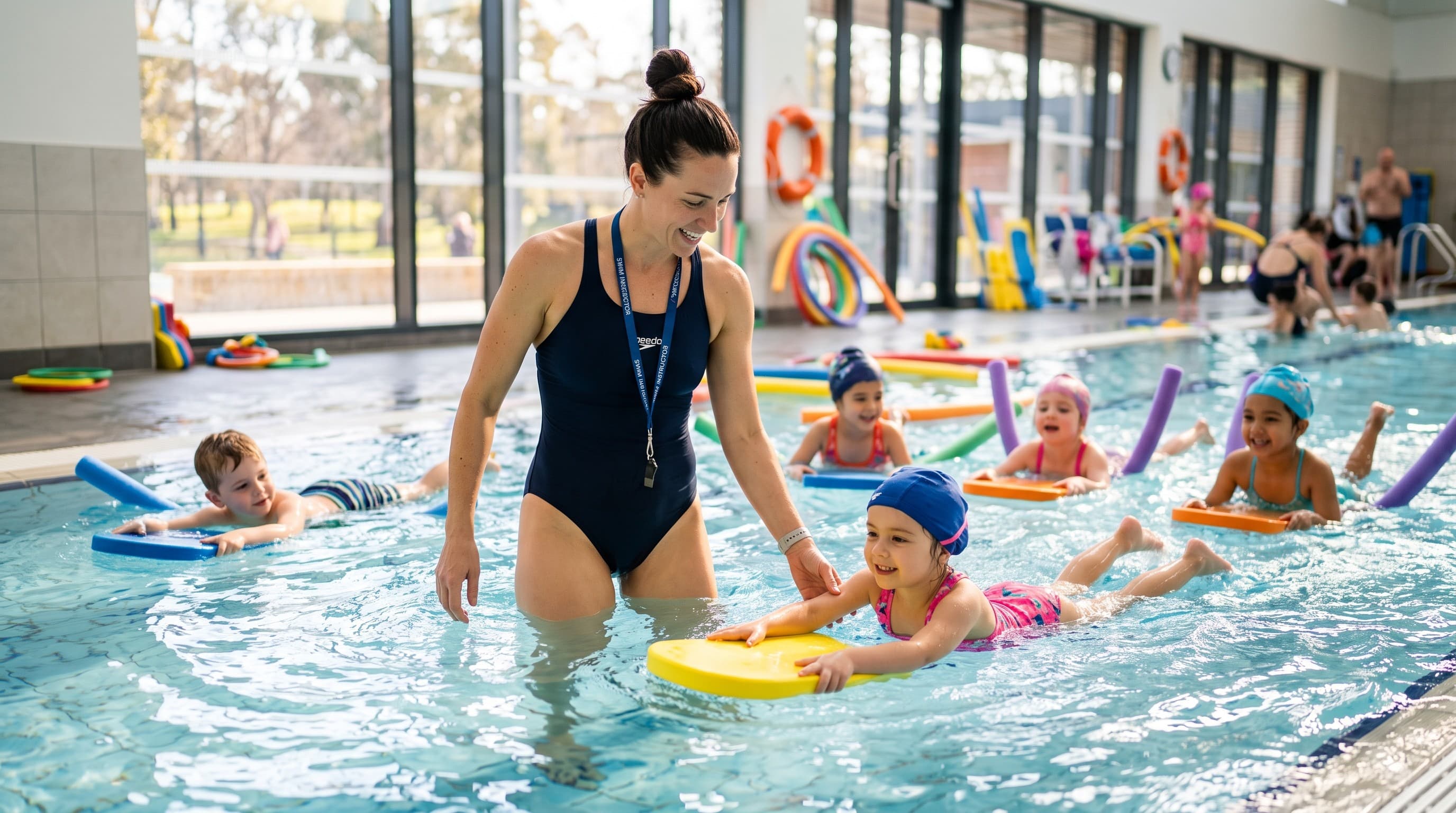
The new instructor stands next to you the first week, in the water or at poolside, and learns the children's names. Knowing the names allows you to intervene as soon as a child gets nervous or swims too far ahead. Show them the progress per child as well, where someone stands, what is being worked on now, what the next step is. Children notice within one lesson whether someone knows where they left off.
Week 2: co-teaching
In the second week you teach together. You handle the explanation and safety, the new hire takes over part of the exercises and gets room to correct. Two pairs of eyes in one group is a gain for the children and the safest way for the new instructor to discover how the group reacts. Give ten minutes of feedback after the lesson and keep it to two points for improvement.
Week 3: teaching alone, you at poolside
In the third week the new instructor runs the lesson alone and you stand at poolside. You intervene only if safety is at risk, otherwise you observe. Agree in advance what you do if there is a safety issue, and let the rest run. Afterwards discuss what you saw. An instructor who has really taught alone in week three will approach week four differently than someone who only observed.
Week 4: independent with a fixed check-in
From week four the group belongs to the new instructor, with one fixed moment per week when you spend ten minutes together reviewing the children's progress and any questions. That fixed moment matters more than how long it lasts, it shows you are looking in and prevents someone from carrying a problem until it is too late.
The onboarding plan in one table
| Week | Goal | Your role | What to watch for |
|---|---|---|---|
| Week 1 | Get to know the group and the children | You teach as usual, the new hire shadows | Do they know the names and levels after two lessons |
| Week 2 | Co-teach and take over exercises | You split the lesson and give short feedback afterwards | Do they dare to correct without waiting for you |
| Week 3 | Run a full lesson independently | You stand at poolside and intervene only for safety | Safety, pacing and whether every child gets a turn |
| Week 4 | Independent, with regular supervision | Weekly ten minutes to review progress and questions | What they want to learn themselves and where they get stuck |
| Afterwards | Continue development | Shadow a lesson monthly and give feedback | Whether quality holds up when it gets busy |
The handover: what a new instructor must know on day one
This is where small swim schools most often go wrong. The previous instructor knew for each child where they stood, what was happening at home and what had been agreed with parents. That knowledge lived in one head, and that head is no longer there. The new hire starts again, and parents notice that immediately in the first lesson.

Per child: where they are and what they are working on
Record for each child what level they are at, which exercises already work and what is being worked on now. In Swimmigo you work with seven levels and 86 skills, and for each exercise with a score from 0 to 6. For a new instructor that is enough to know where to start, without a half hour conversation per child. Without that documentation every change starts from zero.
What has been agreed with parents
Write down what you promised parents, which exercise still needs attention, when the next step is expected, and any agreements about cancellations and make-ups. A new instructor who tells something different than the previous one leads to an angry email you must resolve. Announce the change to parents as well, with a name and a line about the support. Parents accept a new instructor easily if they know someone will stand beside them in the first weeks, and that they can follow progress themselves via the parent portal.
Medical and practical
Allergies, ear problems, epilepsy, fear of deep water, children who cannot participate in a specific exercise: that is rarely in a handover document and it is precisely the information that determines lesson safety. Put it in one place the new instructor reads before the first lesson, and keep it up to date when something changes.
Knowledge in one head is a risk
The same handover you need for a new instructor is what you need for a sick instructor on a Saturday morning or someone who stops immediately. Swim schools that handle this well find that cover is almost no work, the group is in place, the data is correct and parents are informed. Schools that do not arrange this call three people in a panic and hope one answers. What happens in that last case is also in the playbook for a sick or absent instructor.
Retaining: why instructors leave
Hiring a new instructor is more expensive than keeping an existing instructor. Yet attention almost always goes to recruiting. The reasons someone quits are rarely dramatic, too much travel time for two hours of lessons, a schedule that changes every week, or not knowing whether you will ever get your own group. And often the feeling that nobody notices what you do.
Travel time and a schedule that does not stick
An instructor who teaches two evenings alongside another job shows up for those two evenings. If the schedule changes every month, that costs planning each time in a different life. Fix hours early and keep them fixed. If a change is needed, consult the people affected before you alter the schedule.
Career steps you can name
Most small schools do not have a job structure, but they do have a logical route: shadowing, a group of your own, responsibility for a level, or responsibility for organizing an evening. Name that route at the start, even without a salary promise. People stay longer when they know where they will be in a year.
The job itself is not the problem
Swim England asked instructors in 2022 how they experience their work. Ninety six percent said they love the job. People therefore do not leave because they do not enjoy teaching, they leave because the side issues eat the pleasure, unclear expectations, admin done at home, parents addressing them about payments and no form of recognition. Those are things a small school can remove, and that is cheaper than recruiting.
Recognition you can point to
A compliment in passing is nice, but fleeting. Show what an instructor has achieved, which children progressed to the next level, which certificates were awarded, what parents wrote in reviews. Also put the hourly rate and the agreements on paper instead of negotiating when it comes up. Clarity about money is a form of recognition no one has to guess about.
What you set up in the app as your team grows
As soon as you teach with two or three people, the question is not whether you need a system, but whether the data is correct when someone else stands for the group. That is exactly the point where a shared spreadsheet breaks down, everyone has their own version and no one knows which is current.
Roles with different permissions
In Swimmigo a school has three roles, owner, administrator and instructor. The owner decides who becomes an administrator. An administrator sees the administration, including payments and revenue. An instructor works with the groups and progression. That way not everyone who teaches needs access to finances, and you as owner do not have to do everything yourself. The page for swim schools and instructors lists what you do in the app per role.
Adding a colleague
A new instructor first links the location and then requests access to the school. Colleagues see that request and approve it together, after which the new hire is in the team with the correct role. For parents the connection runs via a QR code or an invitation, so the progress of their child goes directly to the right person.
Transfer a group or arrange cover
If a group moves to another instructor, or if a colleague temporarily covers, parents are notified automatically. Parents prefer to hear it from the school rather than from their child on the way home. If someone leaves the team, groups and pupils automatically go to the owner, so no group falls between two stools.
The same data from day one
A new instructor opens the group and sees per child the level, the skills being worked on and notes from previous lessons. No hour-long handover, no folder that gets lost. What else is in the app, from grouping to lesson payments and certificates, is on the feature page. Parents pay nothing to view progress in the app. For the school there is a free demo with unlimited pupils, then 30 days free trial, and afterwards the Solo or School subscription via the App Store or Google Play. The School subscription is meant for teams and locations, with unlimited instructors and unlimited pupils.
Conclusion
Finding a new instructor is the easiest part, especially if you start with people who already know your pool and with the trainer in your region. The work is in the four weeks after, onboarding with a fixed structure, having the data for each child in order before the change, and arranging the side matters so someone stays. Swim schools that do this well grow mainly because their instructors stay.
Swimmigo · For swim schools
Run your swim school fully digital
Students, schedules, absences and parent communication in one app, with your own rates and branding.
Sources
- Swim England: Swim England and STA join forces to tackle swimming teacher shortage, 9 June 2023
- Swim England: Deeper dive into impact of swimming teacher shortage across England, 13 June 2023
- STA: Strengthening the swimming teacher workforce, 8 May 2026
- Institute of Swimming: Swimming Teacher and Aquatic Coach Recruitment Academy, accessed October 2026
- CIPD: Induction factsheet, 21 July 2026
Bob van Soest
As an expert in operating sports facilities (such as swimming pools) and developer of, among others, Swimmigo.com, I am passionately committed to making swimming lessons simpler, more fun and more insightful for parents, swimming instructors and everyone who wants to learn to swim.
Frequently Asked Questions
Related articles

Effectively Managing Swimming Lesson Groups and Progress
Practical tips for organizing and tracking swimming lesson groups and student progress. A tracking system ensures better group division and clarity.

Swimming School or Swimming Instructor: Manage It All in the Swimmigo App
Progress, lesson planning, lesson payments, marketing, diplomas, and parent communication: manage all this with the Swimmigo app for swimming schools and instructors.
Starting Your Own Swim School: How to Do It Without Expensive Systems
Want to start your own swim school? Here’s how to approach it: the real costs, the steps from day one, and how to start professionally without costly systems.
Discover Swimmigo
The all-in-one app for swimming lesson progress. For parents, swim schools, and adult swimmers.