July 27, 2026 • Bob van Soest • 11 min read
PrivateSwimLessonsorGroupLessons:WhatSuitsYourChild?[2026]
Private swim lessons or group lessons: which suits your child better? Discover the pros and cons, cost comparison, and the best choice based on character, pace, and budget.
![Private Swim Lessons or Group Lessons: What Suits Your Child? [2026]](/_next/image?url=https%3A%2F%2Fzvblogpostimages.s3.eu-west-3.amazonaws.com%2FAUTOMATISCH_UPLOAD%2F1_ffbf6aff4c85.jpg&w=3840&q=75&dpl=dpl_8HBmXj8pyjjziKcbXKHvXrtJMU4a)
Summary
- The choice between private swim lessons and group lessons depends on your child's character, not on what other parents do
- Private lessons speed up the learning process by 30 to 50%, ideal for anxious children or children with a delay
- Group lessons build social skills and often cost half as much, but the pace is slower
- Smart planning combines both formats: start private for the basics, switch to group once your child is confident
- Swimmigo gives you real-time insight into your child's progress in both formats, in your language
## TLDR
- The choice between private swim lessons and group lessons depends on your child's character, not on what other parents do
- Private lessons speed up the learning process by 30 to 50%, ideal for anxious children or children with a delay
- Group lessons build social skills and often cost half as much, but the pace is slower
- Smart planning combines both formats: start private for the basics, switch to group once your child is confident
- Swimmigo gives you real-time insight into your child's progress in both formats, in your language
Your child is starting swim lessons. Exciting. But then comes the first big decision: do you choose private swim lessons or a regular group? The answer seems simple: private is better, right? That's not how it works. The right format depends on who your child is. Not on the registration form, not on the waiting list, not on what the neighbor does. This comparison helps you make the choice that fits your child, without hype and without guilt.
Note: these are medians based on public rates from Dutch swim schools, collected by Zwembadvergelijker.nl. Your local rates may vary. The extremely high outliers of €225.90 are often special rates for, for example, medically adapted swimming or accelerated programs.
Why this choice is more important than you think
Swim lessons are not a luxury. They are a life-saving skill. Worldwide, about 300,000 people drown annually, and children under 5 make up nearly a quarter of that number, according to the WHO. In the US, drowning is the leading cause of death among children aged 1 to 4, reports the CDC. Swim lessons are therefore not a luxury, but a necessity. And the format in which your child learns to swim determines how quickly that water safety is built. In the Netherlands, the bar is high. The National Council for Swimming Safety sets strict requirements for the National Swim Diplomas. The A diploma requires breaststroke, backstroke, treading water, swimming through a hole, and swimming with clothes on. That is quite a challenge for a child of 5 or 6 years old. The right lesson format can make the difference between a child who happily earns their diploma and a child who gets frustrated and quits after 18 months.The three basic formats at a glance
Swim schools usually offer three formats. Private lessons: one instructor with one child, maximum attention. Semi-private or duo: two children share an instructor. Group lessons: four to sometimes twelve children with one instructor. The underlying swim methodology is the same. What differs is the pace, individual correction, and the atmosphere in the water.What does science say about lesson formats?
Research from the Holland Aquatic Center in Michigan shows that beginner swimmers benefit most from one-on-one attention. Survival skills such as floating, turning on your back, and swimming to the edge require direct physical guidance. In a group of eight children, each child receives on average only 5 to 7 minutes of personal instruction per 45-minute lesson. In a private lesson, that is the full 30 or 45 minutes.Why your child's character is decisive
Temperament is the most important factor. A withdrawn child who feels safe with a trusted instructor thrives faster in a private setting. A social child who likes to imitate other children learns faster in a group. There is no universal "best" format, only the format that fits your specific child. And yes, sometimes you have to try two formats before you know.
Private Swim Lessons: Benefits and Price
Private lessons give your child something no group format can match: undivided attention. The instructor sees every movement, corrects immediately, and fully adjusts the pace to the learning level of that one child. No waiting time, no distractions, no group dynamics determining the pace.Who is private lessons really suitable for?
Children with water fear almost always thrive in a one-on-one setting. Without the pressure of watching peers, they dare to put their face underwater, float, and let go faster. Also, children with a delay, for example after a long waiting list or an injury, catch up rapidly with private lessons. And don't forget children with ADHD or autism: for them, the low-stimulus nature of a private lesson is often an essential condition to be able to learn at all.How much faster does a child learn with private lessons?
Estimates from swim schools in both the Netherlands and the US indicate a learning time reduction of 30 to 50%. A child who takes 15 to 18 months to get the A diploma in a group often achieves the same diploma in 8 to 12 months with two private lessons per week. That also means: fewer months paying lesson fees. The higher price per lesson is partly compensated by the shorter total duration.What does private swim lessons cost in the Netherlands?
Here it gets concrete. Based on data from the Zwembadvergelijker.nl database of 180 Dutch swim schools, prices for a regular group lesson and a private lesson differ greatly. These are the medians per 45 minutes in 2026:| Lesson Format | Median Price per 45 minutes | Price Range |
|---|---|---|
| Group Lesson (6-12 children) | €12.50 | €7.20 - €22.00 |
| Small Group (3-5 children) | €18.00 | €10.00 - €30.00 |
| Duo Lesson / Semi-Private | €35.00 | €20.00 - €65.00 |
| Private Lesson (1 on 1) | €60.00 | €17.80 - €225.90 |
The hybrid approach: the best of both worlds
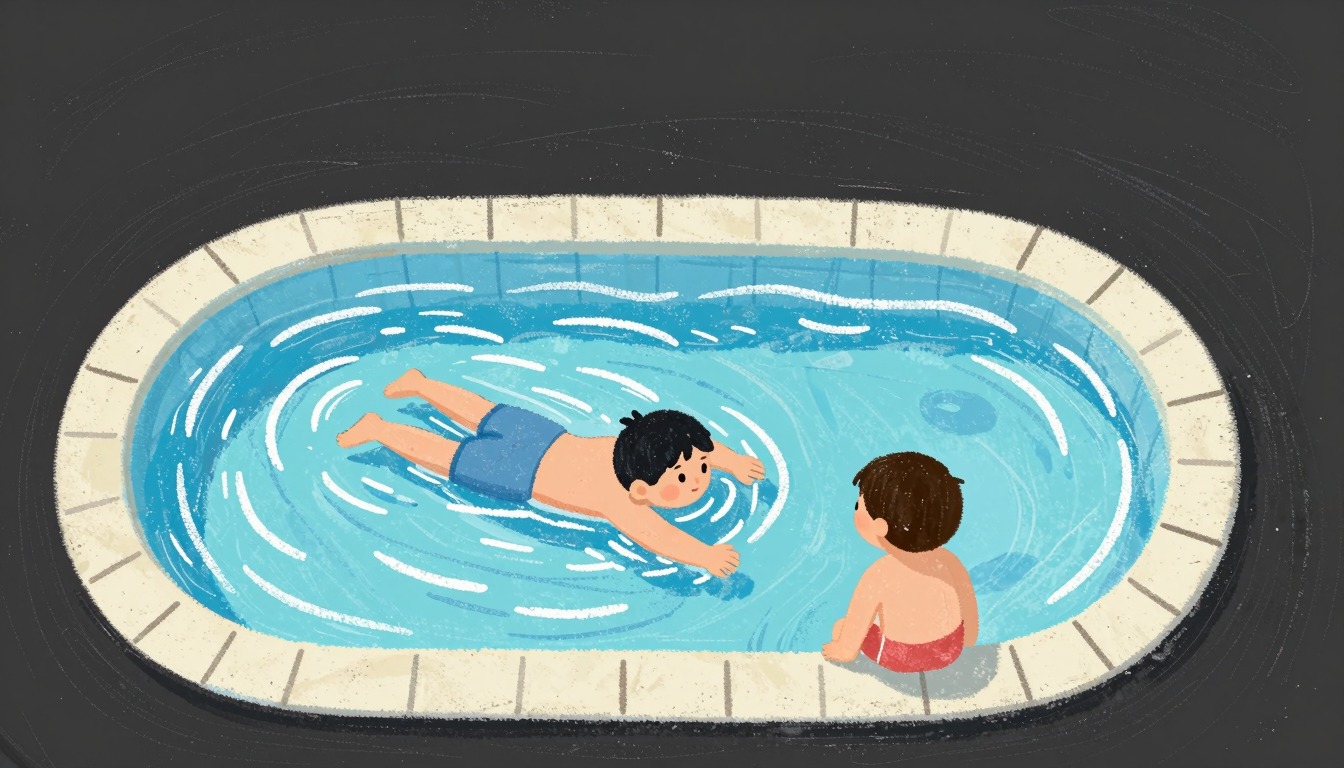
More and more parents choose a combination strategy. Start with 6 to 10 private lessons for the basics: water familiarization, floating, breathing underwater. Once your child confidently dares to enter the water, switch to a small group of 3 to 5 children. Your child then has the safe foundation and benefits from the social group aspect. Many swim schools actively facilitate this transition.
Group Lessons: Why They Work Well for Many Children
Group lessons are not the "second choice." For many children, it is the most natural way to learn. Children watch each other, imitate each other, encourage each other. An instructor in Rotterdam told us: "I see children who got stuck in a private track suddenly make great progress in a group of four. One dares to jump, the other immediately follows."The social engine of group learning
Swim research confirms this. Children learn not only from instructors but also from peers, notes LowCountry Swim School from South Carolina. Seeing a classmate dare to swim through the hole or tread water for 10 seconds motivates more than ten adult encouragements. Peer pressure often works positively in the pool.Cost comparison: what is the real difference?
A group lesson of €12.50 per 45 minutes sounds attractive. But do the math: at 60 lessons per year (weekly), a group lesson costs €750 per year. A private lesson of €60.00 per 45 minutes costs €3,120 per year. That is almost €2,400 difference per year per child. For families with two or three children of swim lesson age, group lessons are often the only financially feasible option. The key is to keep the quality of the group lesson as high as possible, for example by choosing a small group and a school that uses a student tracking system.When does group learning work better than private?
Children already familiar with water, for example through many vacations at the sea or a nearby pool, often do better in a group. They have no fear to overcome; they just want to learn technique. And they learn that well in a group, with the bonus of making friends and learning to cooperate. For extroverted children who get energy from other children around them, a private lesson can be too quiet and intense.The downside nobody tells you about
Group lessons have one big disadvantage: waiting time. Literally. In a group of 8 children taking turns swimming laps, each child waits on average 7 minutes per exercise. In a 45-minute lesson, that is 25 to 30 minutes of water time lost watching instead of doing. In a private lesson, every minute is active learning time. That pace difference explains why children in a group need on average 60 to 80 lessons for the A diploma, while private learners often achieve it in 35 to 50 lessons.Which format suits which child? A practical decision map
Parents struggle with this question because every child is unique. There is no decision tree that works for everyone. But there are patterns that guide you.Choose private lessons if your child:
Is afraid of water and feels tense at every lesson. Is easily distracted by sounds and movements around them. Has fallen behind due to corona, an injury, or a long waiting list. Has special needs such as autism, ADHD, or a motor disability. Performs better under direct, calm guidance than in a competitive setting.Choose group lessons if your child:
Is already familiar with water and mainly needs to learn technique. Gets energy from other children around and likes to cooperate. Can wait their turn without getting frustrated. Is socially motivated and enjoys seeing friends during the lesson. Fits within a tighter budget, as group lessons are significantly cheaper.Choose semi-private/duo lessons if your child:
Benefits from personal attention but also wants a buddy in the water. Has a sibling or friend at the same level. Is between the two extremes: not the stimuli of a full group but still social interaction.
How Swimmigo helps, regardless of your lesson format
Whether your child takes private lessons or is in a group of ten: as a parent, you want to know how it’s going. Not a vague phone call from the instructor once a month, but real-time, transparent, in your language. Swimmigo is built to bridge that gap. The app is available in Dutch, English, German, French, and Spanish, so you can follow your child’s progress in your own language, wherever you live in the world.Real-time insight into every exercise
Swimmigo works with 7 levels and 86 detailed skills. You see per exercise whether your child has yet to start, is working on it, or has mastered it. No vague reports, no "it’s going okay." Concrete smileys show exactly where your child stands. And that works for all formats: the instructor ticks off what your child can do, whether in a group of two or twelve.Push notification at every milestone
The best moment for a parent: the notification that your child has reached a new level. Swimmigo sends you a push message as soon as your child moves to the next level. Whether you’re at work, cooking at home, or on vacation: you’re there, virtually. And at levels 5, 6, and 7, the app generates a real personalized swim diploma with your child’s name, date, and achieved level. Free.For the instructor: everything in one free app
Swimmigo is also a solution for swim teachers. Creating groups, moving students between groups, tracking scores per level: all with swipe gestures on your phone. No more paper tracking systems that get wet at the pool. No administration that takes hours. And parent communication runs automatically. A parent who sees their child’s progress in real-time doesn’t call every week asking "how is it going?" That parent just looks in the app.Conclusion
Private swim lessons or group lessons: it’s not a competition. Both formats lead to the same diploma, the same safe child who is self-reliant in the water. The art is to choose what fits your child, your situation, and your budget. And remember: the choice is not final. You can start with private and switch to group. You can schedule a few private lessons alongside regular group lessons. The only thing that matters is that your child learns to swim with pleasure and confidence. The rest is secondary.Read more: Complete overview of tracking swim lesson progress | How to choose the right swim school? | Complete overview of swim lesson costs [2026]
Sources
- WHO: Drowning fact sheet, with worldwide drowning statistics, last updated 2024
- CDC: Preventing Drowning, US guidelines for water safety and swim lessons, September 2025
- Holland Aquatic Center: Should my child take group swim lessons or private swim lessons?, practical overview of lesson formats, 2023
- LowCountry Swim School: Private vs Group Swim Lessons, comparison of formats with attention to temperament and pace
- National Council for Swimming Safety, Dutch quality standards for swim education and certification
- Zwembadvergelijker.nl: Private swim lesson prices in the Netherlands [2026], current price data from 180 Dutch swim schools, July 2026

Bob van Soest
As an expert in operating sports facilities (such as swimming pools) and developer of, among others, Swimmigo.com, I am passionately committed to making swimming lessons simpler, more fun and more insightful for parents, swimming instructors and everyone who wants to learn to swim.
Frequently Asked Questions
Discover Swimmigo
The all-in-one app for swimming lesson progress. For parents, swim schools, and adult swimmers.