PeriodandSwimmingLessons:HowYourDaughterKeepsSwimmingDuringPuberty[2026]
![Period and Swimming Lessons: How Your Daughter Keeps Swimming During Puberty [2026]](/_next/image?url=https%3A%2F%2Fzvblogpostimages.s3.eu-west-3.amazonaws.com%2FAUTOMATISCH_UPLOAD%2F1_36eba8374518.jpg&w=3840&q=75&dpl=dpl_GWyfLj8UVegbQ18STkVQms8Vj7LD)
Summary
- Girls usually get their first period around age twelve, exactly when many children are still working on their B or C diploma.
- With a normal period, you can swim, also with a tampon. Sanitary pads don’t work in water because they soak up water.
- In Australian research with Swimming Victoria, 91.5 percent of girls aged 10 to 16 worried about leaks and 62.8 percent skipped training.
- Missing one lesson per month adds up to twelve lessons per year, which is why children stay stuck at the same level.
- Swim schools keep girls longer by allowing cancellations without explanation, scheduling make-up moments, and sending short updates to parents via the app.
She swam with pleasure and now she doesn’t want to anymore
For two years your daughter went to swimming lessons without complaining. Until one week when she suddenly doesn’t want to go. She feels unwell, says she has stomach pain, and prefers to skip this time. Maybe she hasn’t said it out loud yet, but she has gotten her first period. Wearing a swimsuit, in a pool with thirty children, she doesn’t quite know what to do.
As a parent, you have practical questions. Is it okay for her to swim? What can she wear? And how do you cancel a lesson without the whole swim club knowing, while she is still two levels away from her diploma?
Below you’ll read what is and isn’t possible in the water, how to talk to her about it, and what a swim school can do so that a normal physical change doesn’t mean the end of swimming lessons.
What changes when your daughter gets her period
The first menstruation occurs during the swimming lesson period
Girls get their first period between the ages of nine and sixteen, most around twelve, writes the Center for Youth and Family. That is exactly the age when many children are still working on their B or C diploma. Swimming lessons and puberty therefore overlap, and no one planned for that in advance.
Why girls drop out especially during puberty
According to the Knowledge Center for Sport & Exercise, girls and boys participate in sports equally until about age twelve. From twelve onwards, weekly sports participation among girls is lower and girls are more vulnerable to dropout than boys. A British study among four thousand teenagers shows how big that difference is. Of the girls who once considered themselves sporty, 43 percent drop out after primary school. Fear of being judged is mentioned by 68 percent as a barrier. In that same study, 78 percent of girls say they avoid sports when they have their period.
Why swimming is especially sensitive
In a swimming pool, you can hide very little. Research by the Australian Federation University, together with Swimming Victoria, shows what this does to girls aged 10 to 16. More than nine out of ten worry about visible leaks. Nearly two-thirds skipped training because of their period. Almost one in five considered quitting sports altogether. A fourteen-year-old swimmer expressed it in that study like this: she feels isolated because she can’t use a tampon and no one told her what she can do instead.
Is it okay to swim when you have your period?
What medical advice says
Yes. The UMC Utrecht is clear: with a normal menstruation you can just exercise, and you can swim with a tampon. The advice is to change it just before and immediately after swimming. There is therefore no medical reason to skip a lesson.
Why sanitary pads don’t work in the water
Sanitary pads absorb water. Once wet, they no longer stop blood. So they are not an option for the pool, not even for a 45-minute lesson.
Tampon, cup, or menstrual swimwear
There are more options than many girls think. The CJG advises starting with mini-tampons and practicing insertion in the middle of the period because that is easiest. A menstrual cup also works, although young girls often find insertion still scary. Additionally, there is swimwear with built-in protection for girls who don’t want to insert anything.
| Option | Works in water | What to watch for |
|---|---|---|
| Tampon | Yes | Start with the smallest size that fits, change before and immediately after the lesson, then every four hours. |
| Menstrual cup | Yes | Insertion requires practice. Young girls often find this scary, and that’s okay. |
| Menstrual swimwear | Yes, on light to normal days | Built-in protection without insertion. Not enough on the heaviest days. |
| Sanitary pad | No | Absorbs water and then no longer stops blood. Not suitable even for a short lesson. |
| Regular menstrual underwear | No | Useful outside the pool, but soaks up water and then slips down. |

The first time using a tampon: how to approach it together
Practice at a calm moment, not on the morning of the lesson
Inserting a tampon rarely works the first time if you’re rushed and already in your swimsuit. Practice at home, at a moment without hurry, sitting on the toilet or lying down with knees drawn up. Many brands provide tampons with an applicator, which makes it easier for beginners. If she feels the tampon, it’s not inserted deep enough.
What to tell about hygiene and safety
Change every four hours, wash hands before and after changing, and throw tampons in the trash bin instead of the toilet. The CJG also mentions a fear parents often hear: sports or tampons do not break the hymen.
If it doesn’t work, what then?
Some girls can’t manage it, even after a few tries. That’s not strange and doesn’t mean there’s something wrong with her body. Then there are other options: try a cup, swimwear with built-in protection, or skip a lesson that week. The important thing is that she doesn’t feel like she’s failing.
Cancel or keep swimming?
How many lessons does she really miss?
Missing one lesson is not a disaster. It only becomes a problem if it happens every month and no one keeps track. In the Australian study, 62.8 percent of girls skipped training because of their period. Missing one lesson per month adds up to twelve missed lessons per year.
What a missed lesson does to her progress
Swimming skills build up with repetition. Children who miss lessons repeatedly tend to stay at the same level longer and take more time. That is exactly the point where families drop out: it takes too long and there seems to be no end. How much a child regresses after a long break varies per child, and the more gaps there are, the more has to be rebuilt. A school that notices stagnation in time can intervene before a child has to repeat an entire level. In Swimmigo, School Pulse automatically signals when a student remains inactive on a level for more than twelve weeks.
Ask for make-up lessons instead of figuring it out yourself
Many swim schools offer make-up lessons or groups with extra spots reserved. Ask at the start of the program how your school arranges this, instead of asking the reception every month. In the app, a school can mark absences and schedule make-up lessons in the group planning, so your child doesn’t lose their spot in the roster.
What you can do as a parent: cancel as soon as you know she won’t come, ask for a make-up moment, and keep track of how many lessons are missed.
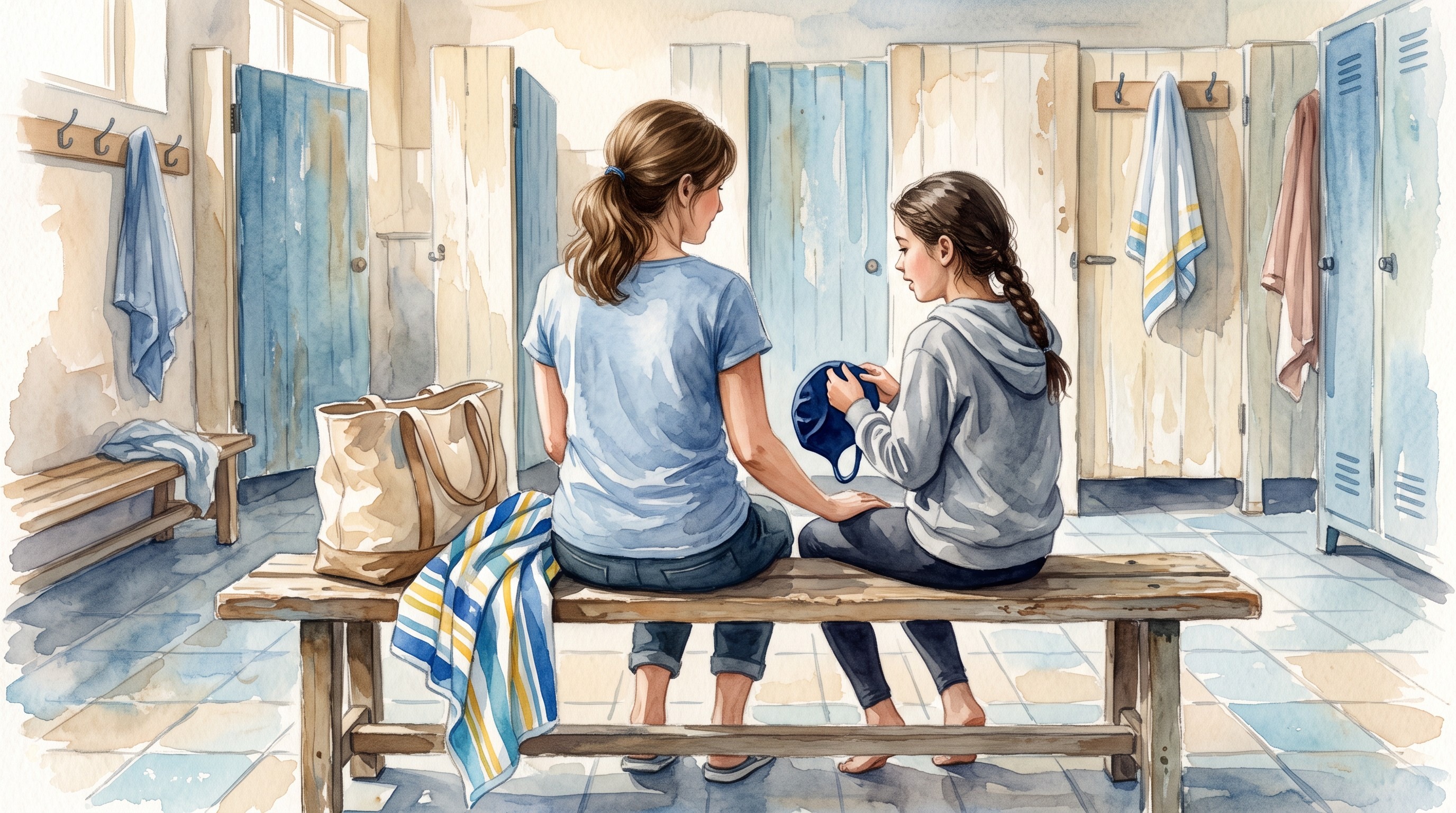
When swimming lessons suddenly become an expensive month
Menstrual products cost money, and not everyone can afford that
A pack of tampons is not a large amount, but it adds up on top of lesson fees, swimwear, and travel costs. The Poverty Fund reports that 1 in 8 girls and women in the Netherlands cannot afford necessary menstrual products. Worldwide, about 500 million people lack access to products and decent facilities, according to the WHO. For a family already struggling financially, an extra product for swimming can sometimes be too much.
Cancel without explanation at reception
No one wants a conversation at the reception about their daughter’s cycle. A parent who feels obliged to explain eventually stops canceling altogether. Simply not showing up becomes the path of least resistance, and everyone loses: the school has no insight into attendance and the child falls behind.
Ask for help without a long story
Those who cannot easily pay for lessons or products can look at municipal schemes and funds. What is covered differs per municipality. In this overview about saving on swimming lessons, you can see how to apply per route.
What a swim school can do
Make cancellations easy and without explanation
Include in your agreements that cancellations without reason are allowed and that a make-up moment is offered. This costs you almost nothing and keeps girls in your group who would otherwise quietly disappear. Swimming lessons are already something children from the lowest income group drop out of more often: 33 percent of them have no diploma at all, compared to 5 percent in the highest group, according to figures from the Mulier Institute. An extra barrier does not help.
Schedule make-up lessons, not just in a WhatsApp group
If make-up moments are only arranged via a parent WhatsApp group, some parents know about it and others don’t. Record them in the schedule, with the spots you reserve. This way a parent can choose a spot without having to have a conversation.
Inform parents without a class talk
A short, businesslike update to all parents in a group works better than a talk at the poolside. In Swimmigo, a school can send messages with read receipts, and notifications automatically arrive in the parent’s language, in five languages. Parents also see per exercise where their child stands, and in the app they find lesson packages, costs, and payment moments. That is information a girl does not have to tell anyone about herself. Want to know more about what parents can follow? See Swimmigo for parents or read how the platform works.
What research shows works
The numbers at a glance
These numbers show how big the barrier is.
| What was measured | Result | Source |
|---|---|---|
| Girls worried about visible leaks | 91.5 percent | Federation University, 2025 |
| Girls who skipped training due to menstruation | 62.8 percent | Federation University, 2025 |
| Girls considering quitting sports altogether | 18.1 percent | Federation University, 2025 |
| Girls avoiding sports during their period | 78 percent | Women in Sport, 2022 |
| Girls dropping out of sports after primary school | 43 percent | Women in Sport, 2022 |
| Girls citing fear of judgment as a barrier | 68 percent | Women in Sport, 2022 |
| People worldwide who menstruate | 2.1 billion | WHO, 2026 |
What research institutions recommend
The Australian study ends with a few concrete recommendations: darker colors in sportswear so stains are less visible, menstrual products available at the sports location itself, and more education for associations, clubs, coaches, and parents. Two of these can be applied immediately by a swim school, namely products in the restroom and education for parents. The third point, clothing, usually lies with the parents.
Why this is a global issue
The WHO estimates that 2.1 billion women and girls worldwide menstruate, and about two out of three experience pain during menstruation. The organization explicitly states that good menstrual health requires that someone is not stigmatized and can decide for herself how to participate. This applies just as much to the pool as to the school desk. Whether you live in Rotterdam or Seville, the pattern is the same, only the facilities differ.
How to keep the conversation with your daughter light
What to say and not say at the poolside
An eleven- or twelve-year-old girl doesn’t want her father or mother to discuss this with the lifeguard. Therefore, arrange in advance what needs to be arranged, and keep it brief during the lesson itself. Ask her what she prefers: some girls want the instructor to know, others don’t. Tell her she can decide for herself and that she can always skip a lesson if she doesn’t feel comfortable.
Don’t make it a headache
The more weight you put on it, the bigger it becomes. Swimming with a tampon is possible with a normal period, and she doesn’t have to tell the group anything about it. Encouraging her to continue while giving her space to skip once keeps her in the water longer than making a big deal out of it. If she continues to have symptoms that hinder her, or if the bleeding is so heavy she can’t go to school or sports, then the doctor is the right place, not the poolside.
Conclusion
Having your period is no reason to stop swimming lessons, and most girls can go in the water with a tampon, cup, or swimwear with protection. The barrier lies in the discomfort around it: not knowing what is allowed, not wanting to stand out, and not wanting to explain. As a parent, it helps to discuss the topic early and lightly and to make cancellations easy. As a swim school, it helps to allow cancellations without explanation, schedule make-up moments, and inform parents discreetly. This way a girl keeps swimming during the period her body changes, instead of stopping then. This article provides general information: in case of doubt about symptoms, the doctor decides, not a website.
Sources
- WHO: fact sheet menstrual health (2.1 billion people who menstruate, 500 million without access) (June 18, 2026)
- Federation University: menstruation is quietly driving girls out of sport (study with Swimming Victoria among girls aged 10 to 16) (October 6, 2025)
- Women in Sport: Reframing Sport for Teenage Girls (78 percent avoid sports during menstruation) (March 7, 2022)
- Knowledge Center for Sport & Exercise: sport and exercise for girls, what motivates and what hinders them (updated December 22, 2019)
- UMC Utrecht: first period (patient brochure, sports and swimming during menstruation) (2026)
- Center for Youth and Family: your daughter gets her period (mini-tampons, tampons, and swimming) (2026)
- Poverty Fund: menstrual product distribution points (1 in 8 cannot afford products) (2026)
- PMC: female athletes' knowledge of biopsychosocial puberty-related topics in sports (puberty as main cause of dropout) (2025)
- Mulier Institute: swimming skills and diplomas by income group (2024 figures)
- WHO: fact sheet drowning (236,000 deaths per year) (2026)
Bob van Soest
As an expert in operating sports facilities (such as swimming pools) and developer of, among others, Swimmigo.com, I am passionately committed to making swimming lessons simpler, more fun and more insightful for parents, swimming instructors and everyone who wants to learn to swim.
Frequently Asked Questions
![What Can Your Child Eat Before Swimming Lessons? Nutrition Tips for More Energy in the Water [2026]](/_next/image?url=https%3A%2F%2Fzvblogpostimages.s3.eu-west-3.amazonaws.com%2FAUTOMATISCH_UPLOAD%2F1_8b82011f11a5.jpg&w=3840&q=75&dpl=dpl_GWyfLj8UVegbQ18STkVQms8Vj7LD)
Discover Swimmigo
The all-in-one app for swimming lesson progress. For parents, swim schools, and adult swimmers.