Who Takes Your Child to Swimming Lessons? How to Arrange It When You Can’t Be There [2026]
![Who Takes Your Child to Swimming Lessons? How to Arrange It When You Can’t Be There [2026]](/_next/image?url=https%3A%2F%2Fzvblogpostimages.s3.eu-west-3.amazonaws.com%2FAUTOMATISCH_UPLOAD%2F1_6aeeef1295c4.jpg&w=3840&q=75&dpl=dpl_B4CtmeJzxU1sWb8C7jHQgM1hPJvD)
Summary
- Drop-off and pick-up almost always work, the transfer of information is the weak point
- Record who may pick up your child and who is responsible that day
- Give the supervisor the exercise of these weeks, not just the swim bag
- Going independently to swimming lessons is a different step than being independent in the water
- Notifications and levels in five languages keep grandparents and babysitters involved too
The swimming lesson is on the calendar, but you have to work that afternoon. One of your parents drives, the babysitter brings your child, or the after-school care handles drop-off and pick-up. Usually, that runs smoothly. But every week there remains a small gap: no one knows exactly what your child did in the water.
That gap isn’t immediately a problem. It only becomes annoying if it happens every week. The person supervising that day doesn’t know which exercise is central, you only hear weeks later that your child is almost ready for the next step, and the instructor doesn’t know who is responsible for your child that day.
Why drop-off is almost never the real bottleneck
The lesson falls in the middle of your workweek
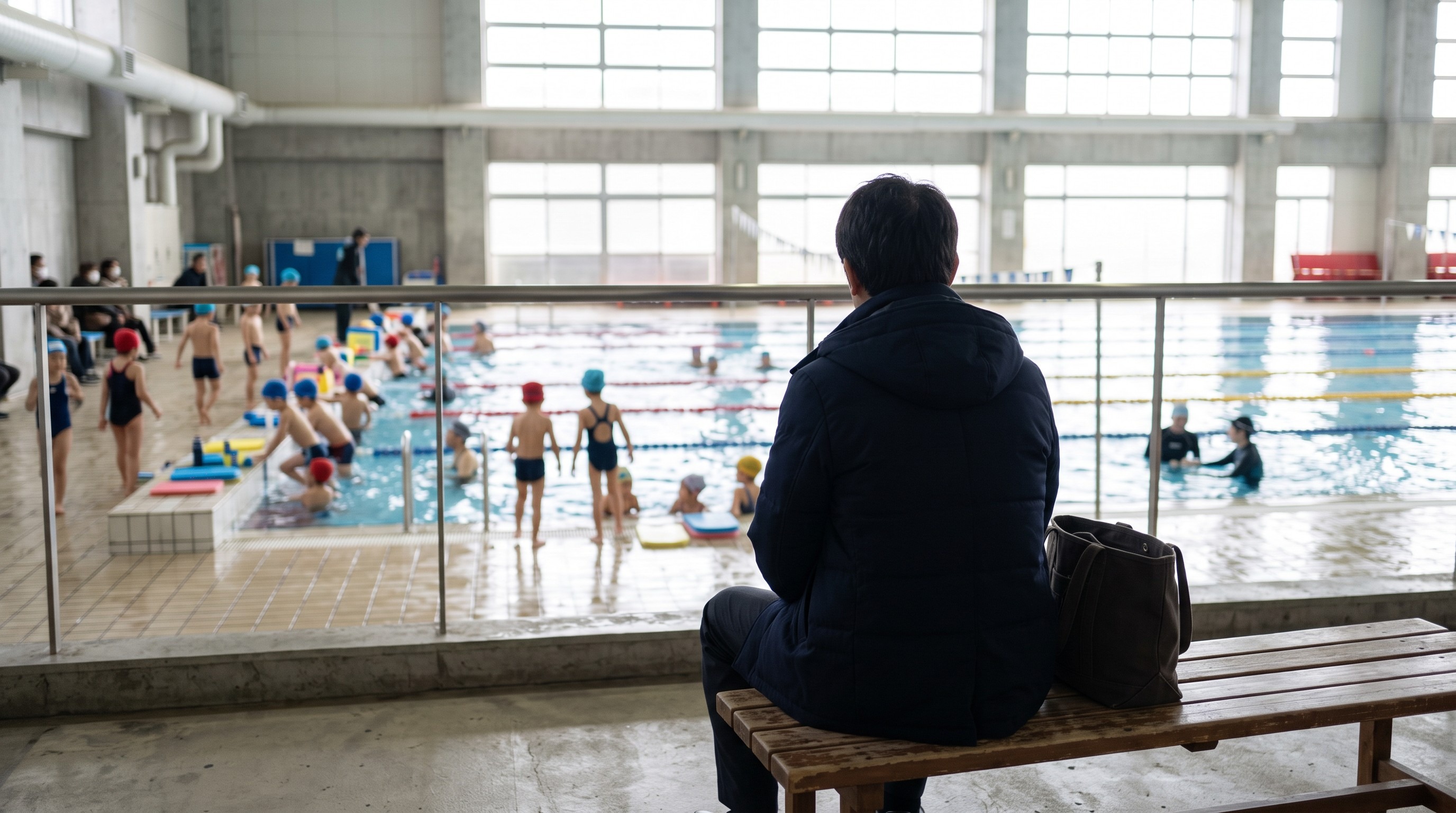
Swimming lessons are given during the hours the pool is free. These are often the hours when parents are not free: just after school, late afternoon, or Wednesday afternoon. Some parents solve this with leave or working from home. For two working parents, that rarely works every week.
Swimming schools see the same pattern on their side. A schedule that only works for parents with flexible hours consistently results in cancellations.
Who actually does the drop-off
In many families, it’s a combination of people: one week a parent, the next week a grandparent, sometimes a babysitter, sometimes after-school care. Each of these people has their own view of the lesson and their own idea of what’s important. Without agreements, the swimming school loses track of who is coming and who is taking the child.
Where it goes wrong: the transfer of information
Drop-off and pick-up almost always go well. The transfer of information cracks. A grandparent who comes once a month doesn’t know that your child is working on back floating with clothes on this month. You as a parent hear the grandparent’s story at home, not the instructor’s. And the instructor misses the questions you would ask if you were there.
Agreements to make in advance with the swimming school
Who may pick up your child
Record with whom your child may leave after the lesson: only you, also the babysitter, also grandparents, or a fixed list of names. Swimming schools are strict about this, and rightly so. A child who gets into the car with the wrong adult at the end of the lesson is a scenario no one wants to experience.
Report changes as soon as they are known. A new babysitter who arrives at a closed door the first time or is not allowed to take the child causes everyone a quarter of an hour delay.
Reporting if someone else brings your child
Who reports your child sick if you are at work and the babysitter notices it? Agree that the person who knows also reports it, and that you confirm it later if the swimming school wants. This way, the swimming school gets the message on time and you don’t have to wait until your break.
Contact details of the supervisor
Put the number of the supervisor of that day in your child’s student file. A swimming school that only has your number in case of a wet suit or a fallen child loses time you’d rather not lose.
Photos and permission when grandparents accompany
Swimming schools sometimes take photos during lessons for parent communication or their own channels. If your child is brought by someone else, it must be clear who gives permission and what happens with those photos. For young children, parents arrange this; for divorced parents, it’s wise to record who signs for what. More about this is in photos, student data and parental consent.
What the supervisor of that day needs to know
A supervisor doesn’t need to be able to give swimming lessons. There are four things that make the difference between just being present and really being involved.
Which exercise is central now
Every swimming school works in blocks: a few weeks of water familiarization or floating, then a period with breaststroke, then working on endurance. If the supervisor knows what your child is currently working on, they can ask a targeted question after the lesson. That is exactly the conversation where children tell what they learned.
What is in the bag
Swimwear that fits, a towel, pool slippers, and if necessary a swim cap. Floatation aids from home do not go into the pool if the swimming school uses its own equipment. If you’re unsure about an aid, ask the swimming school. We wrote earlier about what is safe and not in this piece about swimming aids and floatation devices.
Encouraging without coaching
Shouting from the side how a stroke should be done rarely works. Children hear their own instructor, and two voices at once make it unclear. A thumbs up, holding a towel ready, and a calm remark after the lesson do more.
Preparing what your child can do themselves
Let a child who can do it pack their own bag and use their locker. That saves the supervisor work and makes the step to going alone smaller. How independent changing looks in practice is in changing and showering at swimming lessons.
| Who | Role in the week | What they need to know |
|---|---|---|
| Regular supervisor | usually drops off and picks up, often a parent or grandparent | which exercise is covered these weeks, who goes along after the lesson, which number to call in an emergency |
| Substitute | babysitter, after-school care or another parent temporarily dropping off | child’s name, group and instructor, directions to locker and pool, the pick-up agreement |
| Instructor | gives the lesson in the water | that someone other than the parent is coming today, and who that is |
| Swimming school | reception, planning and administration | who may pick up the child, which emergency number is current, who gives permission for photos |
How to stay informed yourself when you’re not there
What an instructor records per lesson
An instructor who takes two minutes after the lesson to note per student what worked and what didn’t has exactly the information you as a parent miss. It doesn’t have to be a report: a score per exercise is enough to see if your child is progressing or stuck.
Notifications on a level increase
The moments when parents most want to watch are scarce: the first lesson, the first time without floaties, the moment a level is achieved. A notification on your phone when your child advances a level is for many parents the difference between being involved and being a spectator.
If the supervisor doesn’t speak the language
More and more children are brought by parents, grandparents or babysitters who speak little Dutch. That makes newsletters at the poolside, notes in the locker, and spoken explanations unusable. The National Council for Swimming Safety has informational material in multiple languages for this, and CBS figures show why it matters: children under 10 born outside Europe have over eight times higher risk of drowning than children with Dutch origin. For 10 to 20 year olds, that’s almost fourteen times. Explanation in the supervisor’s own language is no longer a side issue.
Asking questions at the poolside without disturbing the lesson
Choose one moment per month for a question, and do that at the end of the lesson when the instructor has handed over the group. Random questions at the start of a lesson cost lesson time for all children in the group. What you can check yourself at home, you don’t need to ask.
From what age can your child go alone?
This is the question parents ask most often once drop-off and pick-up become difficult. There is no fixed age for it, because it depends on two things: what your child can do in the water and how they react if something unexpected happens.
What the figures and advice say
VeiligheidNL advises not to let children up to and including six years swim independently. Even after that, a diploma is no guarantee: children who swim little after their diplomas cannot swim without supervision according to the same organization. Worldwide, drowning is the fourth leading cause of death among children aged 1 to 4 and the third among children aged 5 to 14. The WHO calls teaching swimming skills and water safety to school-age children one of the measures that demonstrably contribute to this. In the Netherlands, 100 residents drowned in 2025, according to CBS figures.
Practically that means: a child who cycles independently to swimming lessons is different from a child who is independently in the water. These two things may be separate.
The route to the pool
Practice the route a few times together, including the busy crossing and the last part next to the pool. Point out where your child should park the bike and through which entrance they enter. Also agree where your child waits after the lesson, and how long they may stand there before calling you.
Agreements before your child goes alone
Make it concrete: does your child call before going inside, do you wait at a fixed spot, may your child go with someone else after the lesson, and what time do you expect a message at home. Many children around nine manage this well. If in doubt: do it together for two weeks, see if the agreements hold, and only then let them go alone.
Going alone to the lesson is a different step than being alone in the water
Bringing yourself says something about the route and the building. Swimming alone without supervision says something about skill and self-reliance. A child can take the first step well before the second, and that is normal. Swimming schools usually think the same: let a child leave alone only if the parents have communicated that.
Carpooling with other families
What to agree on in advance
Carpooling solves the logistics at once and requires a bit more agreements than people think: who brings on which day, who picks up, what if a child is sick, and what if the person who brings is unavailable. Record it in a few lines so no one has to negotiate every week.
Who watches whom if you are with multiple families
In a group of adults, almost everyone thinks someone else is watching. VeiligheidNL explicitly calls that a risk and advises to name who watches which child as soon as you are with multiple adults near water. Letting siblings watch children who cannot swim is not a solution. The same agreement works after the lesson: at pick-up, one adult counts the children.
One place for changes
Changes belong in one place: a group chat, a shared calendar, or the swimming school’s parent communication. As soon as there are three channels, someone always misses the latest version.
If something goes wrong
Emergency contacts that are correct
Check once every six months whether the phone number in your child’s file is still correct, and whether the babysitter’s number is included. A swimming school calls the first number that works in an emergency.
What the swimming school must be able to find
Who picks up whom, which child has an allergy or condition, which parent or supervisor should be called first. Swimming schools that have this in a student tracking system don’t have to search in an incident. How a swimming school prepares for emergencies is in the emergency plan for your swimming school.
What you arrange in Swimmigo if multiple people bring your child
For parents: progress remotely
In the Swimmigo app you see per student which of the 86 skills are checked off at which level, from the first water familiarization to working on a diploma. You can share the screen with the babysitter or your parents so they speak the same language as the instructor after the lesson. On Swimmigo’s parent side you can see exactly what parents can view, and on the level page you see which skills belong to each level.
For swimming schools: one place for agreements and messages
A swimming school records who may pick up a student, sends announcements to all involved, and sees who has read a message. That makes the difference between three people figuring it out themselves and one consistent line. On the instructor page you can see how that works.
In five languages
Notifications, levels, and skills are available in Dutch, English, German, French, and Spanish. That helps international families, and it helps everyone who wants to understand today’s lesson in their own language, even if they are still learning Dutch.
Conclusion
Drop-off and pick-up usually get arranged. What remains is the information: who is responsible that day, which exercise is central this week, and how do you know at home what happened. Record those three things with the swimming school and the supervisor of that day. If you let your child go alone, do so based on skill and a practiced route, not just age.
Sources
- VeiligheidNL: Drowning (advice on independent swimming, consulted October 2026)
- CBS: Higher risk of drowning among children not born in the Netherlands (news report, July 2026)
- National Council for Swimming Safety: new CBS figures and the importance of continued attention to swimming safety (July 2026)
- Kinderveiligheid.nl: A safe pool in the garden (tips on agreements and supervision, consulted October 2026)
- WHO: Drowning fact sheet (updated September 2026)
- WHO: Global status report on drowning prevention (2024)
- National Council for Swimming Safety: swimming safety information for newcomers in multiple languages (consulted October 2026)
- Red Cross: First aid tips (consulted October 2026)
Bob van Soest
As an expert in operating sports facilities (such as swimming pools) and developer of, among others, Swimmigo.com, I am passionately committed to making swimming lessons simpler, more fun and more insightful for parents, swimming instructors and everyone who wants to learn to swim.
Frequently Asked Questions
Related articles

Effectively Involving Parents in Their Child's Swimming Lesson Progress
Practical tips for good communication and collaboration with parents about their child's swimming lesson progress.

Improving Swimming Lesson Progress for Better Parent Communication
Discover how to clearly record swimming lesson progress and communicate effectively with parents for more involvement and better understanding.

Effectively Informing Parents About Swimming Lesson Progress
Practical tips to clearly and engagingly inform parents about their child's swimming lesson progress.
Discover Swimmigo
The all-in-one app for swimming lesson progress. For parents, swim schools, and adult swimmers.