Watching Swim Lessons: Can You Watch and How to Stay Involved? [2026]

Summary
- Viewing policies differ per swim school: stands, fixed viewing lessons, or waiting in the hall.
- International guidelines call watching a feature of a good swim school.
- Watch without coaching: stay seated, put your phone away, and save feedback for after the lesson.
- If you can’t watch, ask for updates per skill, a viewing lesson per block, or a photo at a milestone.
- For swim schools: explain the rule and reason beforehand and always offer an alternative.
The door to the pool closes and your child disappears with the group. You sit in the hallway, or behind a window, trying to figure out how it’s going. Sometimes someone next to you sees everything. More often, you only hear afterwards: it went well.
Watching swim lessons seems like a detail. In practice, it often goes wrong due to expectations. Parents think they can stay seated, the school has a viewing policy that is nowhere written down, and the first lesson without you is exciting for both parent and child. Below you’ll find what the guidelines say, why schools differ, and how to stay involved if you’re not allowed to sit next to the pool.
Three Types of Viewing Policies Side by Side
There is no international standard for watching swim lessons. Schools implement it differently, usually for practical reasons: the space, the number of classes in the pool, and the age of the children.
Open Pool: Watching from the Stands or Behind Glass
Some pools have stands, a row of chairs, or a window with a view of the pool. Parents and siblings may sit there, with the rule that you don’t go to the edge. This is the most open form and also the most challenging. The closer you sit to the water, the greater the chance your child looks at you instead of the instructor.
Viewing Moments: The First and Last Lesson
Many schools choose fixed viewing lessons. The first lesson of a block, the last lesson, or once per season an open lesson where parents may sit on the bench. This gives parents an idea of the level and keeps the lessons calm. Downside: you miss the weeks when your child makes a big leap.
Closed Pool: Waiting in the Hall
At small swim schools and pools without public areas, the door stays closed. Parents wait in the hall or only return at the end of the lesson. This only works if communication is good. Without updates, half an hour of waiting feels like half a year.
What the Guidelines Say About Watching
Watching is part of a good swim school, say international guidelines. They are clearer on this point than many parents expect.
Parents Must Be Able to See the Lesson
Water Safety USA, the collaboration including the American Red Cross, YMCA, and pediatricians, literally mentions it in its checklist for parents: a good swim school encourages parental involvement, and in best practice a parent or caregiver can always see the lesson. The same checklist states a ratio of maximum one instructor per four young beginners, and never more than six.
Watch a Lesson Before You Enroll
The American Academy of Pediatrics advises parents to watch a lesson before choosing. Not to get a feel for the atmosphere, but to see if children really swim or mostly wait their turn. Do they swim most of the lesson, do they get attention, and do the instructors appear comfortable?
Under Four Years: Within Arm’s Reach
For babies and toddlers there is an extra rule. Pediatricians call this touch supervision: an adult within arm’s reach, even during the lesson. If you can’t get in the water or watch closely, they recommend a small group or private lesson instead of a large group.
Why a School Sometimes Prefers You Stay Outside
A closed door is rarely unwillingness. Usually three things play a role.
One Instructor, One Voice
Young children find it hard to process two instructions at once. If a parent shouts from the side "head up" or "kick harder," the child hears two different commands and gets confused. Instructors notice immediately: children looking at the side swim the exercise halfway.
Safety and Walkways at the Pool Edge
The pool edge is narrow and the floor is wet. Parents who come to ask something, bring a towel, or lift a child stand in the lesson’s walkway. With a group of young children, that is exactly when supervision lapses.
Crowds, Changing Rooms, and Phones
A full changing room with waiting parents and children changing requires agreements. Then there’s filming and photographing. Schools without a viewing policy get that discussion anyway, just at the worst moment.
How to Watch Without Disrupting the Lesson
If you are allowed to stay seated, as a parent you can do a lot of good or a lot of harm. These three habits help.
Stay Seated and Keep Your Hands to Yourself
Choose a spot and stay there. Don’t walk along the edge, don’t stand by the instructor, don’t hand over towels in the middle of the lesson. Your child adapts faster if they know where you sit and that you stay there.
Put Your Phone Away
Swim England mentions it in its tips for parents: putting away your phone tells your child this lesson is important. A thumbs-up or a wave at the right moment does more than a video you won’t watch again.
Save Your Instructions for After the Lesson
What you see during the lesson is gold for the conversation in the car. Mention one thing that went well, ask what the instructor said as the next step, and let your child tell. That works better than the same correction from the side every week.
Swimmigo · Swim lesson app
Free for parents
Follow your child's swimming progress, see where you stand and report absences in the app.

If Your Child Sees You and Starts Crying or Waving
This is the most frequently asked question from parents who are allowed to stay. The solution is predictability: the same ritual, every lesson again.
The First Lessons Without You
The transition from being together in the water to a lesson with the instructor is the hardest step for many children. Crying at the door doesn’t mean your child can’t swim or that the lesson is too early. It usually means the expectation is new. Give it three to four lessons before drawing conclusions.
A Fixed Goodbye Ritual Works Better Than Explanation
Do the same three times: hand, kiss, wave, and go. Children predict what’s coming and that calms panic more than a five-minute talk at the door. Say what you’re going to do and do it, even if the crying continues.
What Not to Do: Go Back to the Door
Coming back to look again seems kind, but teaches your child that crying works and the door will always open. Stay away until the lesson is over. If the instructor asks you to come in, that’s a different story.
If You Can’t Watch: How to Stay Involved
A closed door doesn’t have to mean closed information. These are the ways that work.
Ask for a Fixed Update Moment
Swim England writes that parents can expect regular updates, via a report or verbal feedback. Ask at registration when those updates come and in what form. Schools that work with the Swimmigo app share progress per skill. Parents see in the app what their child did this week, get a notification at a level increase, and read messages from the school in their own language.
An Open Lesson or Viewing Evening per Block
One viewing lesson every eight weeks costs a school half an hour and gives parents half a year of conversation topics. Ask for it if it doesn’t come automatically. For small schools this is often easier to arrange than a permanent stand.
Photos and Short Clips, with Clear Agreements
A photo of your child at the pool edge, or a ten-second clip of them jumping from the side, tells more than a grade. First arrange how the school handles this: who takes the photos, where they are stored, and who sees them. That should be in the viewing policy, not in a WhatsApp group.
Swimming with Your Child Between Lessons
Data from Swim England shows that nearly 60 percent of parents of children aged 7 to 11 had not swum with them in the previous month. A pity, because long periods out of the water cost fitness and skill. Swimming together once a month shows your child that swimming is something you share, and you see firsthand where they stand.
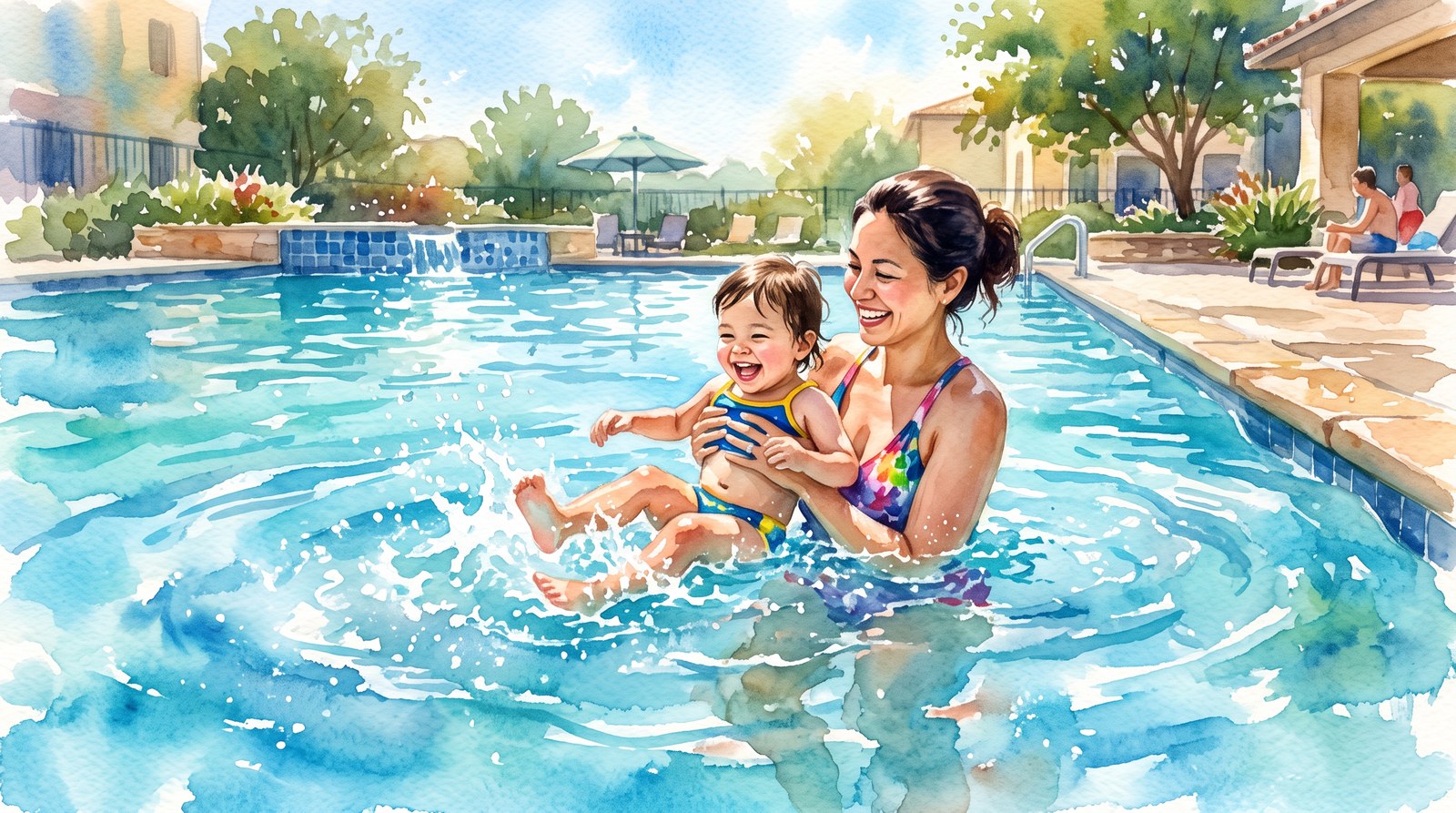
For Swim Schools: A Viewing Policy That Parents Understand
Most complaints about watching don’t arise from the rule, but from surprise. A parent who hears at the door that it’s not allowed feels excluded. Four things prevent that.
Put the Rule on the Website and in the Welcome Email
One paragraph at registration is enough: can you watch, where do you sit, and when are the viewing lessons. Also put it in the confirmation email, because that’s the message parents keep. Those who read it beforehand are not disappointed at the door.
Explain the Reason, Not Just the Rule
"Watching is not allowed" sounds like slamming a door. "Watching is not allowed during the lesson because young children lose the exercise with two voices" is the same rule with a reason. Parents accept almost any rule that sounds logical.
Always Offer an Alternative
A school that does not allow watching must give something back: a monthly update, a viewing lesson per block, a photo at a milestone. In the Swimmigo environment for swim schools progress, messages, and diplomas are in one place, so a parent who can’t watch still knows where it stands. Parents use the app for free; a school chooses the Solo or School subscription, with 30 days free trial.
Explicitly Agree on Photos and Filming
Who takes photos, where are the images stored, and how long are they kept? Record it and ask permission per child. It prevents discussions in the changing room and is fairer to children who do not want to be photographed.
Four Things Parents Often Think
Without Me, My Child Learns Less
Often the opposite is true. Children who keep looking at the side miss part of the lesson. Once they know you are there and stay, attention usually quickly goes to the instructor.
I Can Surely See If It’s Going Well
From a bench you see if a child is smiling and if they go underwater. You don’t see if the arm stroke is correct, if the breathing has rhythm, or if a child is at the next level. For that you need the instructor’s eye or an update showing the skills.
A School That Doesn’t Let You Watch Has Something to Hide
Sometimes yes. Usually a closed pool is a space issue or a conscious choice for calm in the lesson. If the information also stays closed, that is a signal. You may ask questions of a school that shows and tells nothing.
Watching Is the Same as Supervising
Watching is meant to see what your child learns, not to take over the lesson. Once you start coaching from the side, your child has two teachers and one confusion.
In Conclusion
Watching swim lessons is an agreement between school and parent, not a right you can claim and not a favor you receive. The best schools make that agreement clear beforehand and give parents something back if the door stays closed. As a parent, it helps to know what to expect, to stick to the agreement, and to save your questions for after the lesson. More about how to stay involved as a parent is in the overview of parent communication in swim lessons, and the features of Swimmigo show how progress and messages come together in one app.
Swimmigo · Swim lesson app
Free for parents
Follow your child's swimming progress, see where you stand and report absences in the app.
Sources
- American Academy of Pediatrics, Swim Lessons for Children: When to Start and What to Consider, updated May 18, 2026
- Water Safety USA, What to Look for in a Learn to Swim Program
- Swim England, 7 ways to support your child through their swimming lessons, July 26, 2021
- Swim England, When should my child stop swimming lessons?, September 22, 2017
- World Health Organization, Drowning fact sheet

Bob van Soest
As an expert in operating sports facilities (such as swimming pools) and developer of, among others, Swimmigo.com, I am passionately committed to making swimming lessons simpler, more fun and more insightful for parents, swimming instructors and everyone who wants to learn to swim.
Frequently Asked Questions
Related articles
Effectively Involving Parents in Their Child's Swimming Lesson Progress
Practical tips for good communication and collaboration with parents about their child's swimming lesson progress.
Improving Swimming Lesson Progress for Better Parent Communication
Discover how to clearly record swimming lesson progress and communicate effectively with parents for more involvement and better understanding.

Effectively Informing Parents About Swimming Lesson Progress
Practical tips to clearly and engagingly inform parents about their child's swimming lesson progress.
Discover Swimmigo
The all-in-one app for swimming lesson progress. For parents, swim schools, and adult swimmers.