SwimmingLessonsAfteraDivorce:HowTwoHouseholdsKeepProgress,Scheduling,andPaymentsOrganized[2026]
![Swimming Lessons After a Divorce: How Two Households Keep Progress, Scheduling, and Payments Organized [2026]](/_next/image?url=https%3A%2F%2Fzvblogpostimages.s3.eu-west-3.amazonaws.com%2FAUTOMATISCH_UPLOAD%2F1_20c8859b05bc.jpg&w=3840&q=75&dpl=dpl_DqUHNtsMUTtGEGNaUbbB2t9YQZM4)
Summary
- Swimming lessons do not stop after a divorce: with fixed agreements about drop-off, cancellations, and lesson fees, both parents keep an overview.
- Agree on a contact person for the swim school and have that parent forward messages to the other parent.
- Where possible, choose a lesson day fixed in both households, or alternate the drop-off per lesson in a shared calendar.
- Let the swim bag travel with the child and keep the contents the same in both homes, from towel to spare clothes.
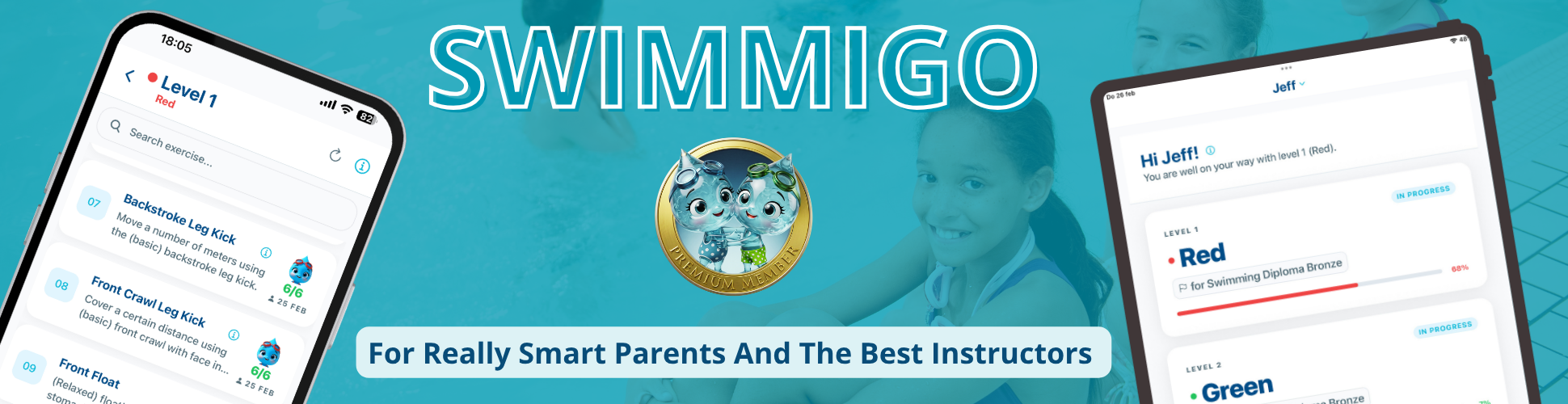
- In Swimmigo, parents see progress per exercise and receive automatic notifications about level, lesson time, and diploma.
Two Households, One Swimming Lesson
Your child's swimming lessons continue even if you separate. The lesson stays on Tuesday at four o'clock, the instructor remains the same, the diploma gets closer. What changes is everything around it: two calendars, two households, and a swim school that usually has only one email address and phone number per student in the system.
As long as both parents know the same information, you hardly notice it. Once one parent cancels a lesson without the other knowing, or the bill remains unpaid in the house where the child is not staying that week, problems arise that your child will ultimately notice in the water.
What Goes Wrong in Practice
Most problems around swimming lessons in two households are logistical. They repeatedly appear in the same forms:
- The swim bag is in one house while the child is in the other house that week.
- One parent cancels, the other parent still brings the child to a lesson that does not take place.
- The school sends a message about the level to one parent, who forgets to forward it.
- The final swim test is scheduled on a day that does not fit the custody schedule.
- The lesson fee is paid twice or not at all, and the school has to follow up.
- Parents have different views on the child's progress, and the conversation at pick-up escalates.
How Often This Happens
This is not a small group. CBS examined how many minors on January 1, 2025, did not live with both legal parents: 23 percent. In 2023, the parents of nearly 43 thousand minors separated, and children between 2 and 7 years old experience this most often, about 2 percent per year. That is exactly the age when most children start swimming lessons.
The Netherlands Youth Institute counted over 13 thousand divorces involving minor children in 2024, accounting for nearly 24 thousand children. Researchers from the Utrecht University estimate that annually over 86 thousand children living at home experience a parental divorce, and about 15 percent of them experience long-term problems.
Internationally, the share of children living with one parent varies widely. In OECD data, accessed via Our World in Data, Greece is at the bottom with 6.5 percent and Lithuania at the top with 31.4 percent. The Netherlands stands at 13.9 percent. The questions parents ask a swim school are the same in all these countries.
| Source | Figure | What It Concerns |
|---|---|---|
| CBS, news report on divorces | 23% | Minors who on January 1, 2025, did not live with both legal parents |
| CBS, National Youth Monitor | 43 thousand | Minors whose parents separated in 2023, 1.7 percent of all minors |
| Netherlands Youth Institute | 13,006 | Divorces with minor children in 2024, involving 23,637 children |
| Utrecht University | 86 thousand | Children living at home who annually experience parental divorce |
| OECD via Our World in Data | 13.9% | Children in the Netherlands living with one parent; Lithuania 31.4 percent, Greece 6.5 percent |
Why Swimming Lessons Are More Sensitive Than School or Sports
The Schedule Rarely Matches the Custody Plan
A school schedule runs five days a week with the child. Whichever house is next, the child goes to school. Swimming lessons are a fixed moment in the week, often on a Tuesday afternoon or Saturday morning. With a week-on-week arrangement, this automatically means your child lives in the house where the swimming gear is one week but not the next. Many schools work with a fixed lesson day per group, so rescheduling is rarely an option, and you will have to adjust the drop-off duties.
There Is a Milestone Attached
A diploma, a certificate per level, or a final swim test afternoon: these are moments when both parents want to be present, even if they prefer to avoid each other. Agree in advance how you feel about this. Will you come together, is a new partner involved, who takes the photos, who goes to the changing room? Children notice tension between parents sharply, especially on a day that should be festive for them.
Two Versions of the Same Story
A six-year-old child tells at home what they remember, and that differs per house. An instructor sees one lesson per week. If you do not fill those gaps together, everyone fills them with assumptions: one parent thinks the child is struggling with backstroke, the other hears the child is almost ready for the next level.

Five Agreements to Make in Advance
A divorce with minor children includes a parenting plan. This contains agreements about how you divide care, how and how often you inform each other about the child, how you make decisions together, and how you share costs. Swimming lessons touch on all these points. You can include these five agreements in it.
One: Who Is the Contact Person for the Swim School
Choose one parent as the contact person and enter that email address and phone number in the school's system. Agree that this parent forwards all messages, including the less pleasant ones. If you want general mailings to go to both parents, request that together so the school does not have to choose who is on the list.
Two: Who Cancels and Who Requests a Make-up Lesson
Agree that the parent with the child on the lesson day cancels and immediately sends a message to the other parent. Check with the school how cancellation works, via app, email, or phone, and the latest time you must cancel. This prevents disputes about a lesson that does not take place.
Three: Who Transfers the Lesson Fee
One payer, one invoice, a fixed moment in the month. Record the amount per month and how you divide it, even if it is part of the costs of care and upbringing. If there is a package with prepayment or a punch card, discuss who advances it and how the other parent reimburses.
Four: How You Inform Each Other About Progress
Make it a fixed habit: after each lesson or each month, a short message about what has changed, without judgment about the other parent or the child. Mention one thing that succeeded and one thing the instructor is working on. This takes two minutes and prevents a level increase from coming as a surprise.
Five: What to Do If You Disagree
Set a route before you need it. For example: first ask the instructor a question, then have a conversation with the school, and only then decide about changing groups or stopping. Include a timeframe, for example two weeks' reflection before your child changes groups. This removes urgency from a decision that affects your child.
The Lesson Week Itself: Drop-off, Pick-up, and Gear
A Swim Bag That Travels Along, With the Same Contents
The simplest solution for the bag: a fixed set that travels with the child instead of per house. Swimwear, towel, flip-flops, a water bottle, and at the bottom a spare underwear and shirt. Label the items with your child's name. Whoever empties the bag after the lesson hangs it to dry and replenishes it, doing so in the house where the child is that week.
Two Towels or One Set That Travels
Choose what suits you. A second set in the other house only works if someone there also washes and replenishes. A set that travels only works if no one takes it out of the bag along the way. Make that choice once and stick to it, because a half-filled bag is exactly the moment a child stands in the changing room without a towel.
Who Brings When the Lesson Is on the Weekend
With week-on-week arrangements, weekend lessons are the hardest. Two solutions that work in practice: choose a lesson day when the child is always with the same parent, or alternate the drop-off per lesson and put that in a shared calendar both parents access. Inform the school who will come, so an instructor does not have to guess who will pick up the child.
| Agreement | Who Does It | How to Record It |
|---|---|---|
| Drop-off and Pick-up | The parent with the child that week | Fixed drop-off turn per week in a shared calendar |
| Canceling Due to Illness | The parent with the child then | First a message to the other parent, then cancel with the school |
| Requesting a Make-up Lesson | The parent who canceled | Choose together which lesson fits, then request via the app |
| Lesson Fee | One parent | One invoice, a fixed moment per month |
| Sharing Progress | The linked parent shares, the other reads along | Short message after each lesson or each month |
| Final Swim Test and Diploma | Together | Agree in advance who is present and who takes photos |
With these agreements on paper, the week remains clear, even in weeks when the child switches houses.

Progress: One Child, One Story
Why Parents View the Same Level Differently
What a child shows at home differs per house. In one house, a child dares the jump, in the other, the water is unfamiliar territory. That difference says something about where practice happens or not, and nothing about who is right. As long as both parents know this, a difference in perception is not a reproach.
Share Only What Has Changed
Anyone who sends a full report after every lesson makes it heavy for themselves. Stick to what is new: a skill that succeeds, a skill the instructor is working on, a changed lesson time, and if something special happened like an ear infection, anxiety about water, or a substitute instructor. Leave out parenting judgments, because then the conversation shifts from your child to parenting.
What the Swim School Can Automatically Share
In Swimmigo, parents follow progress per exercise, with 7 levels and 86 skills from Red to Gold. The app sends a notification when the level increases, when lesson time or group changes, when a lesson is canceled, when a make-up lesson is proposed, and when the diploma is achieved. Messages to the instructor have read receipts, so you know a message has been seen. Parents use the app for free; the swim school chooses a subscription.
For families with two households, this means a shared place instead of forwarded screenshots: the linked parent sees progress directly, and what you want to share you send in a message.
What the Swim School Can Arrange
A Contact Person per Student, Recorded in the File
In almost every system, a student is linked to a parent account. This is due to how the connection works: the account belongs to the child and progress is linked to it. Schools do well to ask at registration if there are two households, who the contact person is, and how the second parent stays informed. Then no one has to reconstruct that later.
Record Who Brings and Picks Up the Child
The student file often only shows the payer and an emergency number. Add who normally brings and picks up the child and who may cancel. This reduces phone calls at the door and confusion at pick-up, especially for children who alternate weekends between parents.
Communicate via One Channel to Both Households
Separate messages to two phone numbers lead to two versions of the truth. Choose one channel where everything is, for example the messaging function in the app or an email to the contact person with the agreement that they forward it. Notifications about level, lesson time, and cancellations then end up somewhere they can be reread, instead of in a conversation that disappears after a week.
Lesson Payments Without Hassle Between Parents
A swim school that puts lesson packages in the app has an administration: parents pay via iDEAL, credit card, or PayPal, and the lesson fees go directly to the school's account. Swimmigo charges 7.5 percent transaction fees per payment; the rest goes to the school. This way, no one has to chase payment requests or pass cash, and every payment immediately appears in the overview. For separated parents, this avoids the hardest conversation of the month.
Money: Who Chooses the Package and Who Pays
First the Choice, Then the Division
Decide together which package fits: single lessons, a package of ten lessons, or a continuous package. Consider the lesson fee the school charges and the surrounding costs, such as registration fees, diploma costs, and extra practice lessons. Put the choice in your agreements, not just in an email someone has to find later.
If One Parent Does Not Contribute
The swim school needs one payer; the division between parents is up to you. If that stalls, seek help with the conversation or agreements, for example by adjusting the parenting plan or revising child support. Keep your child out of it. A child who hears the lesson might not continue because the bill is unpaid loses interest in the water.
What the App Costs
Parents do not need a subscription. An independent swim instructor or a swim school chooses a subscription, with thirty days free trial starting at the first linked student. Monthly cancellable.
| Who | Cost | What You Get |
|---|---|---|
| Parent | Nothing | Progress per exercise, certificates and diplomas, notifications and messages with the instructor |
| Instructor, Solo | 9.99 euros per month | Unlimited students, you are the only instructor, including lesson payments via the app |
| School | 59.99 euros per month | Unlimited instructors and students, multiple locations, team roles, and School Pulse |
| Lesson Payments | 7.5% per payment | Parents pay via iDEAL, credit card, or PayPal; lesson fees go directly to the school |
If Things Go Wrong
The System Emails One Parent
If one of the parents never receives mail from the swim school, it is usually because only one account is linked to the student. Ask the school to send messages concerning both parents also to the second parent, or agree that the contact person forwards everything. Record this at registration, not only when things go wrong.
Keep Conversations Away from the Changing Room
The moment of drop-off and pick-up is the worst time for a difficult conversation. Your child hears it, other parents hear it, and the instructor stands nearby with a group in the water. Make it a habit to discuss issues by email or in a scheduled conversation. A short question about the lesson itself is always possible, a discussion about the bill is not.
If One Parent Keeps Canceling or Does Not Respond
What a swim school can do: keep facts in the file, send notifications via the app instead of separate channels, and request a meeting with both parents if repeated. What a school cannot do is resolve conflicts between parents. Stick to what the school can do: ensure the child gets the lessons paid for and both parents have the same information.
Outside the Netherlands: Different Diplomas, Same Questions
Diplomas Are Not the Same Everywhere
In the Netherlands, many children earn the A, B, and C diplomas; other countries have different systems with different requirements and names. The World Health Organization lists drowning worldwide as the third leading cause of death by unintentional injury, with an estimated 236 thousand deaths per year. Children under five are at greatest risk. Good supervision in and around water, from an inflatable pool in the garden to a seaside vacation, must be arranged the same in both households.
Swimming Lessons for Parents Who Do Not Share the Language
Swimmigo is available in five languages: Dutch, English, German, French, and Spanish. Notifications about progress, lesson time, and diploma come in the language the parent has chosen. This is practical if a parent lives abroad, speaks another language, or does not fully understand the school message in Dutch.
Conclusion
Separating does not make your child's swimming lessons more complicated than necessary. With a contact person, a swim bag that travels, one payer, and a shared place where progress is recorded, both parents and the swim school know where they stand. Arrange agreements before something goes wrong, and keep conversations about your child away from drop-off and pick-up times.
Also Discover
- For parents: progress, notifications, and lesson payments and for swim schools
- All features of Swimmigo and the student tracking system
- Fitting swimming lessons into a busy family life
- Digital parent communication for swimming lessons
- Changing swim schools without losing progress
Sources
- CBS: number of children experiencing divorce increased again, December 2025
- Netherlands Youth Institute: statistics on divorce, accessed September 2026
- Netherlands Youth Institute: effects of divorce on children, accessed September 2026
- Dutch Government: what must be in a parenting plan, accessed September 2026
- Dutch Government: overview for making a parenting plan, accessed September 2026
- Uitelkaar met kinderen: being parents together after divorce, accessed September 2026
- Utrecht University: children with more than one home situation, accessed September 2026
- Our World in Data based on OECD Family Database: share of children living with one parent, data up to 2023, accessed September 2026
- WHO: drowning, statistics and prevention, updated May 2026
- Mulier Institute: more children in the Netherlands earn all three swim diplomas, 2024
Bob van Soest
As an expert in operating sports facilities (such as swimming pools) and developer of, among others, Swimmigo.com, I am passionately committed to making swimming lessons simpler, more fun and more insightful for parents, swimming instructors and everyone who wants to learn to swim.
Frequently Asked Questions
Related articles

Effectively Involving Parents in Their Child's Swimming Lesson Progress
Practical tips for good communication and collaboration with parents about their child's swimming lesson progress.

Improving Swimming Lesson Progress for Better Parent Communication
Discover how to clearly record swimming lesson progress and communicate effectively with parents for more involvement and better understanding.

Effectively Informing Parents About Swimming Lesson Progress
Practical tips to clearly and engagingly inform parents about their child's swimming lesson progress.
Discover Swimmigo
The all-in-one app for swimming lesson progress. For parents, swim schools, and adult swimmers.