DigitalParentCommunicationinSwimmingLessons:FreeToolsforSmallSwimSchools[2026]
![Digital Parent Communication in Swimming Lessons: Free Tools for Small Swim Schools [2026]](/_next/image?url=https%3A%2F%2Fzvblogpostimages.s3.eu-west-3.amazonaws.com%2FAUTOMATISCH_UPLOAD%2F1_bd9fc6bf5372.jpg&w=3840&q=75&dpl=dpl_GWyfLj8UVegbQ18STkVQms8Vj7LD)
Summary
- Small swim schools without a budget struggle with parent communication: WhatsApp is chaotic, email is unread, and expensive software is out of reach
- Free apps like Swimmigo offer a full alternative with student tracking system, parent portal, and multilingual support in 5 languages
- Instructors who switch to structured digital communication save 2 to 4 hours per week on ad-hoc questions and increase parental satisfaction
Digital Parent Communication in Swimming Lessons: Why Free Tools Are the Future
Small swim schools and independent swim instructors face one major problem: no budget for expensive software, yet a need for professional parent communication. WhatsApp groups overflow, emails remain unread, and verbal updates at the poolside are forgotten. At the same time, the market for swim school management software grows by 13.7 percent annually, reaching 345 million dollars in 2024. This growth shows that the need for structured communication is enormous. But not every instructor can afford 50 to 150 euros per month.
This article compares the digital communication channels that do work for small swim schools: from WhatsApp and email to free apps like Swimmigo. We look at functionality, costs, GDPR compliance, and most importantly: what it delivers to the instructor in terms of time savings and parental satisfaction.
What Exactly Is Parent Communication in Swimming Lessons?
Parent communication in swimming lessons includes every contact moment between the swim school or swim instructor and the parent or guardian of a swimming child. It involves much more than just "is everything okay?". It includes:
- Progress reports: how far is my child with the swimming diploma requirements?
- Practical announcements: lesson times, cancellations, make-ups, holidays
- Pedagogical coordination: if a child is anxious, angry, or learns unusually fast
- Safety information: what is allowed and not allowed in and around the pool
- Financial communication: rates, invoices, payment arrangements
For independent swim instructors and small swim schools, this is a significant challenge. There is no secretary to answer the phone, no communications department to send newsletters. The instructor does everything themselves, often in the ten minutes between two lessons.
The Three Biggest Pain Points in Parent Communication at Swimming Lessons
1. Lack of Time for Swim Instructors
A swim instructor often gives 4 to 6 lessons in a row. Between lessons, there are at most 10 minutes to leave the pool, receive the next group, and answer any questions from parents. Structured progress meetings usually don’t happen. In practice, instructors spend on average 3 to 5 hours per week on administration and parent contact outside lesson hours. This is unpaid time and comes at the expense of recovery time.
2. Information Gap for Parents
Parents see their child in the water for half an hour once or twice a week. What exactly happens, which exercise is done, and whether progress is made often remains unclear. NRZ research shows that parents mainly choose swim schools based on practical reasons such as distance and lesson times. They lack sufficient information to select based on quality. This same information gap means parents don’t know if the chosen swim school is achieving results until the diploma moment arrives, or doesn’t.
3. Fragmented Communication Channels
One swim school uses WhatsApp, another email, a third a parent portal, and a fourth mainly verbal handover at the poolside. For parents with multiple children at different swim schools, it’s chaos. NRZ recommends that swim schools work with a recognized diploma system and are transparent about progress. But as long as there is no clear communication channel, that transparency remains absent.
Communication Channels Compared: What Works and What Doesn’t?
WhatsApp and Informal Chat Groups
Many small swim schools use WhatsApp for quick announcements. The advantage is immediacy: everyone reads it right away. The downside is the lack of structure. Conversations overlap, important information gets lost in the scroll, and there is no file buildup per student. For the swim instructor, it also means private and work life mix. Still, WhatsApp is the only feasible option for many independent instructors simply because there is no budget for an expensive communication system.
Email Newsletters
For general announcements such as holiday closures, rate changes, or events, email still works well. The downside is that email is not suitable for individual progress reports. Parents want information about their child, not the whole group. Moreover, the response to email is low: various studies on parental involvement in education show that only 20 to 30 percent of parents actually read a newsletter.
Parent Portals and Student Tracking Systems
Digital platforms are the gold standard for parent communication in swimming lessons. A good parent portal shows parents in real-time which skills their child masters, which need attention, and when the next level is in sight. The global market for swim school management software was valued at 345 million dollars in 2024 and grows by 13.7 percent annually. This shows that more and more swim schools are switching to structured digital communication. The problem for small independents: most systems quickly cost 50 to 150 euros per month.
Verbal Handover at the Poolside
The classic "quick catch-up" at the poolside has one big advantage: it’s personal. For sensitive topics such as anxiety, behavioral problems, or stagnation, a personal conversation is the best form. The downside is that verbal communication is not documented. What is discussed today is forgotten next week, and when the instructor changes, all context is lost.
How Often Should You Communicate with Swimming Lesson Parents?
The Golden Mean: Not Too Much, Not Too Little
Too much communication irritates; too little causes uncertainty. The ideal frequency depends on the type of information, but as a rule of thumb: at least once a month a structured progress update per student. In addition, there are occasional announcements (cancellations, schedule changes, holidays) that must be shared immediately.
A common pitfall is that swim instructors only communicate when there is a problem. If a parent only hears something when things go wrong, a negative association with every contact moment arises. It’s better to also share positive milestones: the first time floating freely without aid, the first dive through a hoop, the moment the breaststroke succeeds. These micro-wins keep parents motivated and involved.
What Parents Really Want to Know
From NRZ research and practical experiences of swim instructors, parents mainly want to know three things:
- Is my child making progress? (concrete progress, not just "it’s going okay")
- When is the diploma in sight? (expectation management)
- What can I do at home to help? (parental involvement)
If a swim school answers these three questions structurally and clearly, the number of ad-hoc questions from parents decreases by an estimated 60 to 70 percent. That saves the instructor hours per week on loose messages and phone calls.
Parent Communication and the Law: Privacy, Consent, and Data Protection
GDPR and Sharing Student Data
As soon as a swim school processes personal data of children (name, date of birth, progress data, medical details), this falls under the General Data Protection Regulation (GDPR). This means swim schools must have a data processing agreement with their software provider, data may not be kept longer than necessary, and parents have the right to access and delete their child’s data.
An important point: WhatsApp groups where student names and progress are shared almost never comply with GDPR requirements. WhatsApp is not designed for processing personal data in an educational context. The same applies to sharing photos and videos of swimming children via social media without explicit consent from both parents or guardians.
Consent for Visual Material
Many swim schools use photos and videos for marketing or progress reports. This requires explicit, informed consent from parents. A general condition in the registration form is not sufficient. Parents must know what the visual material is used for, where it is shared, and how long it is kept. They must also have the option to refuse consent without consequences for their child’s swimming lessons.
Multilingual Communication: Why This Is Becoming Increasingly Important
Expat Parents and Language Barriers
In internationally oriented cities such as Amsterdam, The Hague, Brussels, and Barcelona, the number of expat families seeking swimming lessons for their children is growing. These parents often do not speak the local language well enough to understand complex swimming lesson information. Terms like "water treading", "single backstroke", and "somersault in the water" are already technical for native speakers; for non-Dutch-speaking parents, they are incomprehensible.
A swim school that communicates in the parent’s native language, or at least in English, builds trust faster and prevents misunderstandings about the child’s safety and progress. Swimmigo therefore supports 5 languages (Dutch, English, German, French, and Spanish) so every parent can follow their child’s progress in their own language. This is not only a service but a safety measure: if parents understand what their child can and cannot do in the water, they can make better decisions about supervision and water safety.
Global Standards for Water Safety
The WHO emphasizes that swimming lessons and water safety education are universal basic skills, regardless of language or culture. A child learning to swim safely in the Netherlands must master the same basic skills as a child in Australia, South Africa, or Canada. Communication about this must therefore also be universally understandable. Visual progress systems such as smileys, color codes, and icons often work better than long textual reports, precisely because they bridge language barriers.
How Swimmigo Solves Parent Communication for Small Swim Schools
What Swimmigo Is
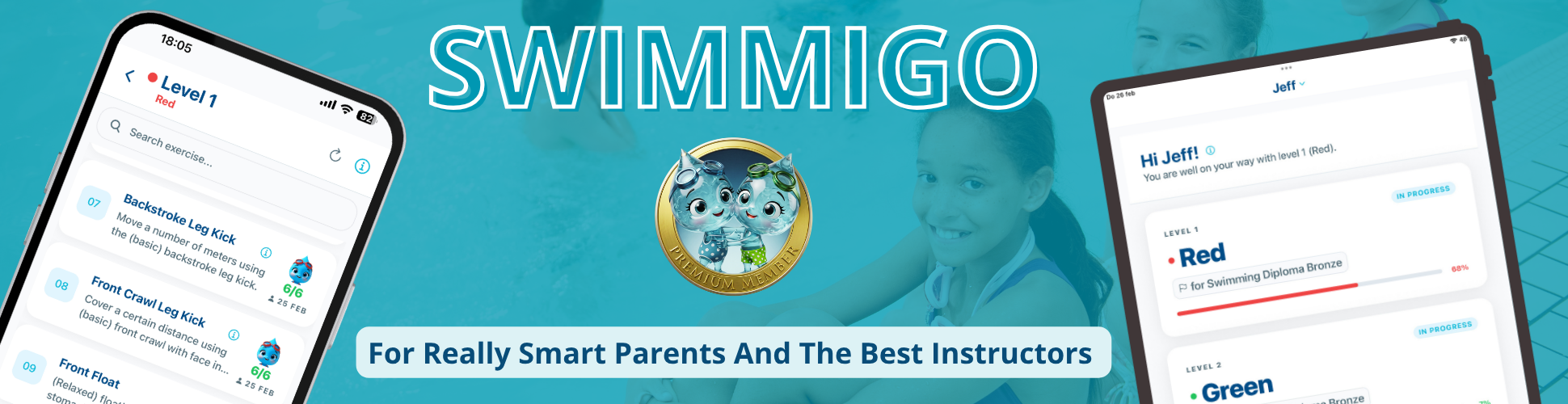
Swimmigo is a free app for independent swim instructors and small swim schools. The app offers a student tracking system with 7 levels (Red through Gold) and 86 skills, divided into 5 categories: water acclimation, leg and arm strokes, breathing, safety, and endurance. For each skill, the instructor can assign a score from 0 to 6 smileys, making progress visible at a glance.
Parents get real-time insight into their child’s progress via a parent link. They see per exercise whether it is on level and receive push notifications upon level increases. Additionally, they can check off practiced skills themselves via a vacation mode, increasing involvement. Once a child fully achieves a level, the app generates a free swim certificate with the child’s name, level, and date. At levels 5, 6, and 7, this is a full personalized diploma.
What Swimmigo Is Not
Swimmigo is not a scheduling or invoicing system. The app focuses purely on swimming lesson progress and parent communication. For schedule management, payments, and student administration, we refer to specialized swim school software. Swimmigo is the communication layer on top: free, in 5 languages, and designed for instructors without a budget for expensive packages.
Communication in Specific Situations
Difficult Conversations with Parents: Anger, Impatience, and Accusations
Every swim instructor encounters this: the parent who thinks it takes too long, the parent who is angry because their child did not advance, or the parent who doesn’t pay tuition but still demands improvement. The key to these conversations is preparation. With a documented progress history in Swimmigo, you can show what you have done, which exercises the child does and does not master, and what the next steps are. A conversation based on data is always more constructive than one based on impressions.
Parents of Children with Special Needs
Children with ADHD, autism, motor disabilities, or anxiety disorders benefit from more intensive communication between instructor and parents. Parents know their child best and can provide crucial information about what does and does not work. An app like Swimmigo offers structure for this: every adjustment in the lesson approach is visible in the progress data, so both instructor and parent maintain a shared view of development.
Communication When Instructors Change
When a child switches instructors (due to vacation, illness, or schedule changes), all context often gets lost in traditional systems. The new instructor doesn’t know which exercises the child already masters, what fears exist, or which didactic approach worked. With a digital student tracking system, the full progress history is available at a glance, including the score achieved per skill. The handover becomes a matter of opening the file instead of remembering.
Conclusion
Digital parent communication is not a luxury but a necessity for small swim schools. WhatsApp and email are a starting point, but a free tool like Swimmigo combines the ease of an app with the structure of a student tracking system. Parents get real-time insight into their child’s swimming lesson progress, in their own language. Instructors save 2 to 4 hours per week on loose messages and phone calls. The result: less frustration, more involvement, and children who learn to swim faster and with more joy.
Read more about how Swimmigo works, check out the 7 swimming lesson levels, or visit the parent page for more information on tracking your child’s swimming lesson progress.
FAQ: General
What is the best way to communicate swimming lesson progress to parents?
A combination of a structured digital overview (app or portal) with occasional personal conversations works best. The digital overview gives parents continuous insight into the current status. Personal conversations are needed in cases of stagnation, special circumstances, or diploma moments.
How often should swim instructors send progress updates to parents?
At least once a month a structured update per student. Additionally, there are occasional updates for special achievements such as a level increase or a breakthrough in a specific skill. Too frequent updates lose their value; too few updates make parents uncertain.
Is WhatsApp allowed for parent communication in swimming lessons?
Strictly speaking, WhatsApp does not comply with GDPR requirements for sharing personal data of children. For short, non-personal announcements it is acceptable, but for progress reports special platforms are necessary.
FAQ: For Parents
My child has been in swimming lessons for months and I see no progress. What should I do?
Request a meeting with the swim instructor and specifically ask which skills your child does and does not master. A good student tracking system gives a score per exercise, so you know exactly where the issue lies.
How can I as a parent support my child’s swimming lesson progress at home?
Regularly go recreational swimming with your child and ask the instructor which specific exercise needs extra attention. Use the vacation mode in Swimmigo to keep track of what your child practices independently during school holidays.
FAQ: For Swim Schools
How much time does a student tracking system save on parent communication?
Instructors who switch from informal communication to a structured system save on average 2 to 4 hours per week on ad-hoc questions from parents.
What does a good communication system cost for a small swim school?
Commercial swim school software ranges from 50 to 150 euros per month. Swimmigo is a free alternative focused on swimming lesson progress and parent communication.
Sources
- World Health Organization: Drowning Fact Sheet, May 2026
- National Council for Swimming Safety: Parents’ Opinions on Swimming Lessons and Water Safety, October 2018
- ZwembadBranche: With These 5 Tips You Keep Your Swim Parents Involved and Satisfied, Nicolette Smale, 2019
- Verified Market Research: Swim School Management Software Market Size, 2025
- Water Safety USA: What to Look for in a Learn to Swim Program, 2024

Bob van Soest
As an expert in operating sports facilities (such as swimming pools) and developer of, among others, Swimmigo.com, I am passionately committed to making swimming lessons simpler, more fun and more insightful for parents, swimming instructors and everyone who wants to learn to swim.
Frequently Asked Questions
Related articles

Effectively Involving Parents in Their Child's Swimming Lesson Progress
Practical tips for good communication and collaboration with parents about their child's swimming lesson progress.

Improving Swimming Lesson Progress for Better Parent Communication
Discover how to clearly record swimming lesson progress and communicate effectively with parents for more involvement and better understanding.

Effectively Informing Parents About Swimming Lesson Progress
Practical tips to clearly and engagingly inform parents about their child's swimming lesson progress.
Discover Swimmigo
The all-in-one app for swimming lesson progress. For parents, swim schools, and adult swimmers.