TeachingYourChildtoSwimWhenYouCan'tSwimYourself:WhatYouCanDo[2026]
![Teaching Your Child to Swim When You Can't Swim Yourself: What You Can Do [2026]](/_next/image?url=https%3A%2F%2Fzvblogpostimages.s3.eu-west-3.amazonaws.com%2FAUTOMATISCH_UPLOAD%2F1_cd74a46d6ba8.jpg&w=3840&q=75&dpl=dpl_DqUHNtsMUTtGEGNaUbbB2t9YQZM4)
Summary
- You do not have to be able to swim yourself to guide your child. The child learns swimming from the instructor.
- In 2024, 46 percent of the Dutch population never swam, and in England 31 percent of adults cannot swim the length of a pool.
- Children under ten born outside Europe drown more than eight times as often as children with Dutch origin.
- What you do: know the trajectory, follow progress, practice water acclimation at home, and agree on supervision with names and tasks.
- Supervision does not replace swimming skills. In an emergency, throw a rescue device and call for help instead of going after it yourself.
You sit on a bench by the poolside, your child waves from the water and you pretend to follow everything. But you cannot swim yourself. What do you say when your child asks if you will go into the water with them, and what can you contribute to a swimming journey where you never get in the water yourself?
You are not alone. In 2024, 46 percent of the Dutch population never swam, and in England nearly a third of adults cannot swim the length of a pool. Parents who cannot swim themselves are therefore more common than the average swimming lesson trajectory suggests.
There is more you can do than you think. A child learns to swim from an instructor, and you handle the rest: understanding the trajectory, following progress, practicing small things at home, and arranging supervision at water with everyone who accompanies your child. Below is how that works in practice for each part.
How Often It Occurs and Why It Usually Remains Quiet
Almost Half of the Dutch Population Never Swims
The Mulier Institute's National Sports Survey shows that 46 percent of Dutch people aged 16 to 80 never swam in 2024. In 2019, that was 30 percent. Those who do swim go on average eight times a year, mostly during holidays or on sunny days. Someone who goes into the water with children once a year is not a swimmer and cannot demonstrate the breaststroke to a child.
Drowning Is One of the Biggest Risks for Children Worldwide
The World Health Organization lists drowning as the third leading cause of death from unintentional injury, with about 236,000 deaths per year. Children under fifteen account for nearly half of that number, and between 2000 and 2021 the number of drownings worldwide decreased by 38 percent. Swimming skills are therefore a basic skill in every country, even in countries without a diploma system with A, B, and C levels.
It Is Also Normal Outside the Netherlands for Parents Not to Swim
Swim England researched how many adults in England cannot swim the length of a pool and found 14.2 million people, 31 percent of the adult population. Helen Mbaziira from Uganda decided to learn to swim at age 43 after her daughter got into trouble in a pool and she could do nothing from the side. She said she was mainly worried about what others would think of her. That barrier recurs in every country where swimming lessons are not taken for granted.
What Parents' Swimming Skills Have to Do with Their Child's
Researchers from the Mulier Institute write that learning to swim becomes less obvious in a family if parents themselves have limited swimming skills. VeiligheidNL states in the guide on swimming safety for newcomers that parents literally not being able to swim contributes to delays in swimming skills in their children, and that parents who do not swim themselves also go to the pool less often with their children.
The CBS showed in July 2026 what this can lead to: children under ten born outside Europe drown more than eight times as often as children with Dutch origin. Between ten and twenty years old, that is almost fourteen times. Children born in the Netherlands with parents from a non-European country have four times the risk. Swimming lessons are therefore not an extra you can postpone for these families.
What You Do Not Need to Be Able to Do Yourself
Demonstrating in the Water Is the Instructor's Job
A swimming teacher sees hundreds of children learn the same thing and builds an exercise step by step that fits together. That is exactly where a parent without swimming experience gets stuck: you cannot let your child feel how a breaststroke works. What a child does need from you is someone who goes to the lesson every week, stays by the side, and asks at home how it went.
Someone Else Can Go Into the Water
If your child is young and likes to play in the water with someone familiar, that does not have to be your role. A partner, grandparent, another parent from the group, or the lifeguard during free swim can fill that role perfectly. Agree in advance who does what, with names and tasks. Without that agreement, supervision sometimes falls to no one, and that is when things go wrong.
Shame Keeps Parents Away from the Poolside
Many parents linger in the changing room, skip viewing days, and do not ask questions if something is unclear. Mbaziira's story reveals exactly that mechanism: what held her back was the idea that she should have been able to do it long ago. The questions parents skip are precisely the questions that provide clarity. How long does this trajectory last, what does my child learn during this period, and where can I see that?
Seven Things You Can Do
1. Learn the Trajectory Your Child Goes Through
Most Dutch swimming schools work with the ZwemABC diploma line. Diploma A corresponds to a pool without attractions, B to a pool with a slide, wave pool, or current, and with C you meet the National Swimming Safety Standard, the level at which you can also manage in calm open water. Of the Dutch, 78 percent do not know what that standard entails. If you do, you can attend a parent evening without guessing what the conversation is about.
2. Follow the Progress, Even If You Are Not at the Poolside
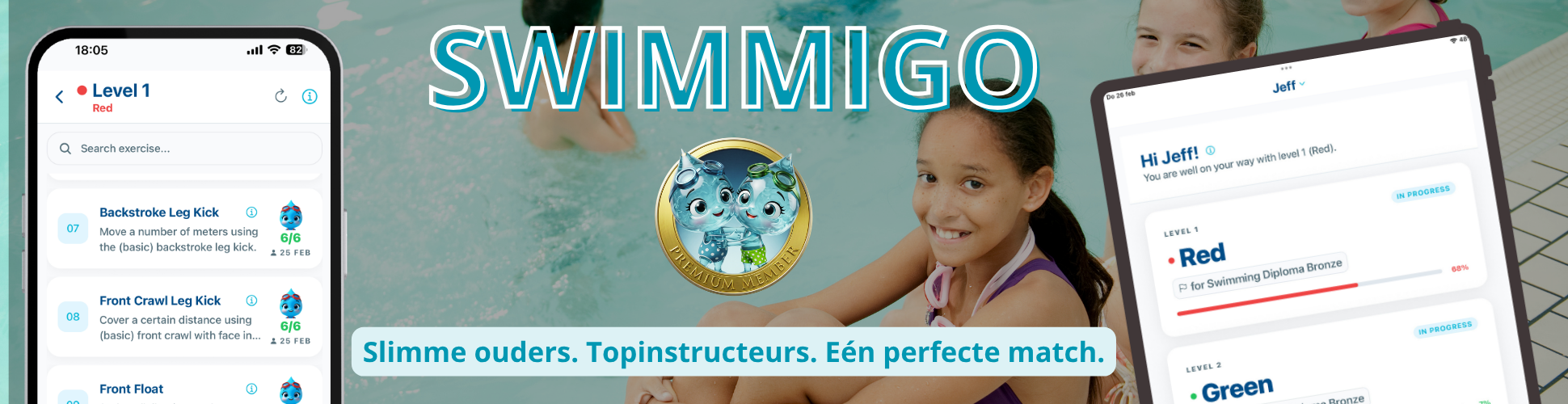
Ask your swimming school which exercises your child is learning this period and how you can see if they succeed. An increasing number of schools use an app that shows per level and per exercise what has been achieved. In the Swimmigo app, a parent sees the same levels and exercises as the instructor, and an update appears after the lesson is updated. For parents, that side is free. So you don't have to settle for the answer that it's going well.
3. Ask for Explanation in the Language You Think In
A swimming lesson is full of words you need to know: water acclimation, water treading, floating, back position. If Dutch is not your first language, that makes the conversation at the poolside unnecessarily difficult. Swimmigo is available in Dutch, English, German, French, and Spanish, and notifications arrive in the recipient's language. Better ask twice for explanation than go home with a half-understood answer.
4. Practice at Home Without Getting Into the Water Yourself
Water acclimation starts small: splashing, wetting the face, looking underwater with goggles, and blowing bubbles in the water. That can be done in the bathtub or shower, with you next to the edge. You do not need to get in, but stay within reach as long as water is involved. Also practice things that happen on dry land, such as squatting, standing up with wet feet, and grabbing the towel yourself.
5. Stay Nearby When Your Child Swims Freely
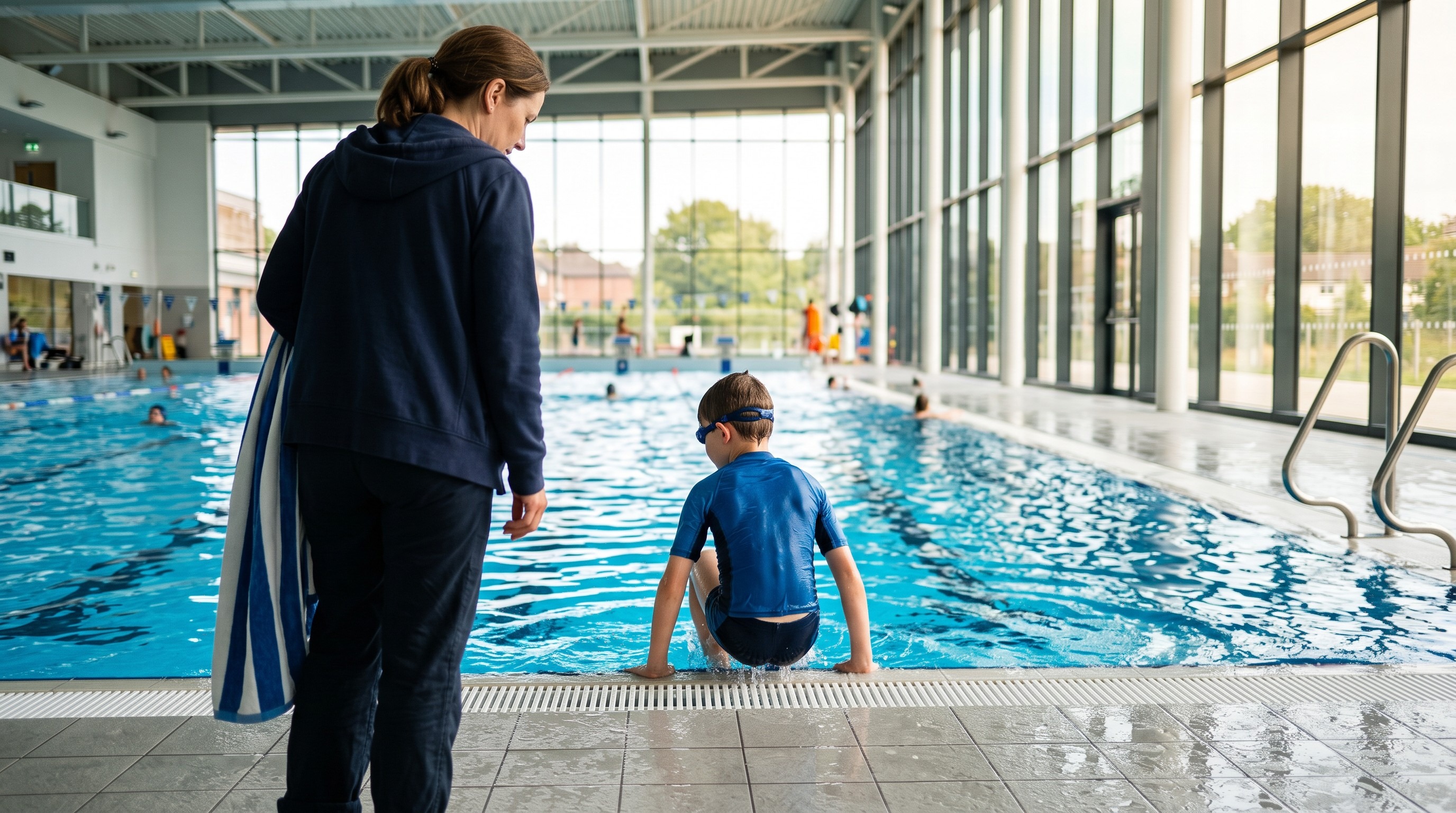
Supervision does not replace swimming skills, but it is the difference between intervening in time and being too late. Stay close to children under twelve, even if they have diploma A, and count on one adult per child if you go to the water with multiple children. If someone gets into trouble, the idea is that you can get help or throw a rescue device without going after them yourself.
6. Maintain the Rhythm and Celebrate Every Step
Children who have swimming lessons every week on the same day and time find it easier to keep going than children whose lessons keep shifting. That also applies to celebrating milestones. A certificate per completed level and a diploma at the final levels give a child a reason to get back in the water next time. In the Swimmigo app, your child receives a certificate as soon as a level is fully completed, and you can share that with family.
7. Dare to Learn to Swim Yourself If You Want
You don't have to, and it is not a condition to guide your child. If you want to, you can learn at any age. Swim England highlights people who learned to swim later in life, often motivated by a child who got into trouble. In the Netherlands, more than a quarter of municipalities have their own scheme to promote swimming skills among adults, and for people with low income the Adult Fund for Sport and Culture contributes. Check with your municipality before you walk into a school yourself.
Supervision Is Different from Being Able to Swim
Why Your Swimming Skills Are Not a Rescue Plan
Parents who cannot swim sometimes panic and go into the water anyway. Then there are two people in trouble instead of one. The safer order is: show your child you are there, throw a rescue device or a stick, and call for help from the lifeguard or bystanders. This applies doubly in open water, because cold and currents disable an adult who cannot swim within seconds.
Open Water Requires More Than Diploma A
In 2024, nearly 40 percent of children aged 6 to 12 had all three diplomas, and 14 percent had none. For open water, diploma C is the standard, while a large part of children stop after A or after A and B. Of the residents who drowned in the Netherlands in the past ten years, 78 percent died in open water. Among residents born outside the Netherlands, that was 93 percent. These figures are not a reason to panic, but to know what to do when you are on vacation by a lake, river, or pond.
Agree on Supervision When Others Take Your Child to Water
Vacations, sleepovers, and family visits are moments when children end up near water without clear agreements. Agree in advance who watches, who says out loud when someone goes into the water, and how far children may go. Name names, even for family you see once a year, and repeat the agreement when new people join.
For Swimming Instructors: How to Reach Parents Without Swimming Skills
Recognize Parents Who Drop Out
Interviews with parents with a refugee background show that language, unfamiliarity with the Dutch swimming lesson system, and a wrong idea about the duration of the trajectory are the biggest barriers. Parents think a child is done after half a year or withdraw their child from lessons because the child manages in the water. If parent and school do not share the same view of the trajectory, it stops naturally.
Communicate in the Parent's Language and Without Jargon
Send updates in the language the parent reads and keep messages short: what was done, what succeeded, what comes next. With Swimmigo settings, you decide per student which updates go out, and the notification arrives in the recipient's language. Two images of an exercise say more than half a paragraph of explanation, especially for a parent who never had swimming lessons themselves.
Make Parents' Swimming Skills Discussable
A swimming instructor often notices first that parents do not swim themselves. Mention it neutrally and offer something concrete: a trial lesson for adults, a referral to the municipal scheme, or a parent-child moment in the shallow pool. Also visibly promote adult lessons on your website and socials, because the barrier is usually shame, not the water.
What the Swimmigo App Costs
Parents use Swimmigo for free. For a swimming instructor or school, there is a subscription with a 30-day free trial starting at the first linked student. There are no costs per student, instructor, or invoice: you choose one fixed amount per month.
| User | Per Month | What You Get |
|---|---|---|
| Parents | free | progress per child, certificates, messages from the school, and payment reminders, in five languages |
| Swimming Instructor, Solo | €9.99 | unlimited students, one fixed monthly fee, you as the only instructor |
| Swimming School, School | €59.99 | unlimited instructors and students, multiple locations, team roles |
| Trial Period | 30 days free | starts at the first linked student, then cancellable monthly |
Swimmigo is available in five languages and is used by swimming schools in multiple countries, from sole proprietors to schools with multiple locations.
What Is Not Possible Without Swimming Lessons
A Diploma and an Honest Assessment of Swimming Safety
Giving swimming lessons is a free profession in the Netherlands and there is no legal regulation for swimming education. Anyone can teach and issue their own diploma, while only license holders of the National Swimming Safety Council may issue the National Swimming Diplomas A, B, and C. So ask a school which diploma your child will get and what that level counts for. Some apps and schools work with their own certificates per level; these help with motivation but are separate from the National Swimming Diplomas.
Conclusion
You do not have to be able to swim to guide your child well through the swimming trajectory. What works is knowing which trajectory your child follows, being able to see progress, practicing small steps at home, and agreeing on supervision at water with names and tasks.
For swimming schools, there is a group of parents currently out of sight. Multilingual communication, explaining the trajectory without jargon, and visibly offering adult swimming lessons require little effort and gain students who otherwise would never have started.
Also Discover
- Teaching your child to swim yourself and practicing at home: is it possible without swimming lessons?
- Complete overview of swimming lessons for adults: learning to swim at a later age
- Is the A diploma enough? Why your child also needs the B and C diploma
- Swimmigo for parents, the levels and skills, for swimming schools and the subscriptions
Sources
- CBS: higher risk of drowning among children not born in the Netherlands, news item 2026/30, July 2026
- WHO: drowning fact sheet, updated May 1, 2026
- WHO: global status report on drowning prevention, 2024
- Mulier Institute: more and more children in the Netherlands obtain all three swimming diplomas, swimming skills of vulnerable children lag behind, 2024
- Mulier Institute: factsheet swimming and swimming safety, trends in swimming participation and opinions on swimming safety, 2024
- Mulier Institute: barriers to learning to swim for children of refugees, November 2022
- Swim England: new statistics reveal more than 14 million adults in England cannot swim, October 2019
- VeiligheidNL, GGD GHOR Netherlands, Pharos and NRZ: guide swimming safety newcomers, May 2023
- Municipality Papendrecht: council letter about the motion Every Child a Swimming Diploma, May 2024
- National Swimming Safety Council: stimulation of adult swimming skills by municipalities, Mulier Institute research, March 2021
- Senate: initiative proposal Swimming Skills Act (36.473), consulted September 2026
Bob van Soest
As an expert in operating sports facilities (such as swimming pools) and developer of, among others, Swimmigo.com, I am passionately committed to making swimming lessons simpler, more fun and more insightful for parents, swimming instructors and everyone who wants to learn to swim.
Frequently Asked Questions
Related articles
![Teaching Your Child to Swim Yourself and Practicing at Home: Is It Possible Without Swimming Lessons? [2026]](/_next/image?url=https%3A%2F%2Fzvblogpostimages.s3.eu-west-3.amazonaws.com%2FAUTOMATISCH_UPLOAD%2F1_7911520ac5b0.jpg&w=3840&q=75&dpl=dpl_DqUHNtsMUTtGEGNaUbbB2t9YQZM4)
Teaching Your Child to Swim Yourself and Practicing at Home: Is It Possible Without Swimming Lessons? [2026]
Teaching your child to swim yourself is partly possible without swimming lessons: becoming water confident and practicing at home works. Read which exercises help and when swimming lessons remain indispensable.
![Swimming Diploma in Two Weeks: Does Turbo Swimming Lesson Really Work? [2026]](/_next/image?url=https%3A%2F%2Fzvblogpostimages.s3.eu-west-3.amazonaws.com%2FAUTOMATISCH_UPLOAD%2F1_3535eb6037e2.jpg&w=3840&q=75&dpl=dpl_DqUHNtsMUTtGEGNaUbbB2t9YQZM4)
Swimming Diploma in Two Weeks: Does Turbo Swimming Lesson Really Work? [2026]
Turbo swimming lessons or holiday courses: can your child get a swimming diploma in two weeks? This is what an accelerated program looks like, what it costs, and for whom it works.
Discover Swimmigo
The all-in-one app for swimming lesson progress. For parents, swim schools, and adult swimmers.