Less correction, safer swimmers: how children really learn to swim [2026]

Summary
- A practical test with five methods for backstroke shows implicit learning transfers better to new situations.
- Explicit corrections give more technical progress, implicit learning gives more speed and propulsion.
- For water safety adaptability matters: a child who falls unexpectedly must be able to save themselves.
- Limit corrections, alternate methods and use video, although more research is needed for a firm conclusion.
How does a child actually learn to swim? One instructor insists on technique: arms like this, legs like that, head in the right position. Another lets children discover and play a lot on their own. For years that debate was mostly about feelings. Now there is a practical test showing the choice really matters, and that the difference is exactly where water safety depends on it.
Why this research matters
The debate: technique versus self-reliance
Two views clash in swim lessons. One focuses on the perfect stroke: the tighter the technique, the better the swimmer. The other focuses on self-reliance: can a child save themselves if they end up in the water unexpectedly? The two may go together, but not necessarily. A child who learns the correct movement neatly can still freeze when the situation differs from the lesson.
What was tested: five methods, one stroke
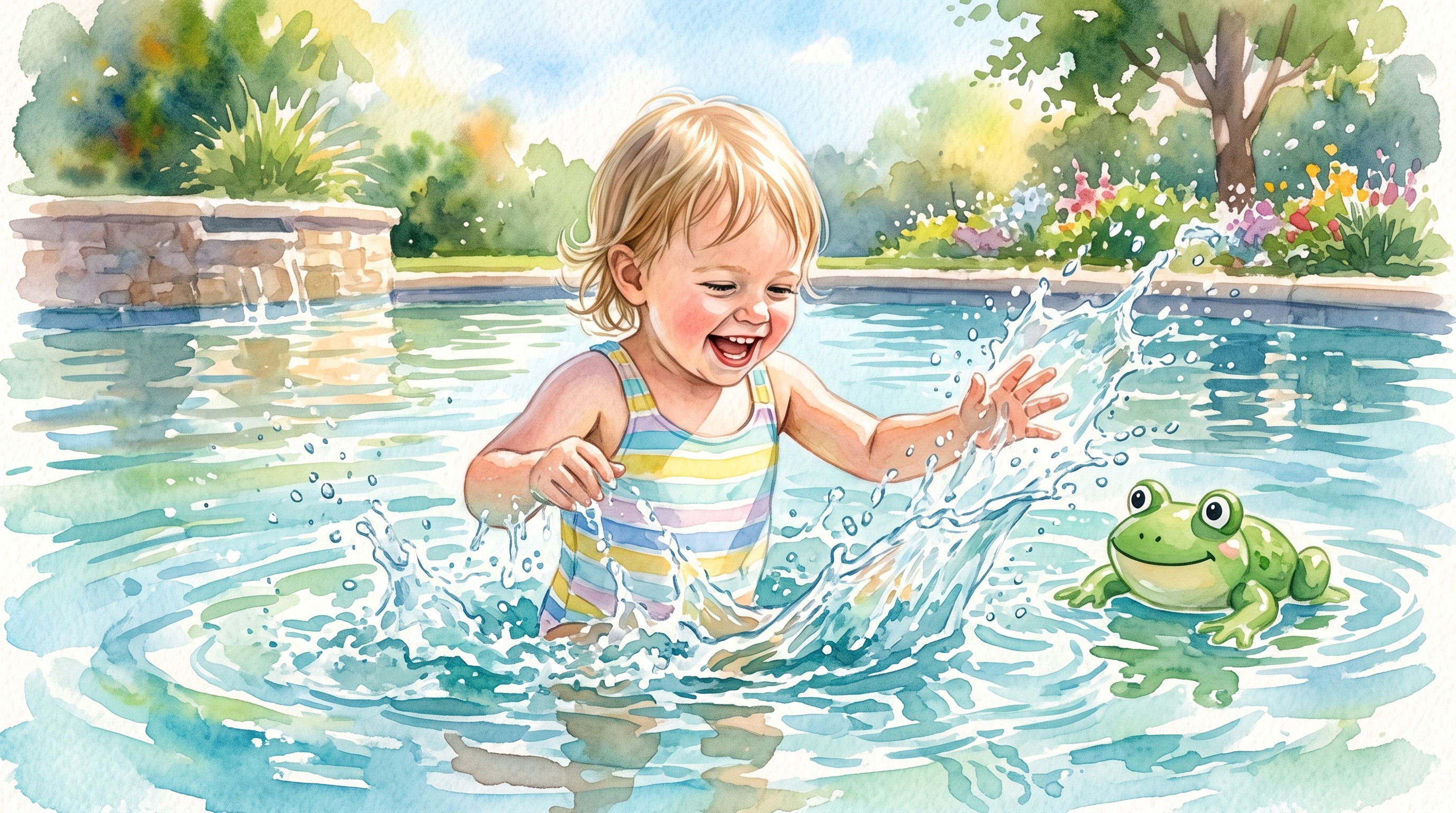
In a practical test five instruction methods for the backstroke were compared in children. Three methods were implicit: learning via an image, such as comparing to a frog, learning with an external focus, like pushing the water away, and learning with equipment, such as shoes with flaps. Two methods were explicit: clear tips and feedback, one of those groups also received video.
What the test showed
Explicit without video performed worst
The group that only received verbal explanation and feedback did least well. Telling a child only how the movement should be, without an image or experience, helps less than you might expect. Words alone land only limitedly with a young child.
Explicit gave the most technical progress
The explicit methods did have one advantage: technique improved the most. Those who received targeted instructions mastered the form of the backstroke more neatly. Technique therefore has value, especially if you look at the movement itself.
Implicit gave the most speed and propulsion
The implicit groups won on another level: speed and propulsion. They moved forward faster and generated more drive in the stroke. That makes sense, because implicit learning focuses on the effect of the movement, not on its form.
Implicit applied the movement better in a new situation
The most important difference was transfer. The implicit groups could apply what they learned better in a new situation. And that is exactly the point that matters for water safety: a child who falls into the water unexpectedly must be able to adapt to something they never practised exactly that way.
Swimmigo · Swim lesson app
Free for parents
Follow your child's swimming progress, see where you stand and report absences in the app.


Why adaptability is the point
A child who falls unexpectedly must be able to adapt
Water is never exactly the same. A different depth, another temperature, clothes that become heavy, a moment of fright. Someone who only knows a rehearsed movement can get stuck as soon as the situation deviates. Someone who has learned to adapt finds a way to stay afloat and reach the edge even in a new situation.
What this means for swim lessons
This is not an argument against technique. It is an argument against a lesson made up only of technique. A lesson in which children are also allowed to discover a lot themselves, using images and play, builds that adaptability you need in an emergency.
What the researcher advises, and what is not settled yet
Limit explicit corrections and alternate methods
The recommendation from the research is clear: limit explicit corrections and alternate them with implicit tasks. Do not spend the whole lesson giving directions about arms and legs, but let children also discover how a movement feels and what it does.
Video works well
Video proves to be a strong addition. A child who sees themselves or a model learns faster than a child who only hears an explanation. That matches the idea of implicit learning: an image says more than a series of verbal instructions.
More and longer research is needed
To be fair: this is one test with a limited group. The researcher himself says that larger and longer studies are needed for a firm conclusion. Treat the outcome as a strong indication, not the final word.
What you can do as a parent or instructor
For instructors
Look critically at your own lesson. Is there an image, a comparison or a game opposite every verbal correction? Alternate technical feedback with tasks that let the child discover for themselves. And use video where you can.
For parents
Practising at home does not have to be a second technique lesson. Let your child try a lot on their own and give an occasional cue. The goal is not the perfect movement, but a child who can save themselves in the water.
Conclusion
The debate between technique and self-reliance is not black and white. Explicit corrections tidy up technique, implicit learning makes children faster and, more importantly, more resilient in a new situation. For water safety that last point is decisive. Less correcting, more letting children discover and the occasional targeted cue is for now the best advice, until larger studies sharpen the picture further.
More about how children develop in the water: the levels page. If you are an instructor, see the instructor page.
Swimmigo · Swim lesson app
Free for parents
Follow your child's swimming progress, see where you stand and report absences in the app.
Sources
- Minkels, van der Kamp, de Vries & Beek: Learning how to swim in 5- to 12-year-old children, an overview of evidence-based learning methods
- InnoSportLab de Tongelreep: how children best learn to swim
- Wulf: Attentional focus and motor learning, a review of 15 years of research, 2013
- World Health Organization: drowning, facts and figures

Bob van Soest
As an expert in operating sports facilities (such as swimming pools) and developer of, among others, Swimmigo.com, I am passionately committed to making swimming lessons simpler, more fun and more insightful for parents, swimming instructors and everyone who wants to learn to swim.
Frequently Asked Questions
Related articles
Teaching Your Child to Swim Yourself and Practicing at Home: Is It Possible Without Swimming Lessons?
Teaching your child to swim yourself is partly possible without swimming lessons: becoming water confident and practicing at home works. Read which exercises help and when swimming lessons remain indispensable.
Teaching Your Child to Float: How to Do It in Small Steps
Floating is the foundation of every swimming stroke. This step-by-step plan teaches your child to float on their stomach and back, safely and playfully, at home or in the pool.
Swim diploma in two weeks: does turbo swimming lessons really work?
Turbo swimming lessons or holiday course: can your child get a swim diploma in two weeks? This is what an accelerated program looks like, what it costs, and who it works for.
Discover Swimmigo
The all-in-one app for swimming lesson progress. For parents, swim schools, and adult swimmers.