CompleteOverviewofDigitalTransformationinSwimmingLessons:HowTechnologyModernizesSwimEducation[2026]
![Complete Overview of Digital Transformation in Swimming Lessons: How Technology Modernizes Swim Education [2026]](/_next/image?url=https%3A%2F%2Fzvblogpostimages.s3.eu-west-3.amazonaws.com%2FAUTOMATISCH_UPLOAD%2F1_f1c65828b31b.jpg&w=3840&q=75&dpl=dpl_FEcJLWFaZFj4CsT2F159aPzMcoRK)
Summary
- The swim school market grows from 4.8 billion dollars in 2025 to 8.6 billion in 2034; swim club management software grows even faster from 1 billion to 2.5 billion in 2035
- AI-driven video analysis, wearables, and underwater cameras make technique training measurable: errors are corrected immediately instead of afterward
- Digital parent communication via apps increasingly replaces WhatsApp groups and paper notes, with measurably higher parent satisfaction and less miscommunication
- Free tools like Swimmigo make professional digitization accessible for every swim school, regardless of budget or size
- The biggest challenge is not the technology itself but the willingness to change processes: swim schools that digitize early build a competitive advantage
Why Digital Transformation in Swimming Lessons Is Now Inevitable
Ask any swim instructor what their administration looks like. Chances are the answer is "Excel and a binder." Or worse: a stack of wet papers by the poolside. The world of swimming lessons has traditionally been a physical profession: you stand in the water, watch children, correct arms and legs. But outside the water, something is happening that fundamentally changes the profession.
The global market for swim school software is growing rapidly. The total swim school market was worth 4.8 billion dollars in 2025 and is projected to grow to 8.6 billion by 2034. Software for swim club management, a related category, grew from 1 billion dollars in 2025 to an expected 2.5 billion in 2035. This growth does not come from the top of the market but from small swim schools and independent instructors discovering that digital tools are no longer a luxury but a necessity. Parents used to real-time tracking of their packages, banking, and step counters expect the same insight into their child's swimming progress. Those who don't offer this lose customers to competitors who do.
This overview maps the full digital transformation: from student administration to AI-driven video analysis, from parent apps to wearables in the water. For swim instructors who want to know where to start. For parents who want to understand what is technologically possible. And for swim school owners who want to make a strategic choice in a rapidly digitizing market.
The State of Digitization in Swim Schools: From Zero to Now
Paper, Excel, and Daily Frustration
Most small swim schools in the Netherlands and beyond still operate largely analog. Student data is kept in an Excel file managed by one person. Progress is tracked on paper cards updated manually after each lesson, or not at all. Communication with parents happens via WhatsApp groups overflowing with messages about lesson times, cancellations, and the eternal question "how did it go today?".
A swim instructor with 120 students spends an estimated 3 to 5 hours per week on pure administration: tracking absences, adjusting levels, informing parents, checking invoices. That's one full working day per month on tasks that don't take place in the water. With a growing teacher shortage and rising operational costs, that's a luxury no one can afford.
The Swim School Software Market in Numbers
The numbers are clear. The total swim school market was worth 4.8 billion dollars in 2025 and is growing to 8.6 billion by 2034, nearly doubling in less than ten years. Software for swim club management is growing even faster: from 1 billion dollars in 2025 to an expected 2.5 billion in 2035, with an annual growth of 9.3 percent. Software is the fastest-growing segment within this.
The total swim school market, including lessons, facilities, and materials, was worth 4.8 billion dollars in 2025 and grows to 8.6 billion in 2034. Software is the fastest-growing segment within this.
| Market Segment | Value 2025 | Projection 2034/2035 | Annual Growth |
|---|---|---|---|
| Total Swim School Market | $4,800M (2025) | $8,600M (2034) | 6.7% |
| Swim Club Management Software | $1,023M (2025) | $2,500M (2035) | 9.3% |
This growth is driven by a combination of factors: rising expectations from parents, increasing competition between swim schools, stricter data protection requirements, and the availability of affordable cloud technology previously reserved for large organizations.
The Six Technologies Changing Swimming Lessons
1. Student Tracking Systems: The Digital Report
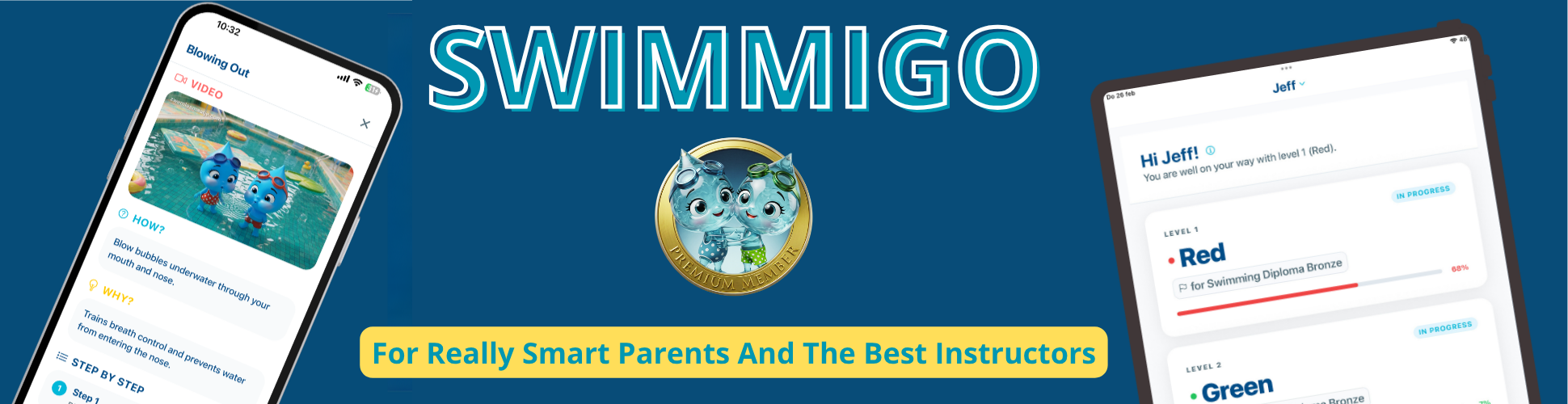
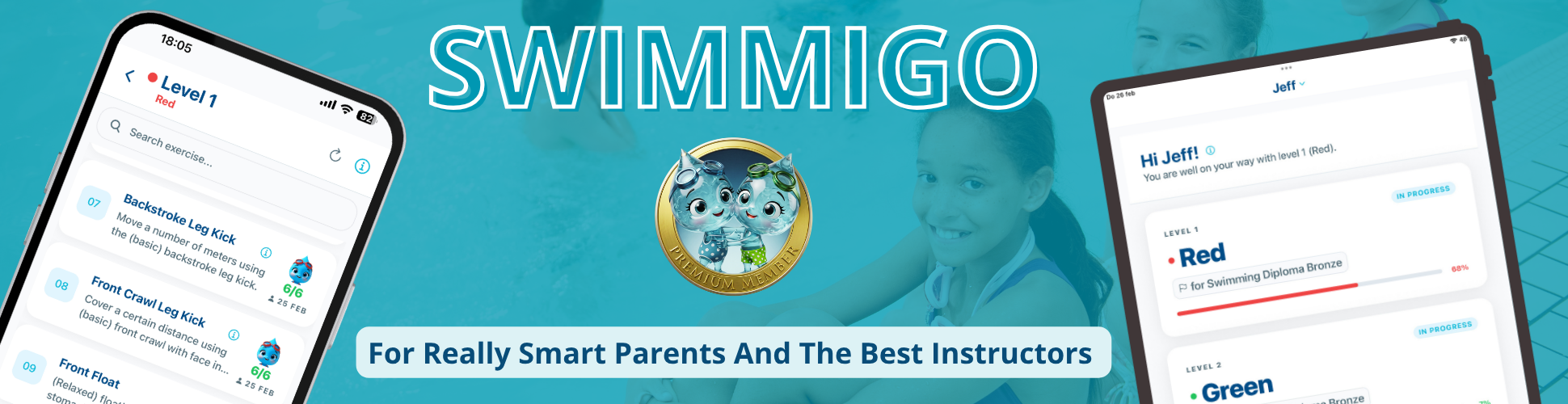
The digital student tracking system is the foundation of every swim school that wants to digitize. Instead of paper cards with checkmarks, the instructor records after each lesson how a student performs per skill. Ideally, this happens during the lesson on a tablet or smartphone at the poolside. The system immediately shows the level, progress over time, and which skills need extra attention.
The power lies in what happens next: parents see the same information in real-time in their own app. No more surprises at the ten-week report. No "I didn’t know he struggled with breaststroke." Parents become co-owners of the learning process instead of passive spectators behind the glass. Research on parental involvement in education consistently shows that informed parents contribute to better learning outcomes. For swimming lessons, where a child often has only one lesson per week and practices at home the rest of the time, that involvement is even more crucial.
2. Parent Communication Apps: From WhatsApp Chaos to Structured Contact
WhatsApp groups with 47 participants are standard in many swim schools. The problem is well known: important announcements get lost in a flood of "my child is sick," "which lane is it today?", and parents accidentally hitting 'reply all.' Instructors get frustrated because they have to answer the same question three times. Parents get frustrated because they miss information.
Modern parent communication apps replace this chaos with structured channels. Push notifications for level upgrades, automatic absence notifications, and a news feed where only the swim school posts messages. Parents can view per child, see which skills are being practiced, and receive alerts when their child advances a level. For multilingual swim schools, there is an extra dimension: apps like Swimmigo support communication in five languages simultaneously, so expat parents are not sidelined by a language barrier.
The time savings for instructors are significant. Swim schools switching to a structured digital communication system report 2 to 4 fewer hours of ad-hoc questions per week. That time goes back to where it belongs: teaching in the water.
3. AI-Driven Video Analysis: The Digital Mirror
One of the biggest challenges in swimming lessons is that as an instructor you cannot look underwater while standing on the side. What a child does with their arms above water tells only half the story. The leg movement, body posture, the catch moment of the hand: that happens below the waterline and is difficult to assess with the naked eye.
Affordable underwater cameras with WiFi streaming like Seavu solve this. The camera hangs at the pool edge and sends a live image to a tablet on the side. The instructor sees in real-time what happens underwater and can correct immediately. No delay, no video files to review later. The correction happens while the movement is still fresh in the student's muscle memory.
On top of that comes AI-driven video analysis. Software automatically detects errors in the stroke: too deep arm entry, asymmetrical leg movement, incorrect breathing timing. A systematic review of 42 studies between 2018 and 2024 on AI in swimming shows the technology is maturing quickly. The combination of real-time sensor data with video analysis makes technique training measurable instead of subjective. For competitive swimmers, this is already common practice. For swim schools, it is the next step in professionalization.
4. Wearables: Data on the Wrist
The smartwatches swimmers wear have evolved beyond simple lap counters. Modern swim wearables measure stroke rate, stroke length, SWOLF score (an efficiency index), heart rate underwater, and automatically recognize which stroke is being swum. An instructor in the water with 10 children cannot manually track how many laps each child has swum and at what intensity. A wearable does this automatically and objectively.
The value for swim schools lies not in the raw data but in the trends. A child whose stroke efficiency stagnates for three weeks likely has a specific technical problem needing extra attention. A child consistently with a high heart rate during breaststroke wastes energy due to incorrect breathing. These insights were previously visible only to very experienced instructors who observed each child intensively. With wearables, they become objective and available to every instructor.
5. Digital Swim Diplomas and Certificates
The paper diploma on the wall is a nostalgic image, but digital offers more. A child who reaches level 5 in a modern swim school receives not only a physical diploma but also a digital certificate shareable with family. Parents can save it, forward it to grandparents, or share it on social media.
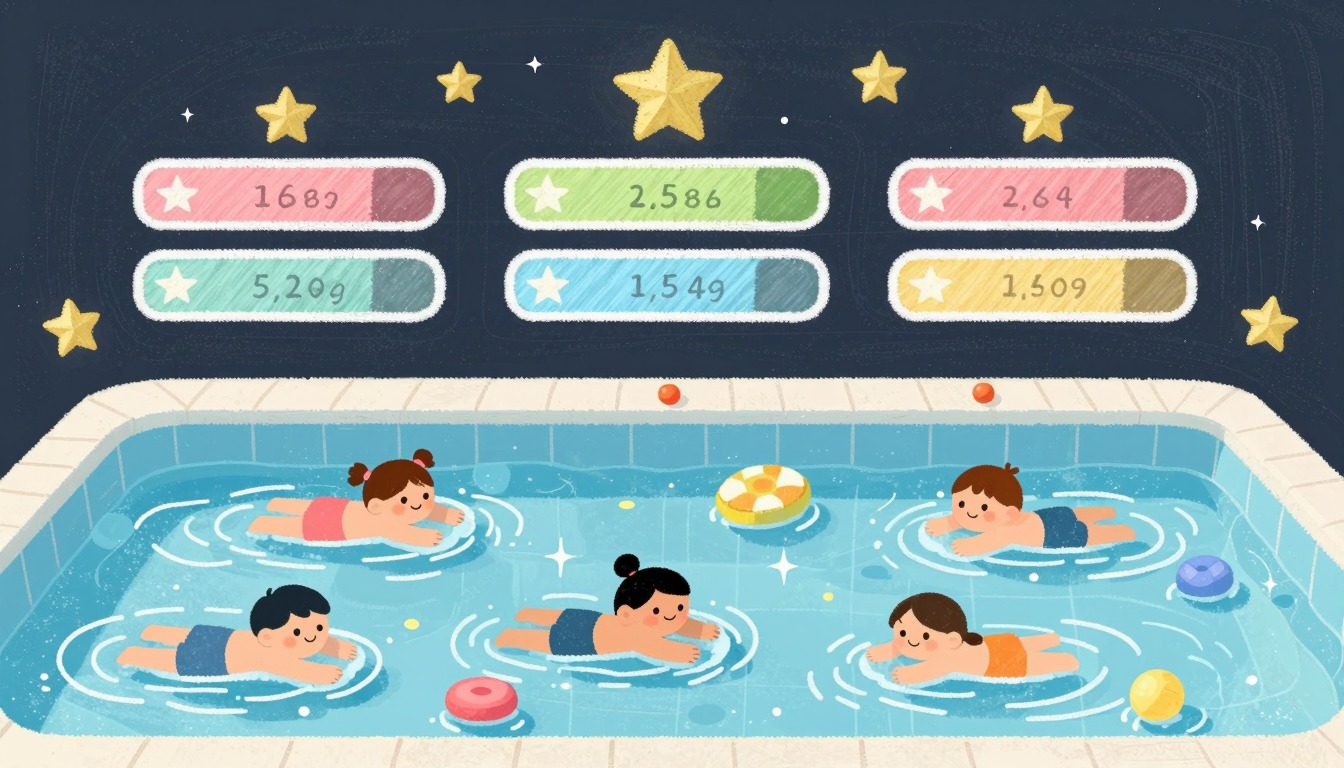
The pedagogical value is greater than it seems. Children who see their progress visually and shareably grow stronger in motivation. Swimmigo’s smiley system uses six levels per skill, from red (beginner) to gold (star). A child who sees four out of six boxes filled has a concrete goal in mind. That works better than "you need to practice harder."
6. Scheduling and Rostering: The Lost Excel File
Lesson schedules, group assignments, absences, substitutions during illness: the planning of a swim school is a logistical puzzle rearranged weekly. In many small swim schools, one person does this manually in Excel, which is error-prone. A student assigned incorrectly suddenly ends up in a group too high or too low. A substitute who doesn’t know which children have special needs misses crucial context.
Digital scheduling tools automate this puzzle. Students are assigned by level and availability, absences are processed in real-time, and substitutes see each student’s profile in their group immediately upon arrival. For swim schools with multiple locations and instructors, this is the difference between chaos and overview.
The Impact on Parents: From Spectator to Partner
What Parents Currently Miss
The classic swimming lesson trajectory is a black box for parents. You drop your child off at the pool, wait half an hour behind glass, and hope there is progress. Every ten weeks you get a paper with a level indication: "your child is moving to level 4." Why? Which skills have improved? What should be practiced at home? That information is usually missing.
A WHO study shows drowning is the fourth leading cause of death worldwide among children aged 1 to 4 and the third among children aged 5 to 14. Every year 300,000 people drown, nearly a quarter of whom are children under 5. Good swimming lessons save lives. But only if parents know what their child can and cannot do, can they practice effectively at home and make better decisions about water safety. A parent who thinks their child "can swim" because they have an A diploma, while the child actually only learned to swim in a heated indoor pool with a fixed edge, gets a false sense of security.
What Digital Tools Do Give Parents
A parent app showing mastery level per skill changes the conversation at the kitchen table. Instead of "how was swimming?" with the standard answer "fun," it becomes: "I see your breaststroke leg movement is orange, shall we practice in the toddler pool this afternoon?" The parent becomes part of the learning process.
For expat parents, this is even more important. They often don’t speak the instructor’s language well, don’t understand the Dutch diploma system, and cannot place the swimming lesson culture. A multilingual app showing the same progress information in English, German, French, and Spanish removes that barrier. Swimming lessons become more inclusive and parents feel taken seriously.
The Impact on Swim Instructors: From Administration to Teaching
Time Savings: Hours Returned to the Water
The math is simple. A swim instructor switching from paper administration to a digital student tracking system with integrated parent app saves 3 to 5 hours per week. That’s 150 to 250 hours per year. Hours that previously went to Excel and WhatsApp return to where the instructor’s passion lies: teaching children to swim better.
The savings come from three sources. First: real-time registration during the lesson instead of filling in afterward. Second: automatic parent notifications instead of individual messages. Third: all student information in one central place instead of spread over three systems and a binder.
Quality of Teaching
Digital tools improve not only efficiency but also the quality of teaching itself. An instructor who opens the dashboard before each lesson sees at a glance: which children are in the group, their current skill levels, who needs extra attention, and who is about to move to the next level. This context was previously fragmented over paper, memory, and experience. Now it is consolidated on one screen.
Visual progress systems like the smiley model also have a proven motivating effect on students. Children who physically see their smiley move from orange to green experience progress concretely. This reduces dropout and increases lesson motivation.
How to Start Digitizing as a Small Swim School?
Step 1: Choose One System That Integrates Everything
The biggest mistake digitizing swim schools make is buying separate tools: one app for scheduling, another system for student tracking, and yet another tool for parent communication. That fragmentation creates exactly the problem digitization was supposed to solve: information scattered in multiple places and not synchronized.
Instead, choose an integrated platform combining scheduling, student tracking, parent communication, and reporting in one environment. For small swim schools with limited budgets, Swimmigo is the logical choice: it’s completely free, supports five languages, and is specifically built for the combination of instructor functionality and parent access that swim schools need.
Step 2: Start with the Basics, Expand Later
No one implements AI video analysis, wearables, and a fully digital student tracking system all at once. The best order: first the student tracking system and parent app (two sides of the same coin), then scheduling, then advanced tools like video analysis and wearables.
The first step immediately delivers the biggest time savings and gives parents an experience they don’t get with a non-digitized competitor. From day one, parents see their child’s progress in the app. That’s the moment digitization shifts from cost to competitive advantage.
Step 3: Train Your Team on the Process, Not the Buttons
The biggest barrier to digitization is not technical but human. Instructors who have worked with pen and paper for twenty years are not convinced by a feature list. They need to experience that the system lightens their work, not complicates it. Implementation succeeds or fails in the first two weeks: if instructors notice they spend less time on administration after lessons and parents ask fewer questions, they are convinced.
Therefore, train not on "how to fill in a score" but on "how to finish administration within thirty seconds after the lesson and parents automatically get an update." Process thinking wins over feature training.
Limitations and Realistic Expectations
What Technology Does Not Solve
An app does not turn a bad instructor into a good one. Digital tools are aids, not replacements for craftsmanship. The instructor’s eye that sees a child hesitantly enter the water, the hand on the shoulder that gives confidence, the calm voice explaining why something doesn’t work: these are human qualities software can never replace.
Moreover, technology always has a learning curve. The first weeks with a new system take more time, not less. Only after getting used to it does the time saving appear. Swim schools expecting digitization to run smoothly from day one drop out too early.
Privacy and GDPR: Not a Side Issue
A student tracking system processes data of minors: names, birthdates, sometimes medical details, and detailed performance information. This is sensitive data covered by GDPR. Choose only tools explicitly GDPR-compliant, storing data on European servers, and able to provide a data processing agreement. Free tools that sell data to advertisers are not an option: fines can reach up to 4 percent of annual turnover.
Swimmigo is GDPR-compliant and stores data within the EU. The app only requests data strictly necessary for the student tracking system and shares nothing with third parties.
The Future: Where Is This Heading?
AI That Predicts the Diploma
The next generation of student tracking systems does more than register: they predict. Based on historical data from thousands of students, AI can estimate how many lessons a child still needs for the next level, which skills are the biggest stumbling blocks, and when a motivation dip is likely. Instructors receive these insights proactively instead of having to recognize patterns themselves.
Virtual Reality for Water Acclimation
Experimental projects with VR swim training let children get used to water in a safe, virtual environment before entering the real pool. For children with extreme water fear, this can make the difference between never learning to swim and eventually daring to enter the water. The technology is still in its infancy but early results are promising.
The Connected Pool
Smart pools with built-in sensors, cameras, and real-time data analysis are no longer science fiction. Some pioneering swim centers experiment with cameras that automatically recognize stroke types, measure distances, and record mistakes without an instructor needing to watch. The instructor receives a dashboard with focus students and specific correction advice. The profession changes from "seeing and remembering everything yourself" to "data-informed coaching."
Discover more: Swimmigo for parents, for swim schools, all features, or the student tracking system.
Sources
- WiseGuy Reports: Swim Club Management Software Market Forecast, 2025
- DataIntelo: Swim School Market Research Report, 2025
- WHO: Drowning Fact Sheet, 2025
- Technology.org: 7 Innovative Technologies Swim Coaches Are Using, August 2026
- Springer: AI for Swimming Recommendation Systems, A Systematic Review, 2025

Bob van Soest
As an expert in operating sports facilities (such as swimming pools) and developer of, among others, Swimmigo.com, I am passionately committed to making swimming lessons simpler, more fun and more insightful for parents, swimming instructors and everyone who wants to learn to swim.
Frequently Asked Questions
![Administration, Communication, and Payments for Your Swim School in One App [2026]](/_next/image?url=https%3A%2F%2Fzvblogpostimages.s3.eu-west-3.amazonaws.com%2FAUTOMATISCH_UPLOAD%2F1_ff9bf21fb987.jpg&w=3840&q=75&dpl=dpl_FEcJLWFaZFj4CsT2F159aPzMcoRK)
Discover Swimmigo
The all-in-one app for swimming lesson progress. For parents, swim schools, and adult swimmers.