My child cries at swimming lessons: what is actually going on and what you can do [2026]

Summary
- For most children the crying eases within three to four lessons, without changing the lesson itself.
- The water is rarely the cause. The transition to the lesson, the goodbye and the stimuli in the hall weigh more heavily.
- A short goodbye, a fixed place out of sight of your child and one small step per lesson work better than explanations afterwards.
- If the crying becomes worse each week or the anxiety also occurs at home, that is a signal to speak with the swimming school and, if needed, a doctor.
For most children the crying eases within three to four lessons, without you having to change the lesson itself. What makes a child cry is rarely the water. It is the transition: a hall with echoes, a row of unfamiliar children, an instructor who is not yet a familiar face and a parent who walks away while the child does not know how long that will take.
You do not have to wait for it to pass on its own. A short goodbye, a fixed spot out of sight of your child and an instructor who makes one small step each lesson usually help more than a long talk afterwards. And there is a moment when crying is no longer just getting used to it, but a signal to intervene.
Why a child cries at swimming lessons
Children cry at swimming lessons for reasons that have little to do with swimming. The pool hall is large and hollow, so every sound echoes. Other children are around, the floor is wet, the air smells of chlorine and there is an adult in the water your child has never seen. For a four year old that is a lot to process in fifteen minutes.
The water is rarely the cause
A child who cries often still takes part in the exercise. The water supports the child, the instructor holds on and nothing bad happens. Children between four and seven are usually reassured quickly. What lingers is the announcement: changing clothes, the line, the waiting until it is your turn.
Water confidence and swimming ability are two different things. According to Swim England, water confidence is not the same as skill or competence, and that goes both ways. A child who cried last month can be the best floater in the group this month. A child who never cries does not automatically know how to swim.
Saying goodbye to the parent
Around the age of three a child begins to understand that you leave and come back. The feeling does not develop at the same pace. For children between four and ten this can show as crying at the moment of departure and worrying beforehand, in the car or the night before: will you really stay, where are you going, how long will it take. The children's hospital CHOC describes that anticipation as a normal sign of separation anxiety at this age, and only when the child suffers daily from it does it become a reason for extra help.
A new place with lots of noise
Some children have more trouble with stimuli than others. A hall where everything reverberates, where water splashes and where thirty people talk at once demands a lot of attention. Children who are sensitive to that have little left over for the lesson itself. They often need three to four visits before the hall is no longer the first impression.
Cold water, hunger and tiredness
A lesson at five o'clock after a school day is a heavy task for a five year old. Water around 30 degrees feels cold when you have to stand still, and a child who has not eaten since lunch has little interest in something exciting. An empty stomach, a short night or a busy school day is enough to bring tears closer to the surface.
Waiting is the hardest part
In a group of ten a child spends a large part of the lesson waiting for their turn. For a child whose nerves are already high, that is the moment it goes wrong. The larger the group, the more waiting time, the greater the chance of crying at the pool edge. That is not a character flaw, but a consequence of group size.
An instructor who is not yet trusted
Trusting a stranger takes time, especially for children who have not spent much time with others. An instructor who is the same every week, follows the same order and tells the same jokes gains that trust faster than a substitute who means well but is new.
Pain the child does not name
A five year old will not say that their ear hurts or that the goggles pinch their nose. They cry. Look at the whole child: do they pull at an ear, rub their eyes, is the swimwear tight at the shoulders or crotch, and is there a cold or ear infection starting. With pain the solution is medical, not didactic.
What the moment of crying tells you
The moment the tears start says more than the number of tears. A child who cries during dressing and laughs two minutes later needs something else than a child who becomes quiet after twenty minutes and does not participate for the rest of the lesson.
| What you see | What it often means | What helps |
|---|---|---|
| Crying in the changing room, laughing in the water | Tension about the transition, not about the lesson | Short goodbye, fixed routine, get into the water quickly |
| Crying after a quarter of an hour, after a good start | Tiredness, cold or hunger | Light snack beforehand, warm towel ready, eat earlier |
| Crying only when you are in view | Seeking attention at the goodbye | Sit out of sight, fixed greeting when picking up |
| Crying as soon as water gets in the face | Sensitivity to water on eyes and ears | Goggles, build up more slowly with the instructor |
| Increasingly worse each week, also outside the pool | Anxiety that does not subside | Smaller group or private lesson, and consult with the school |
| Crying along with earache or headache | Physical cause | Have it checked first, skip the lesson for now |
Crying in the changing room, laughing in the water
This is the most common form and also the most hopeful. The tension is in the anticipation, not in the doing. Children like this are usually unrecognisable after five minutes in the water. For this group it works better to keep changing time short and not wait too long in the corridor.
Crying that only starts after ten minutes
A child who starts well and collapses halfway is often tired or cold. Look at what happened earlier that day: a long school day, a bad night, a busy morning. Sometimes a different lesson time is enough, otherwise a small snack before the lesson helps.
Crying that gets worse every week
If the intensity increases instead of decreases, something else is going on than getting used to it. Maybe the group is too large, there is a conflict with another child, the instructor has changed or there is pain that is not noticed. This is the moment to ask specifically what happens in the lesson.
Swimmigo · Swim lesson app
Free for parents
Follow your child's swimming progress, see where you stand and report absences in the app.


What to arrange beforehand
The biggest gains lie in the hours before the lesson. Children who know what is coming leave room to find something scary without panicking.
Practice in the bath and shower
Water on the face gets used to fastest at home, in an environment where nothing is required. Swim England advises parents to sing in the bath and play with floating toys, so water becomes something you play with instead of something that happens to you. Let your child pour a cup over their own head and keep the head up if they want. Three times a week for two minutes works better than one half hour session.
Visit once without a lesson
Take your child to the pool at a time when there is no lesson. Show the hall, the changing rooms, the showers and the edge where the lesson starts. Swim England recommends going for a casual swim together before lessons start. What your child has already seen cannot surprise them later.
Introduce your child to the instructor
Ten seconds is enough: a name, a hand, a joke about the swim cap. Many pools offer the option to meet beforehand, and it pays to ask for that. If that is not possible, showing a photo of the instructor or describing how they look helps.
Choose clothing your child can manage
A swimsuit that does not pinch at the shoulders, a towel that is easy to wrap and shoes without laces save time and irritation when your child is already tense. Let your child pack the bag the night before with a checklist stuck on the bag.
A light snack, not a full stomach
Hunger makes children irritable and cold water amplifies that. A small bite half an hour before the lesson is enough, a full meal just before swimming works against it. Think of a piece of fruit, a sandwich or a handful of nuts if there are no allergies.
Allow extra time and do not rush
Rushing into the building, a swim cap that does not fit and a locker that will not open set the tone for the whole lesson. Leave ten minutes earlier than you think you need. That is one of the cheapest ways to reduce crying.
Make an appointment you keep
Say what you will do and do it. I will stay until you are in the water, then I will wave and go for coffee. I will be back in forty-five minutes. A child who knows what to expect can bear the tension. A child who has to guess if you will stay holds onto the anxiety.
What to do when the lesson starts
Short goodbye without negotiating
A hug, a kiss, one sentence and leave. The longer the goodbye, the more time your child has to imagine something going wrong. Do not argue about whether to go: that increases the tension next week and teaches your child that the arrangement is negotiable.
Sit out of sight
Stay in the building, but sit where your child cannot see you continuously. Children who can seek eye contact every minute focus on you instead of the lesson. Watch at the end of the lesson, not at the beginning.
Let the instructor take over
Once your child is in the water, the instructor is in charge. They see what happens and can better judge whether a child should sit out for a moment or just join in. If you coach from the side, your child has two captains and will not know who to listen to.
Do not go back if your child cries
This is the hardest point. Running back into the changing room teaches your child that crying stops the lesson, and next week it will be worse. Stay away, unless the instructor needs you or your child is truly panicking: hyperventilating, not responsive, recoiling at touch. In that case you remove your child, and that is not a defeat but a signal that the build-up went too fast.
Keep your own face calm
Children read their parents' tension perfectly. A mother who stands with clenched hands at the edge or checks her phone every ten seconds gives her child a reason to worry. Do something else: coffee, a book, a chat. That is easier said than done, but it truly helps.
Ask when picking up about one thing that went well
Not: was it fun? A child who has just cried will say no to that and the conversation becomes heavy. Ask about something concrete: did you look under water today, could you float for two seconds? That teaches your child the lesson delivered something, even if it was scary.
What not to do
Stopping after one difficult lesson
One lesson is a snapshot, not a pattern. Children usually need three to four lessons to get used to a new place, a new instructor and a new routine. Stopping after the first time mainly teaches your child that anxiety is a reason to quit.
Promise to stay and then sneak away
Sneaking away while your child looks at a towel works once and then never again. Your child then learns to monitor if you are still nearby, and that makes the next lesson restlessness. Say it honestly, even if it brings ten seconds of crying.
Rewarding for not crying
An ice cream for a lesson without tears turns crying into a bargaining chip. Also, a child might hide what they feel, and then you no longer see the tension while it is still there. Reward participation, not holding back tears.
Comparing with a sibling or friend
Look how well your sister does is not encouragement but a message that your child falls short. Every child has their own pace in the water, and a five year old who cries is not slower than a five year old who laughs. It is simply on a different path at that moment.
Talk about anxiety without removing it
Children pick up fears. If you tell over coffee that you never learned to swim and still find water scary, your child is likely to absorb that. Save that story until your child swims independently.
Conversely, denying also does not help. If your child finds something scary, that feeling is valid. Saying it is not scary teaches a child not to trust their own feelings. Better say: it is scary, and you will try anyway. That is honest and keeps the door open.
Why you should not stop once it gets better
Once the crying stops, the lesson seems successful. Yet that is precisely when many children later drop out, and that wastes the months you already invested.
Many children stop around their eighth year
In Australia, where swimming lessons are widely organised, many children stop around age eight. That emerges from data from the Royal Life Saving Society, summarised in The Conversation. Busy schedules, costs and a child who no longer feels like it are the main reasons. Parents often overestimate their child's level: a 2026 study found that 65 percent of children aged 10 to 12 whom parents considered reasonable swimmers could not swim 50 metres continuously.
A child who takes lessons happily and without tears is therefore not automatically finished. Water confidence is not the same as being able to swim, and that difference becomes clear when your child must go beyond swimming a lap back and forth.
Swimming lessons are a protective layer, not a checklist diploma
The World Health Organization counts about 300,000 fatal drownings per year, and drowning is the third cause of death among children aged 5 to 14. The WHO lists teaching swimming and water safety to school children as one proven way to reduce that number. The American Academy of Pediatrics therefore sees swimming lessons as an extra protective layer alongside supervision and barriers, and advises starting for many children around one year of age.
This is not an argument to push a child who cries. It is a reason to continue lessons after the getting-used-to phase, even if the hard part is over.
How long it may take
The first two lessons
Crying in the first two lessons says little. Everything is new: the hall, the smell, the instructor, the other children and the ritual of changing and showering. Children who cry the first time are sometimes proud afterwards of what they did. Ask about that, instead of about the crying.
Week three and four
Around the third or fourth lesson you see a clear change in most children: shorter crying, joining earlier, or no tears at all. If the crying remains as intense as in week one, that is the time to look at group size, timing and instructor.
Why it returns after a break
After a holiday, illness or several missed lessons the crying often returns briefly. That is not a loss of skill but readjusting to the routine. Expect two lessons before your child is back in the flow, and do not start immediately in a new group.
What is definitely not normal
A child who cannot be consoled after the lesson, who has nightmares about the pool, who refuses to eat or whose behaviour changes drastically in the days afterwards shows more than getting used to it. Also look at the week as a whole: does your child sleep worse, eat less, act irritable on days with lessons? Then it is time to talk to the swimming school and, if it persists, to a doctor or youth professional.
When you need to look further
Water anxiety that does not subside
True water anxiety is different from nerves about a new situation. A child with water anxiety will not get their face wet, clings to the edge and panics if they cannot feel the bottom. That does not go away after three lessons and requires a special build up, often with an instructor experienced with anxious children.
Overstimulation that lingers
Some children are thrown off for the whole day by one hour in a noisy hall. If your child needs hours to recover after the lesson, or if noise, touch and wet clothes cause problems outside the pool, that says something about how they process stimuli. A smaller group, a quieter time slot and headphones in the changing room can help a lot.
Anxiety that also shows at home
If the crying is limited to the pool, the lesson is usually where it can be resolved. If the anxiety also affects school, sleepovers or leaving a parent, and it interferes with daily life, that is a reason to seek further help, as the American Academy of Pediatrics describes. Swimming lessons are not the cause then, but one place where it becomes visible.
A physical cause
Ear infection, a perforated eardrum, eczema that reacts to chlorine, goggles that are too tight or swimwear that pinches: these are all reasons a child cries in the water without being able to explain it. Have it checked and inform the swimming school so the instructor knows what to watch for.
Measuring progress without looking at the tears
Tears say something about tension, not about skill. A child who performs an exercise while crying learns as much as a child who does the same while laughing. The difference lies in what you measure and what you pay attention to.
Small steps count too
The first time with the face under water, the first time floating solo, the first time jumping off the edge without holding a hand. Those are the moments a child progresses, and they often come with a lot of drama. Note them, because next month they will feel normal.
What your child did this lesson
After a lesson with tears it is easy to remember only the crying. Ask the instructor for two things that went well and one thing that still needs work. That gives your child an honest view and you a reason to come back next week.
A score per exercise makes the conversation easier
At Swimmigo an instructor works with seven levels and 86 exercises, and scores each exercise from 0 to 6. For a child who cries that is useful: the instructor can tick off what did succeed, while you as a parent see movement. That is exactly the conversation you want after a difficult lesson. More about that is at the levels and skills.
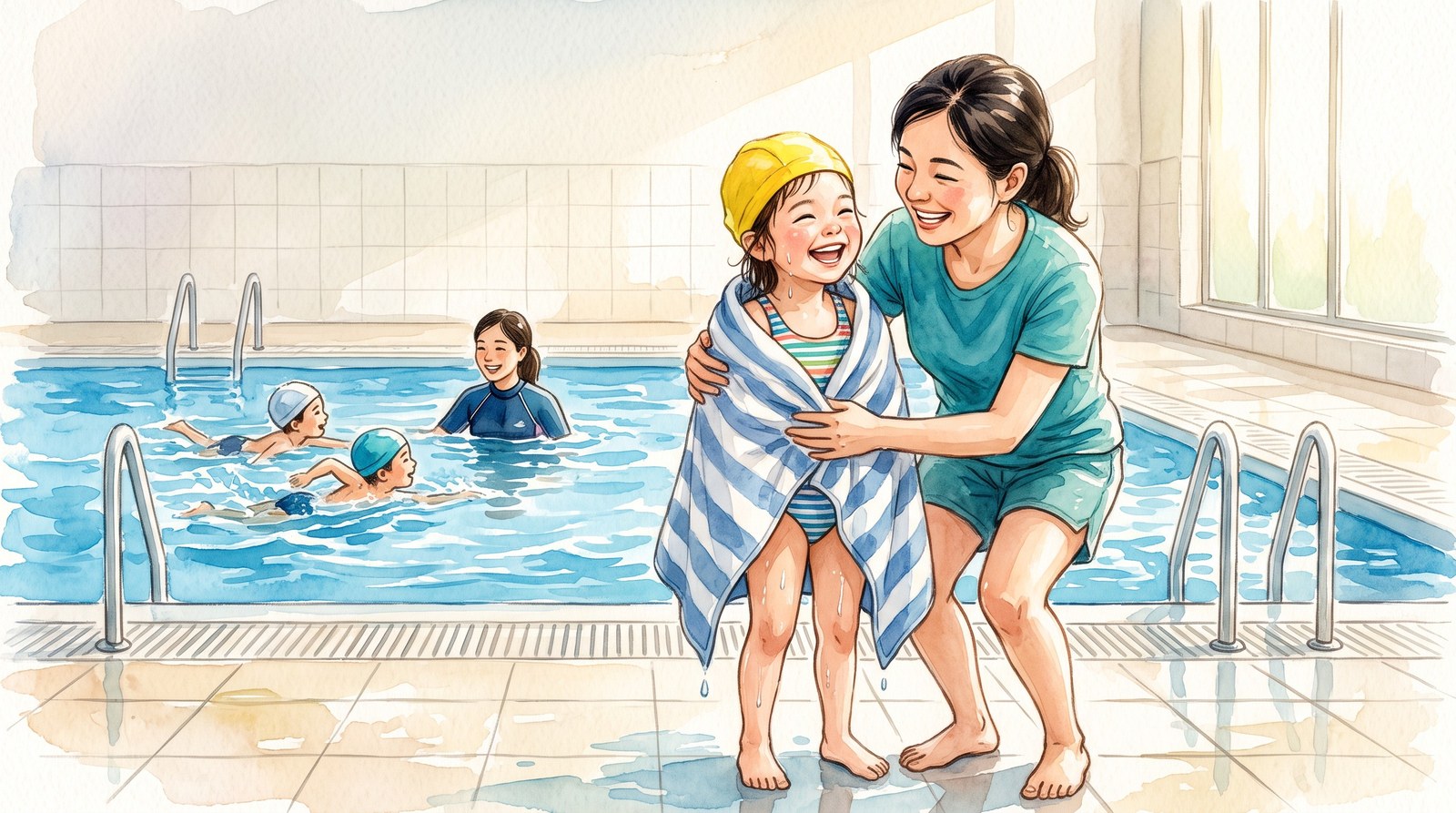
Do not expect a straight line
Children learn to swim in leaps. Weeks without visible progress alternate with a lesson where suddenly three things fall into place. That is normal and it is why one difficult lesson tells you nothing about the next.
If it does not get better after weeks
Smaller group or a different time
Ask the swimming school if there is a group with fewer children or a time that suits your child's rhythm better. A lesson at four o'clock right after school is harder for many children than a lesson on Saturday morning.
Private lessons as a stepping stone
A few private lessons can help build confidence without the pressure of a group. Once the crying stops, your child can return to a group. See it as a detour, not a final destination.
A break with a plan
Sometimes stopping briefly is the calmest choice, provided you make a plan: practice at home in the bath, swim casually once a month and set a date to return. Without a plan a break often becomes an end.
Questions to ask the swimming school
Ask concretely: how many children are in the group, is the instructor the same every week, what does my child do once I have gone, and what do you notice about the tension. A school that can answer those questions knows what happens in the water. At Swimmigo for parents you see those answers reflected in progress per exercise and in messages from the instructor.
What a swimming school can do
A fixed start ritual each lesson
The same order, the same song, the same first exercise. A child who knows what comes next has less to puzzle over and more space for the water. That ritual is one of the cheapest interventions there is.
Give parents a place out of sight
A bench behind glass, a waiting room with coffee: it helps both children and parents. Most schools that work with anxious children have thought about this intentionally.
Two sentences of feedback after the lesson
What went well and what is the next step. Two sentences are enough if they are concrete. Parents who know their child learned something keep the lessons going longer. That is also why schools using Swimmigo can share progress per exercise instead of writing a summary afterwards.
So what do you do next week
Crying at swimming lessons is almost never a sign that your child does not want to swim. It is a sign that something needs processing: a goodbye, a noisy hall, an empty stomach or a group that is too large for what your child can handle. You can do something about that, usually without changing the lesson itself.
The approach that most often works is boring: the same ritual each week, a short goodbye, not returning when there are tears and asking afterwards what succeeded. Give it four lessons. If it does not decrease in that time, that is the signal to discuss group, timing and build up with the school. Swimming lessons are then not about forcing, but about finding the right conditions.
Further reading
Swimmigo · Swim lesson app
Free for parents
Follow your child's swimming progress, see where you stand and report absences in the app.
Sources
- World Health Organization: Drowning fact sheet, updated 1 May 2026
- American Academy of Pediatrics: Swim Lessons for Children, When to Start and What to Consider, updated 18 May 2026
- CHOC Children's: Age by age symptoms of separation anxiety and how to help kids, 26 September 2023
- American Academy of Pediatrics: Help your child manage fears and anxieties, updated 2026
- Swim England: Preparing kids for swimming lessons, 6 January 2016
- Swim England: 7 ways to support your child through their swimming lessons, 26 July 2021
- Swim England: Learn to Swim Programme, accessed November 2026
- The Conversation: Some kids stop swimming lessons too early, how well can your child actually swim, with data from Royal Life Saving Society Australia, 2025
Bob van Soest
As an expert in operating sports facilities (such as swimming pools) and developer of, among others, Swimmigo.com, I am passionately committed to making swimming lessons simpler, more fun and more insightful for parents, swimming instructors and everyone who wants to learn to swim.
Frequently Asked Questions
Related articles
How Swimming Lessons Contribute to Your Child’s Development: More Than Water Safety
Swimming lessons stimulate motor skills, cognition, and social growth in children. Discover how swimming lessons support development, backed by scientific insights.
Swimming as Medicine: The Proven Health Benefits of Swimming Lessons for Children
Swimming is more than water safety. Discover how swimming lessons improve children's health: from reducing asthma to better motor skills and social abilities.
How Swimming Lessons Boost Your Child’s Confidence: More Than Just a Diploma
Discover how swimming lessons strengthen your child’s confidence through micro-wins. From fear to self-assurance, the mental growth behind every swim lesson.
Discover Swimmigo
The all-in-one app for swimming lesson progress. For parents, swim schools, and adult swimmers.