CompleteOverviewofSwimmingLessonsandChildDevelopment:MoreThanJustaDiploma[2026]
![Complete Overview of Swimming Lessons and Child Development: More Than Just a Diploma [2026]](/_next/image?url=https%3A%2F%2Fzvblogpostimages.s3.eu-west-3.amazonaws.com%2FAUTOMATISCH_UPLOAD%2F1_e8a136fa77bc.jpg&w=3840&q=75&dpl=dpl_GWyfLj8UVegbQ18STkVQms8Vj7LD)
Summary
- Children who start swimming early score 6 to 15 months better on cognitive tests than peers, according to a large Griffith University study of 7,000 children.
- Motorically skilled children obtain their swimming diploma faster: those who can roll and crawl well have an advantage in the water, according to research from VU Amsterdam.
- Baby swimming stimulates both fine and gross motor skills and lays a neurological foundation that benefits children for years.
- Swimming lessons train executive functions such as following instructions, turn-taking, and impulse control: skills that directly impact school performance.
Parents enroll their child in swimming lessons with one goal: that swimming diploma. Safe in the water, ready for vacations and school swimming. But what most parents don’t know: during those weekly hours in the pool, much more happens beneath the surface than just breaststroke and kicking. A growing body of international research shows that swimming lessons are one of the most powerful developmental stimuli you can give a child: from baby swimming to the A-diploma and beyond.
Motor Development: Why Rolling and Crawling Are Half the Work
Anyone who has closely observed a swimming lesson knows how complex breaststroke actually is. Arms and legs move simultaneously and oppositely. It’s like cycling while doing a somersault. No wonder that motorically skilled children have a significant head start.
What Does the Research from Amsterdam Say?
In 2025, movement scientist Wietze Bernards from VU Amsterdam, together with the Athletic Skills Model, studied 29 children aged 4 to 6 years. The conclusion was crystal clear: children who could roll and crawl better scored significantly higher on swimming skills, even if they had the same number of swimming lessons as peers with poorer motor skills. The average time to obtain the A-diploma increased from 42.5 hours in 2016 to 51 hours in 2025, and the researchers see a direct link to the decreased motor fitness of young children.
Why Motor Skills Are Declining
Research among 70,000 children at 428 schools shows that the motor skills of Dutch children are declining year after year. More screen time, less outdoor play, and less free movement space mean that simple movements, floating, kicking, moving arms and legs simultaneously, are becoming a significant challenge for more children. Swimming instructors notice this immediately in the pool: larger skill level differences within groups, slower progress, and more frustration among children.
What Parents Can Do at Home
The good news: basic motor skills can be well trained at home without a pool. Let your child roll on the floor, crawl through a homemade obstacle course, climb on the playground climbing frame, jump off walls. The more versatile a child moves before swimming lessons, the smoother they will move in the water later. Jorick Hendriksen from the Athletic Skills Model even advocates for a motor skills screening before starting swimming lessons: better to start based on what a child can do than on age alone.
The Cognitive Benefits: Swimming Children Think Faster
The most remarkable research on swimming lessons and brain development comes from Australia. A team from Griffith University followed 7,000 children from Australia, New Zealand, and the United States for four years, observed 120 swimming lessons in 40 swimming schools, and intensively tested a core group of 176 toddlers and preschoolers with internationally validated tests.
The Numbers That Amazed Researchers
The results were striking. Swimming children were 6 to 15 months ahead of the normal population in cognitive skills, problem-solving math, counting, language, and following instructions. In specific tests, the differences were even greater: 11 months ahead in oral expression, 17 months in story retelling, and no less than 20 months in understanding and following directions. Lead researcher Robyn Jorgensen admitted: "We expected better physical development, but the scores in language and math really surprised us."
Why Swimming Activates the Brain
Swimming is a bilateral cross-pattern activity: left and right brain hemispheres must cooperate in a rhythmic pattern. This strengthens the corpus callosum, the connection between both hemispheres, which is crucial for language processing, reading, and abstract thinking. At the same time, the body continuously measures resistance, buoyancy, and position in a three-dimensional space in water, a complex sensorimotor puzzle that trains spatial awareness. The University of Padua demonstrated in 2022 that baby swimming not only improves gross motor skills but also fine motor skills and grip strength, abilities later linked to language development.
The Language and Memory Effect of Swimming
A separate study by Madison Pruitt and Giovanna Morini in 2021 showed that children aged 6 to 12 retained new words significantly better after a swimming session than after coloring or a CrossFit-like workout. The aerobic effort of swimming appears to have a direct effect on the ability to store new information, an effect that lasts for hours after the lesson. For parents doubting about scheduling: a swimming lesson right before school or homework might actually be smarter than afterward.
This broad cognitive stimulation explains why swimming is recognized worldwide as a developmental engine. Whether your child swims in an Amsterdam indoor pool, a tropical resort in Thailand, or an outdoor pool in southern France: the neurological mechanisms are universal.
Social and Emotional Development: The Hidden Curriculum
Besides motor skills and cognition, there is a third pillar that makes swimming lessons unique: social and emotional growth. Unlike many dry-land sports, this growth takes place in an environment that is exciting, sometimes even frightening, for young children. That makes the learning effects extra powerful.
Overcoming Fear of Water as a Life Skill
Three out of ten children experience some form of fear of water. Confronting that fear in a safe, guided setting is exactly what psychologists call "scaffolding": step by step pushing a boundary with support. A child who learns that they can float while previously thinking they couldn’t internalizes a powerful lesson: fear can be overcome through practice. This lesson is not limited to water; children carry this self-image into other challenging situations, from a difficult math problem to the first day at a new school.
Social Learning in a Swimming Pool: Taking Turns, Waiting, Encouraging
In a swimming lesson, unwritten rules apply that children pick up playfully. You wait your turn at the ladder, you listen to the instructor even if the water is cold, you encourage a classmate who still finds it scary. These are executive functions, the mental processes needed to plan and regulate behavior. They prove to be better predictors of school success than IQ, and swimming lessons train them intensively, every lesson again.
Self-Confidence Through Visible Progress
One of the most powerful motivational mechanisms for children is visible progress: from not daring to jump to jumping off the edge, from kicking with a float to free kicking, from a tiny breaststroke to a full lap. Star systems, stamps, and badges work so well here because they literally make these micro-victories visible. Children feel proud and take that pride home.
The First Step: Baby Swimming and the Young Brain
Most parents associate baby swimming with splashing, singing songs, and quality time with mom or dad in warm water. But beneath the surface, much more happens.
The Neurological Basis of Floating and Grasping
The first year of life is a critical period for neurological development. During this phase, the brain rapidly forms new connections, and the quality of sensory input partly determines how rich that network becomes. Water is a multi-sensory environment: the skin senses temperature and resistance, the vestibular system registers movement in three dimensions, the eyes see distorted light and motion. The University of Padua showed that babies who regularly move in water score better on both reflexes and grip strength compared to babies without water experience. Buoyancy creates a unique environment where babies can make movements not yet possible on dry land.
From Reflex to Voluntary Movement
Water accelerates the transition from reflexive to voluntary movement. On dry land, a baby of a few months old is limited to what gravity allows: lying down, rolling, crawling. In water, supported by a parent’s hands, that same baby can move arms and legs more freely in all directions. This expands the movement repertoire and trains brain areas later needed for walking, running, and climbing. Icelandic researcher Hermundur Sigmundsson showed in a longitudinal study that babies who had swum performed significantly better motorically at ages 4 and 5 than the control group.
Every Country, Every Language: Why Swimming Lesson Development Is Universal
The mechanisms that make swimming lessons so valuable for child development, the bilateral movements, sensory stimulation, social interaction, work worldwide. A child in the Netherlands learning to swim with the ABC diploma system, a child in Australia swimming via the Swim and Survive program, and a child in Sweden receiving swimming lessons at school: all three train the same neurological circuits.
What International Figures Tell Us
The World Health Organization (WHO) reports approximately 300,000 drowning deaths worldwide annually. Children under 5 years make up nearly a quarter of all victims. Drowning is the third leading cause of death for children aged 5 to 14, ahead of diseases like measles and tuberculosis. In 92% of cases, it concerns low- and middle-income countries where access to swimming lessons and water safety education is limited. The WHO calculated that investing in swimming skill training and childcare for young children between now and 2050 could save 774,000 children’s lives worldwide and save $400 billion in societal costs.
From Local to Global: The Role of Digital Tools
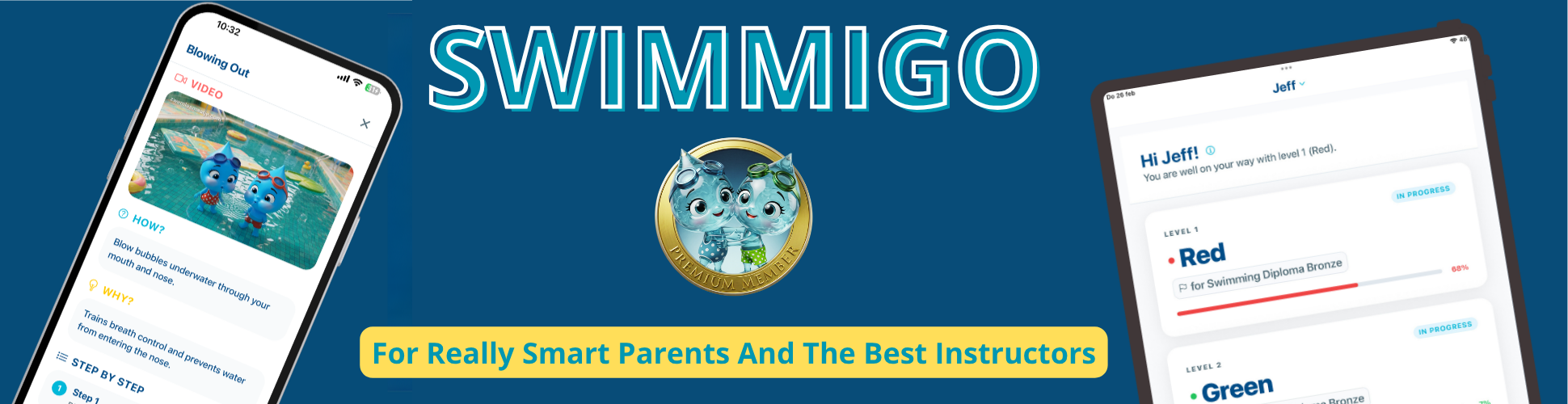
In the Netherlands, swimming lessons are still often organized with paper tracking systems, WhatsApp groups, and verbal handovers at the pool edge. It’s no different in other European countries. But the need for structured progress tracking, clear parent communication, and efficient planning is universal. Swimmigo is available in five languages, Dutch, English, German, French, and Spanish, and is used by swimming instructors and parents in various countries to facilitate exactly this: making visible what otherwise remains under water.
The Role of the Parent: Watching Without Swimming Along
Many parents struggle with the same feeling: you bring your child to the pool, say goodbye at the changing room, and an hour later see a child return with wet hair and a tired smile. What exactly happened during that hour remains vague.
The Black Hole Between Drop-Off and Pick-Up
Pools are not designed for spectators along the poolside. Parents often sit in a cafeteria with limited view of the water or are even asked to wait outside. The result: a communication gap that contributes to frustration. A parent who doesn’t know which skill was practiced this week cannot practice at home or discuss it with the child. This gap is not uniquely Dutch: from London to Los Angeles, parents voice the same complaint at pools.
How Digital Progress Insights Bridge the Gap
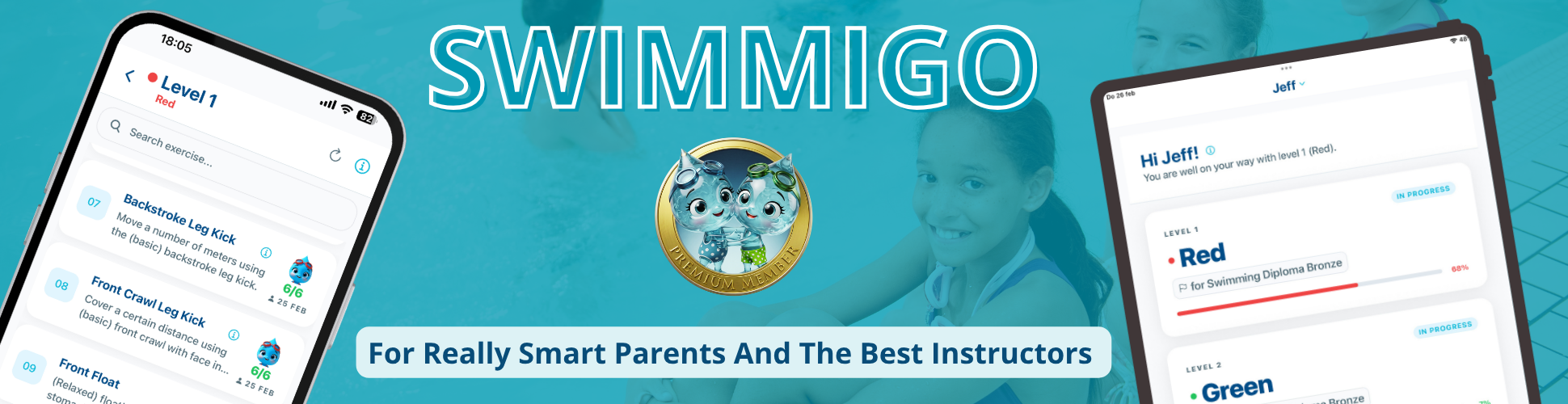
Apps like Swimmigo solve this by making progress per exercise visible. Parents see exactly which skills their child masters and where work is still needed. They receive push notifications upon level increases. They can check off holiday exercises themselves. And best of all: at levels 5, 6, and 7, they receive a personalized swimming diploma with their child’s name on it. No vague "it’s going okay" at the pool door, but concrete information that opens a conversation at home: "Hey, I see you practiced backstroke today, how did it go?"
How Swimming Instructors Can Optimize Development
For instructors, the challenge is different. You stand daily in the pool and see the motor delays, the shorter attention spans, and the frustration of children who don’t seem to progress. The question is: what can you do with that knowledge?
Maximum Movement, Minimal Waiting
The most important lesson from the research is that children must move as much as possible in the water. Waiting on the side, long explanation moments, and practicing one by one are the biggest motivation killers and developmental inhibitors. Use paddle variations (hands as cups, fists, spreading fingers), contrast exercises (big-small, fast-slow), and postpone perfecting technique until the water feeling is sufficiently developed. A child who has fun and accumulates many movement meters learns faster than a child trying to make perfect breaststroke without water feeling.
Making Individual Progress Visible
With groups of 10 to 15 children, it’s impossible to keep track in your head which of the 86 skills have been checked off per child. A digital student tracking system like Swimmigo makes this clear: you see scores per level per child, can form groups based on current levels, and seamlessly transfer progress when instructors change. No lost data, no children falling back because a new instructor doesn’t know where they are.
The Impact Beyond the Diploma: What Swimming Means for Life
The question "when will my child get the diploma?" is understandable but actually too narrow. Swimming lessons build foundations that last much longer than that piece of paper on the wall.
From Breaststroke to School Desk
The executive functions trained in the pool, following instructions, waiting your turn, dealing with stress, persevering when something doesn’t work immediately, turn out to be at least as important at school as the curriculum itself. Children who master these skills can concentrate better, work more independently, and are less easily unsettled by setbacks. Swimming lessons are thus indirectly an investment in school success.
The Lifelong Health Benefits of Swimming
Swimming is one of the few sports you can practice from 0 to 100 years old. It is injury-free, suitable for people with overweight, joint complaints, or disabilities, and it trains heart and lungs without stressing the joints. A child who learns to swim at a young age and develops positive associations with water has a greater chance of staying active as an adult. In an era where physical inactivity and obesity are increasing worldwide, this is an underestimated health benefit.
Sources
- WHO: Drowning Fact Sheet, May 2026
- Griffith University: Swim study reveals a smart pool of talent, August 2013
- Sport&Strategy / VU Amsterdam: Do children learn to swim better by rolling and crawling?, June 2025
- ZwembadBranche: Motor skill delay in children calls for action, 2025
- Leo et al. (2022): Baby Swimming and Motor Development, International Journal of Environmental Research and Public Health

Bob van Soest
As an expert in operating sports facilities (such as swimming pools) and developer of, among others, Swimmigo.com, I am passionately committed to making swimming lessons simpler, more fun and more insightful for parents, swimming instructors and everyone who wants to learn to swim.
Frequently Asked Questions
Related articles
![How Swimming Lessons Contribute to Your Child’s Development: More Than Water Safety [2026]](/_next/image?url=https%3A%2F%2Fzvblogpostimages.s3.eu-west-3.amazonaws.com%2FAUTOMATISCH_UPLOAD%2F1_4a34b35175e7.jpg&w=3840&q=75&dpl=dpl_GWyfLj8UVegbQ18STkVQms8Vj7LD)
How Swimming Lessons Contribute to Your Child’s Development: More Than Water Safety [2026]
Swimming lessons stimulate motor skills, cognition, and social growth in children. Discover how swimming lessons contribute to development, backed by scientific insights.
![Swimming as Medicine: The Proven Health Benefits of Swimming Lessons for Children [2026]](/_next/image?url=https%3A%2F%2Fzvblogpostimages.s3.eu-west-3.amazonaws.com%2FAUTOMATISCH_UPLOAD%2F1_19c95e0c14ad.jpg&w=3840&q=75&dpl=dpl_GWyfLj8UVegbQ18STkVQms8Vj7LD)
Swimming as Medicine: The Proven Health Benefits of Swimming Lessons for Children [2026]
Swimming is more than water safety. Discover how swimming lessons improve children's health: from reducing asthma to better motor skills and social abilities.
![How Swimming Lessons Boost Your Child's Confidence: More Than Just a Diploma [2026]](/_next/image?url=https%3A%2F%2Fzvblogpostimages.s3.eu-west-3.amazonaws.com%2FAUTOMATISCH_UPLOAD%2F1_33ab6dce26ef.jpg&w=3840&q=75&dpl=dpl_GWyfLj8UVegbQ18STkVQms8Vj7LD)
How Swimming Lessons Boost Your Child's Confidence: More Than Just a Diploma [2026]
Discover how swimming lessons enhance your child's confidence through micro-victories. From fear to self-assured, the mental growth behind every swimming lesson.
Discover Swimmigo
The all-in-one app for swimming lesson progress. For parents, swim schools, and adult swimmers.