CompleteOverviewofBabySwimmingandToddlerSwimming:ForParentsandSwimSchools[2026]
![Complete Overview of Baby Swimming and Toddler Swimming: For Parents and Swim Schools [2026]](/_next/image?url=https%3A%2F%2Fzvblogpostimages.s3.eu-west-3.amazonaws.com%2FAUTOMATISCH_UPLOAD%2F1_232a38776f8d.jpg&w=3840&q=75&dpl=dpl_GWyfLj8UVegbQ18STkVQms8Vj7LD)
Summary
- Baby swimming is about water acclimatization and fun, not real swimming lessons. Children under 1 year do not learn strokes but get used to water with a parent.
- From 1 year, children can learn basic skills like floating on the back and moving forward. Science shows benefits for motor skills and cognition.
- No swimming lesson replaces parental supervision. The WHO names 0-4 year olds as the main risk group for drowning worldwide.
- Swimmigo helps swim schools digitally track progress of the youngest learners with a simple smiley system and real-time insights for parents.
What Exactly Is Baby Swimming and Toddler Swimming?
Many parents think of swimming lessons as the well-known A-diploma. But the path to that first diploma often starts years earlier. Baby swimming and toddler swimming are the first steps in the water, long before a child officially starts swimming lessons. It’s not about breaststroke or freestyle. It’s about getting used to water, discovering how your body floats, and most importantly: having fun together with mom or dad.
In the Netherlands, these lessons are extremely popular. Pools across the country offer programs for children from just a few months old. Yet there is a lot of confusion among parents: is it really good to start so young? From what age is it safe? And what does a baby actually learn in the water?
Worldwide, we see the same picture. In Australia, the US, the UK, and Germany, baby swim programs are an integral part of the swimming landscape. Swimmigo is available in five languages and is used by swim schools worldwide to specifically track this youngest group of learners. Because whether you teach in Amsterdam, Austin, or Auckland: the very youngest deserve a structured approach.
Baby Swimming: Getting Used to Water Together
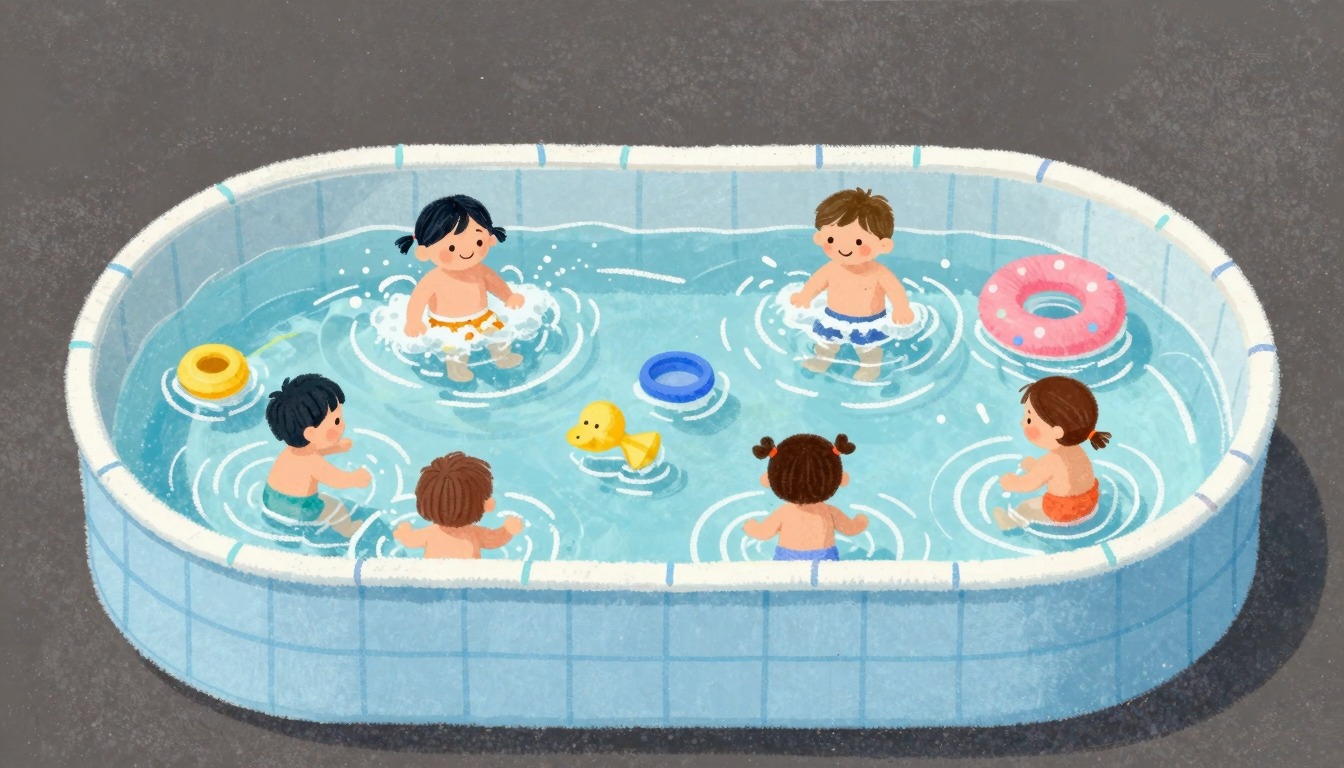
Baby swimming is intended for children from about 6 weeks to 1 year old. A parent goes into the water and holds the baby the entire time. The focus is on skin contact, building trust, and getting used to the sensation of water. Think of floating on the back while dad supports, gently splashing with little hands, and singing songs in a warm bath of 32 degrees Celsius.
The movements are primitive. A newborn baby still has a dive reflex: they automatically hold their breath when their face goes underwater and make swimming motions with arms and legs. This reflex disappears around 6 months, but the memory of water as something pleasant remains if you start early.
Important to know: baby swimming is NOT swimming lessons. The American Academy of Pediatrics does not recommend formal swimming lessons for babies under 1 year. There is simply no evidence that it reduces the risk of drowning. But getting used to water in a safe, supervised environment is valuable for the bond between parent and child.
Toddler Swimming: First Steps Toward Independence
Between 1 and 4 years, a lot changes. Toddlers learn to float on their back, blow bubbles underwater, and swim a few meters with their own 'swimming stroke' (usually a kind of dog paddle). Parents are still in the water, but the focus shifts from 'playing together' to 'discovering skills together.'
Scientific research shows that children aged 1 to 4 can benefit from learning basic swimming and survival skills. The National Council for Swimming Safety (NRZ) emphasizes that developing a 'water sense' is central: gaining control over the water, maintaining balance, and being able to return to a safe position. A child who falls into the water must be able to roll onto their back and keep floating. Those are life-saving seconds.
Survival Swimming: The New Trend
In recent years, survival lessons have come over from the US. Think of programs like ISR (Infant Swimming Resource) where babies from 6 months learn to roll onto their back and keep floating, fully clothed. The idea: a child who falls into a pond or pool can save themselves until help arrives.
Opinions on this are divided. The NRZ states there is little research on the effectiveness of survival lessons for babies and toddlers. There is no evidence that these children drown less often. Moreover, there is a risk of false security: parents think their child is 'swim safe,' while a toddler simply cannot assess risks. Falling into cold outdoor water with shock and clothes is very different from an exercise in a warm pool with an instructor nearby.
From What Age Can a Child Enter the Water?
There is no magical age at which every child is suddenly ready for water. Children develop at their own pace. What works for one 2-year-old toddler may still be too exciting for another 3-year-old. Yet based on research, clear guidelines can be given per age phase.
Under 1 Year: Water Acclimatization with Parents
Babies younger than 1 year may be in the water, but only for water acclimatization. The AAP is clear: no formal swimming lessons under 1 year, no evidence for drowning prevention in this group. The Belgian High Health Council goes further and advises against baby swimming in public pools for children under 12 months due to health risks.
What should you watch out for? A baby cannot regulate breathing like an older child. The water must be at least 30 degrees Celsius because babies cool down quickly. Lessons should not last longer than 20 to 30 minutes. It is really about getting used to water, not training. Parents must maintain physical contact with their child the entire time.
From 1 to 4 Years: First Swimming Skills
This is the phase when children really start learning something in the water. The NRZ advises letting children from 1 year get used to moving in water. Research shows toddlers can pick up basic skills: floating on the back, moving forward with their own stroke, and orienting underwater. These are not complex swimming strokes but lay the foundation.
A systematic review from the University of Lisbon in 2023 confirms that exposure to aquatic activities has positive effects on the gross and fine motor skills of young children. Researchers also saw improvements in visual perception, cognitive flexibility, and reaction speed in toddlers who participated in swimming programs. These effects go beyond just 'learning to swim': swimming stimulates the overall development of a young child.
From 4 Years: Ready for Real Swimming Lessons
Around 4 years, most children are developmentally ready to truly learn to swim. They can handle more complex movements, understand instructions better, and have the strength and coordination for breaststroke and backstroke. In the Netherlands, the formal swimming lesson trajectory for the A-diploma usually starts between 4 and 5 years. Children who have done baby or toddler swimming often enter the deep end with more confidence. They are already used to water on their face, know what floating feels like, and do not find a pool scary.
Note: the NRZ emphasizes there is no scientific evidence that children learn to swim faster or better if they start very young. The advantage lies in comfort and confidence, not in an accelerated swimming diploma. A child who enters the water for the first time at four can get their A-diploma just as quickly as a child who has been coming since babyhood.
What Does Science Say About Baby Swimming?
The research community is not unanimous. There are indications of positive effects, but also questions. Let’s look at what we do know, and what we don’t.
Motor Development: Faster Milestones
Australian research from Griffith University shows that children who start swimming lessons before their first birthday reach motor milestones earlier on average than peers who do not swim. Think crawling, standing, and walking. The explanation is simple: in water, a child moves more freely than on dry land. There is less gravity, so arms and legs can make bigger movements. Water provides resistance without stressing the joints, an ideal combination for muscle building in the very young.
The systematic review by Santos and colleagues (2023) confirms this picture. Aquatic activities are generally safe for babies’ health and show positive effects on both gross and fine motor skills. Premature babies and newborns also benefited from aquatic therapy, provided their physiological values remained within safe limits.
Cognitive Benefits: More Than Just Splashing
Swimming is not only good for the body. The bilateral movements children make in water, the cross-movement of arms and legs, stimulate the connection between the left and right brain hemispheres. This forms new neural pathways. Research suggests early swimming is associated with better language development, spatial awareness, and even stronger math skills later in childhood.
A Norwegian study from 2002 found that babies who participated in swimming programs had better balance and grip than non-swimming babies. Such findings accumulate and suggest that water is not just a fun extra, but a developmental environment in itself. In many countries, from Norway to New Zealand, swimming for young children is structurally embedded in early childhood curricula.
What Research Cannot Prove
Let’s also be honest about the limitations. There is NO evidence that baby swimming reduces drowning risk. The WHO names children aged 0 to 4 worldwide as the main risk group for drowning. Lack of supervision is the most cited cause. No swimming lesson can replace supervision.
Also, little is known about transfer: do children apply the skills they learn in a warm, controlled pool in an unexpected emergency? In cold water, with clothes, in panic? The answer is: we don’t know. The NRZ is clear about this: swimming lessons are useful and well-structured, but swimming safety depends on much more than learned techniques. The child’s character, specific circumstances, water temperature, and presence of supervision all play a role.
Safety: What Parents Should Watch For
Water and small children is a combination that demands 100% alertness. The numbers don’t lie. Worldwide, tens of thousands of children drown annually, especially in low- and middle-income countries. But even in countries with good swimming facilities like the Netherlands, Australia, and the US, drowning is one of the leading causes of death among young children.
Supervision Is Irreplaceable
The AAP uses the term 'touch supervision': for children under 4 years, an adult must always be within arm’s reach, in and around the water. Not 'nearby,' not 'watching from the side.' Within arm’s reach. A child can drown in less than 30 seconds, in water 5 centimeters deep. This applies to the pool, but also to the pond in the park, the inflatable pool in the garden, and the bucket of water next to cleaning supplies.
Swim wings and inflatable armbands are toys, not safety devices. They can slip, deflate, or hold a child in a dangerous position (with the head underwater). Approved life jackets are the only flotation devices that count as safety equipment. But even with a life jacket: stay within arm’s reach.
Pool Conditions Safe for the Very Young
Not every pool is suitable for babies and toddlers. Here is a checklist:
- Water temperature: At least 30°C, preferably 32°C for babies under 1 year
- Water quality: Chlorine and pH levels must be strictly monitored. Babies have thinner skin and are more sensitive to irritation
- Air quality: Good ventilation is crucial. Chlorine fumes can cause respiratory issues in babies
- Lesson duration: Maximum 20-30 minutes for babies, 30-45 minutes for toddlers
- Group size: Maximum 8 to 10 parent-child pairs per instructor
- Hygiene: Swim diapers mandatory, changing area nearby, showering before swimming
How to Choose the Right Provider for Your Child?
The offer is large and diverse. From traditional parent-child swimming at the local pool to expensive survival courses with one-on-one guidance. How do you know what fits your child?
Questions to Ask During an Introduction
A good provider doesn’t mind if you ask critical questions. In fact, it’s a sign of professionalism if they answer openly and honestly. Ask about the instructors’ training. A Swimming Instructor diploma from the NRZ or a comparable international certification (AUSTSWIM in Australia, STA in the UK) is a minimum requirement. Also ask about the philosophy: is it about fun and water acclimatization, or about performance and survival? Both can be good, but it must fit your child and your expectations.
Ask about lesson observation: can you come watch once without your child? If yes, pay attention to the atmosphere. Do children laugh or cry? Is the instructor calm and patient? Does he or she address the children at eye level? A good instructor for the very young is more coach than drill instructor.
Different Lesson Types at a Glance
The NRZ roughly distinguishes three types of baby and toddler swimming:
| Type | Focus | Parent in Water? | Age |
|---|---|---|---|
| Parent-child swimming | Fun, social bonding, water acclimatization | Yes, always | 6 weeks to 4 years |
| Survival swimming | Self-reliance, floating on back | Sometimes, depending on program | 6 months to 4 years |
| Therapeutic swimming | Motor development, rehabilitation | Often one-on-one with therapist | 0 to 4 years |
There is no 'best' form. It depends on your child, your own preferences, and what is available in your region. The NRZ points out that providers of survival lessons must be extra clear about what their program can and cannot achieve. A child who has learned to float in a warm pool is not automatically safe in open water.
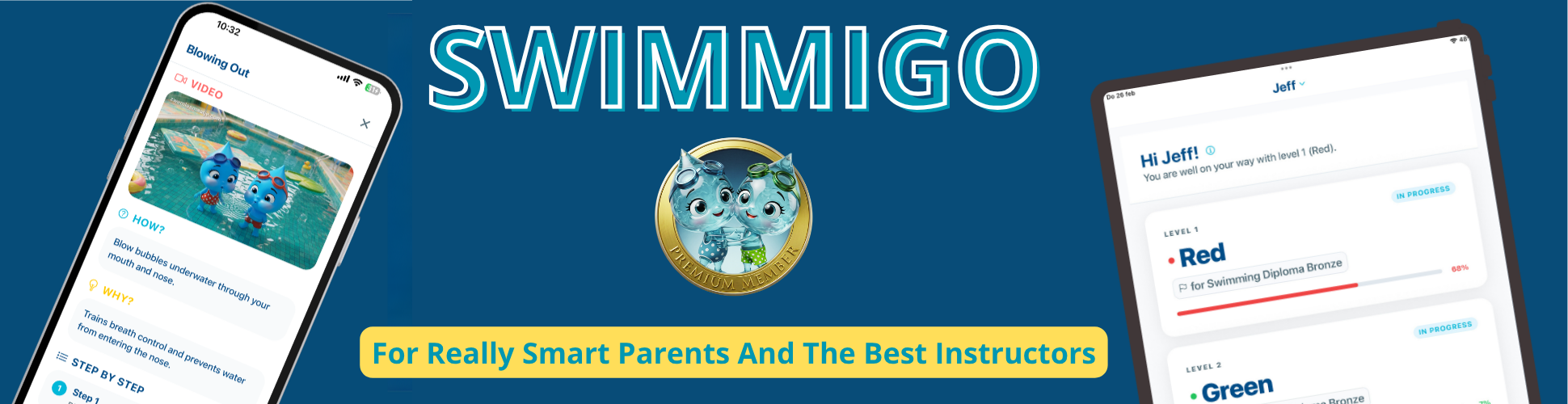
How Swimmigo Helps Swim Schools with Baby and Toddler Swimming
Baby and toddler lessons pose unique challenges for swim schools. There are no diploma requirements like with the Zwem-ABC, but parents do want to know how their child is developing. Progress is subtle: first a child dares to put their face in the water, then blows bubbles, then floats 3 seconds on their back. How do you record that without standing at the poolside with a clipboard all lesson long?
Tracking Progress Without Paperwork Hassle
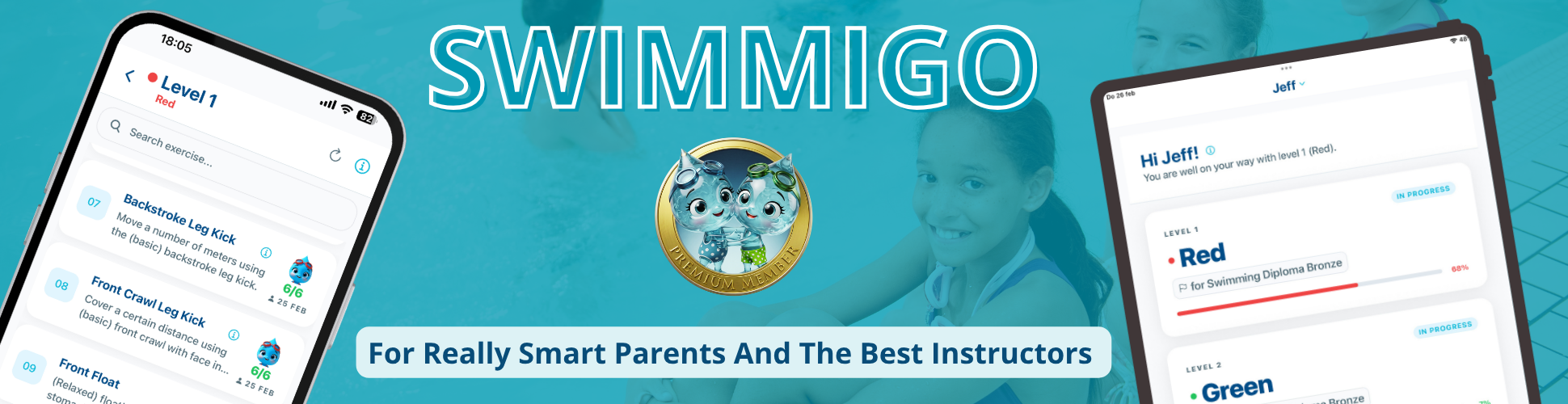
Swimmigo lets instructors record each child’s progress with one tap on their phone or tablet. The app has a special level system from 0 to 6 smileys, perfect for the subtle steps babies and toddlers make. No grades, no complicated forms. Just quickly tap a smiley during or right after the lesson, and the progress is saved.
For swim schools with multiple instructors, this is gold. One week you teach, the next week your colleague. Without a system, no one knows exactly where each child left off. With Swimmigo, you see at a glance what was practiced last time and how far the child was. That brings peace and confidence, for instructors and parents alike.
Keeping Parents Involved from the First Lesson
Parents of the very youngest are often extra involved. They want to know what happens in the lesson, what their child practiced, and if it’s going well. Swimmigo lets parents watch progress in real-time via the app. They see how their child scores per exercise and get a push notification when a new level is reached.
That’s not only nice for the parent, it also saves the swim school a lot of time. No more emails asking 'how is my child doing?', no exploding WhatsApp groups after every lesson. All communication runs through the app. And when a child reaches a milestone (first time floating on back!), parents can immediately download a free certificate as a keepsake. Swimmigo is available in Dutch, English, German, French, and Spanish and is used worldwide by swim schools that take the youngest learners seriously.
Conclusion
Baby swimming and toddler swimming are not miracle cures, but they are a valuable start. Children get used to water, build confidence, and develop motor skills in an environment found nowhere else. Science confirms benefits for motor skills and cognition but also tempers expectations: swimming lessons do not make a toddler drowning-proof. Supervision remains the most important safety measure.
For swim schools, tracking all those small developmental steps of babies and toddlers is a challenge. Swimmigo makes that simple, clear, and fun. So instructors can focus on what really matters: seeing children step out of the water with a smile.
Read more about how parents use Swimmigo, discover all 7 levels and 86 skills, and see how the features can help your swim school.
Frequently Asked Questions
Sources
- National Council for Swimming Safety: Blog on Swimming Safety and Lessons for Babies and Toddlers, November 27, 2020
- American Academy of Pediatrics: Swim Lessons for Children, When to Start and What to Consider, 2025
- Santos C, Burnay C, Button C, Cordovil R: Effects of Exposure to Formal Aquatic Activities on Babies Younger Than 36 Months, A Systematic Review (Int J Environ Res Public Health), April 2023
- Ouders van Nu: Everything You Want to Know About Baby Swimming, 2024
- World Health Organization: Global Report on Drowning, Preventing a Leading Killer, 2014

Bob van Soest
As an expert in operating sports facilities (such as swimming pools) and developer of, among others, Swimmigo.com, I am passionately committed to making swimming lessons simpler, more fun and more insightful for parents, swimming instructors and everyone who wants to learn to swim.
Frequently Asked Questions
![Does My Child Need to Be Toilet Trained Before Swimming Lessons? How to Know If They Are Ready [2026]](/_next/image?url=https%3A%2F%2Fzvblogpostimages.s3.eu-west-3.amazonaws.com%2FAUTOMATISCH_UPLOAD%2F1_132fa5090360.jpg&w=3840&q=75&dpl=dpl_GWyfLj8UVegbQ18STkVQms8Vj7LD)
Discover Swimmigo
The all-in-one app for swimming lesson progress. For parents, swim schools, and adult swimmers.