Fear of water in adults: how to learn to swim when water scares you [2026]

Summary
- One third of adults in England cannot swim 25 meters, in the United States 55 percent never had swim lessons.
- Fear of water rarely comes out of nowhere: never had lessons, an unpleasant event in the water or a parent who was afraid.
- Research among 4,914 adults in swim lessons: after an average of nine lessons 69 percent swam at least 5 meters.
- An adult understands an exercise faster than a child, but also feels every muscle that is holding on.
- For swim schools: a separate program with a fixed instructor attracts adults who currently stay away.
Why an adult does not swim
Almost nobody who cannot swim at thirty chose that themselves. Lessons stopped when you were eight, the pool was too far away, it never happened in your family, or something happened in the water that you still think about. The result is the same: you skip the boat on holiday, you stick to the shallow side of the hotel pool and you hope nobody asks you to go in the water.
What lies beneath is rarely unwillingness. It is a body that has learned that water is dangerous, and a mind that repeats that warning every time. Swim lessons for adults with fear of water therefore do not start with the breaststroke. They start with the idea that the water does something to you.
What fear of water in adults actually is
Fear of water, not a dislike of water
People with fear of water do not hate water. The problem is that water does not do what the mind expects. Your feet cannot find the ground, you do not know exactly how deep it is and your body does something other than what you tell it. Those three things together feel like loss of control, and the body responds with tension.
That tension cannot be wished away. Shoulders rise, the breath stays high, legs sink the moment you stop kicking. Instructors who teach anxious adults often recognize it in the first minute: someone who can explain exactly how floating works, and still does not dare to try.
Where aquaphobia ends and swim lessons begin
For a small number of people the fear is more than normal tension. The Cleveland Clinic describes aquaphobia as a specific phobia: extreme fear at the sight or even the thought of water, in severe cases so far that someone stops showering or washing their face. Then swim lessons are not the first stop, a therapist is.
For most adults it is milder. There is tension, avoidance and shame, not a phobia. An instructor who builds up calmly is then exactly the right person.
Four routes that often lead to fear of water
- Never had lessons, because it was not customary in the family or country of origin.
- Lessons stopped after an unpleasant event: being held under, a pool that was too deep, an instructor who went too fast.
- An almost-accident in open water, sometimes as a child, sometimes later.
- A parent who was afraid themselves, so water never became normal.
At an intake the question what happened yields more than the question what level someone has. An answer like "I once had lessons but stopped" shows where the boundary lies.
How many adults cannot swim
The figures are less marginal than they seem. In England 31 percent of adults cannot swim a length of 25 meters, reports Swim England based on its own research. In the United States 15.4 percent of adults say they cannot swim and 55 percent never had swim lessons, according to the CDC. Worldwide the share in low and middle income countries rises to three quarters.
| Where | What the figures say | Year |
|---|---|---|
| England | 31 percent of adults cannot swim 25 meters, that is 14.2 million people | 2019 |
| United States | 15.4 percent say they cannot swim and 55 percent never had swim lessons | 2024 |
| High income countries | 25 percent of adults cannot swim | 2019 |
| Low and middle income countries | 75 percent of adults cannot swim | 2019 |
| Adults in swim lessons in Australia | After an average of nine lessons 69 percent swim at least 5 meters, 8 percent reach 50 meters | 2018 to 2021 |
What those figures do not say
Most of these figures come from self report, and self report is optimistic. In the Australian research into adult swimming ability young adults overestimate their own skills in a pool. Someone who says they can swim sometimes manages ten meters in still water and no ten meters in the sea. For a swim school that is a reason to see what someone really does in the first lesson, instead of trusting what is on the registration form.
That the topic matters is clear from the figures from the World Health Organization: about 300,000 people drown each year, and the WHO names teaching swimming and water safety skills as one way to reduce that number.
Swimmigo · Swim lesson app
Free for parents
Follow your child's swimming progress, see where you stand and report absences in the app.

Why lessons at 34 work differently than at 7
Adults understand more and feel more
A seven year old jumps in without thinking. It does not consider what could happen and comes up with a big grin. An adult knows what drowning is, has seen the news and has a mind that keeps thinking during the entire lesson. That works both ways: you understand an exercise faster, and you notice every muscle that is holding on.
Your body reacts to tension before you do anything
Fear costs buoyancy. Whoever holds the breath high, stiffens the arms and lifts the head, sinks with the legs. That is not a technical mistake but a stress reaction, and correcting it with "just relax" does not help. What does work is an exercise where relaxing is the only way to succeed, for example lying still on your back for ten seconds with one hand on the edge.
Shame takes more lesson time than technique
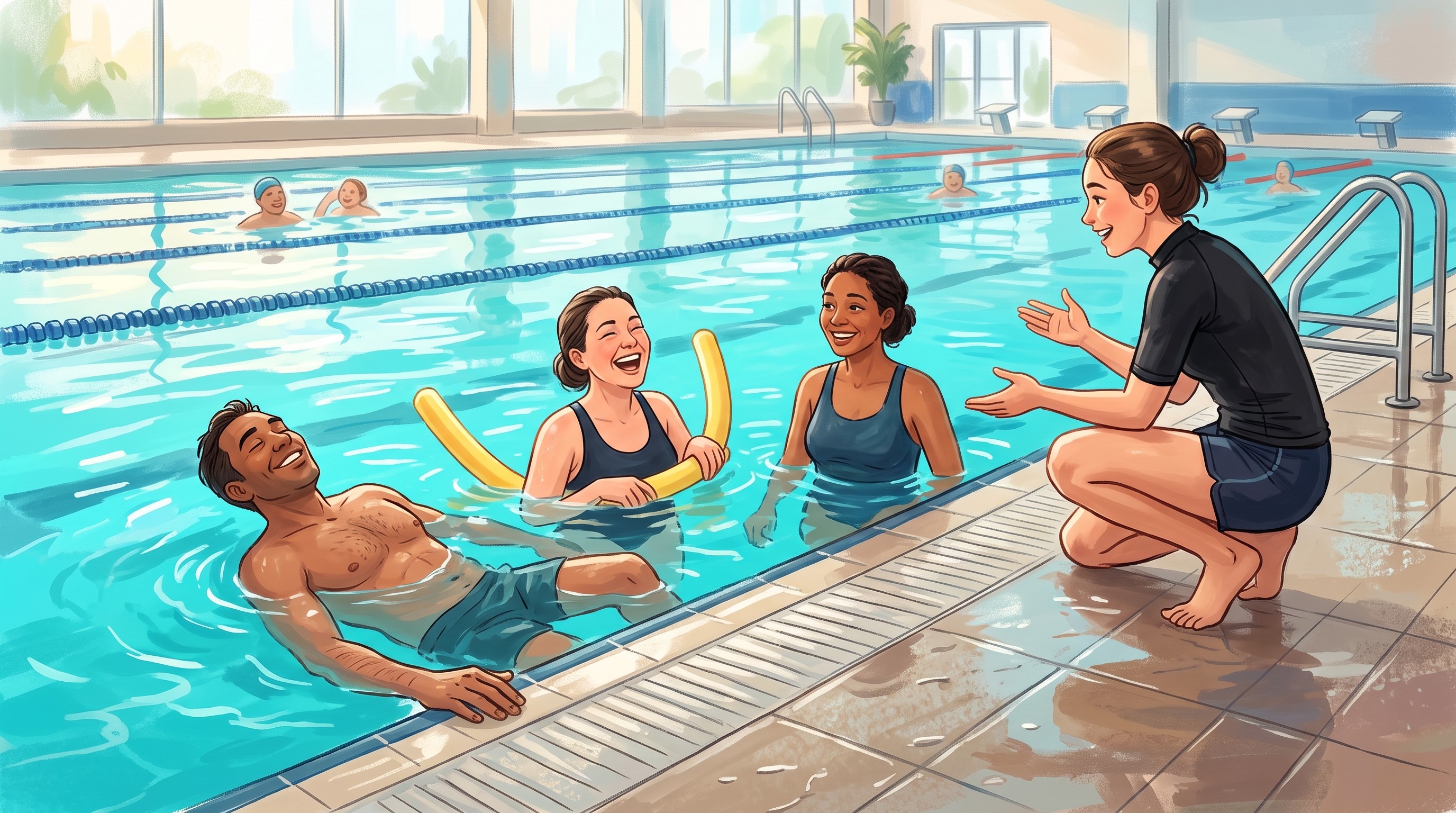
The English figures come with a story that recurs. Swim England interviewed a 43 year old woman who had never learned to swim because it was not common where she grew up, and who was mainly worried about what others would think. That shame is the real brake in the first lessons. It disappears only when someone notices that nobody in the pool is watching them.
Build up in steps you can handle
Treatments for fear of water work with exposure in small steps, and swim lessons use the same logic. The Cleveland Clinic describes the buildup as a ladder: first breathing and relaxation exercises, then pictures and videos of water, then water in a sink, then touching running water, then walking past a pool and only after that entering the water. For swim lessons that translates into four phases that follow each other.
Step 1: water on your face
This step lasts three lessons for some adults and three minutes for others. It is about the feeling that water on your face is not the same as drowning. An instructor first has you rub wet hands over your cheeks, then once put your face in a handful of water, and only after that your head under.
Step 2: floating and standing up again
Floating is the exercise where confidence usually flips. Not because someone does it very well, but because the body notices that water supports. Important is that standing is always within reach: hand on the edge, feet on the bottom, and the instructor next to you rather than opposite you.
Step 3: exhaling under water
Holding the breath is the habit that lingers longest. Exhaling under water is both a technique and a relaxation exercise: whoever exhales calmly cannot at the same time hold their breath from tension. This is also where real swimming begins, because without proper exhalation no one completes a lane.
Step 4: the first meters
Five meters feels like a big goal for an anxious adult and is almost nothing to the outside world. Yet it is exactly the distance where most participants in the Australian study ended up. From five to fifty meters is then a matter of continuing to come.
How long it takes before it clicks
Nine lessons as an average, not a promise
Research among 4,914 adults who took swim lessons in Australia between 2018 and 2021 gives a realistic order of magnitude. The median age was 38 years, participants took an average of nine lessons and spent about 4.5 hours in the water in total. At the final measurement 69 percent swam at least 5 meters and 8 percent reached 50 meters consecutively.
Why stopping after ten lessons is usually too soon
That 8 percent is the most interesting figure from that study. The researchers themselves write that adults often do not continue long enough to achieve the skills that keep you safe in open water. For someone with fear of water there is a second layer: the first lessons are about daring, the later ones about ability. Whoever stops after the first successful experience keeps a little bit of swimming and a large amount of avoidance.
What a swim school does differently for anxious adults
Placing an anxious adult among fast thirtysomethings backfires in two ways. The lesson goes too fast, and there is an audience. Small swim schools can gain here, because they have something big pools do not have: room to set someone apart and to keep the same instructor.
That adults need their own buildup is not only a feeling. Swim England structures its adult lessons in four phases, with their own goals from age 16, because motivation and learning style in adults differ from children.
Intake about the history, not the level
Two questions do most of the work: what happened around water, and what do you want to be able to do at the end. A goal like "go into the shallow pool with my children" is more useful than "I want to learn to swim", because it says something about the distance someone wants to cover and how fast it may go.
Private lessons or a group of three
Private lessons are the fastest route, but not affordable or necessary for everyone. A group of two or three people with the same tension works almost as well and is more social. What does not work is placing an anxious beginner in a group with swimmers who already swim laps.
The same instructor and the same sequence
For children a changing teacher is annoying. For an anxious adult it is fatal, because every new face means explaining again why you are here. Keep the instructor and keep the order of exercises the same. Surprises are not a pleasant variety for this group.
Make progress visible, even for small steps
For children tracking progress is the norm, for adults often not. That is a shame, because someone who can see their own progress has a reason to come back next lesson. The Swimmigo app works with seven levels and 86 skills and a score of 0 to 6 per exercise. That structure is not tied to an age, so a school can use it to track an adult program too. The instructor ticks off what works during the lesson, the student sees at home what was checked and what comes next. Messages with read receipts remove the question whether an appointment arrived.
What you can do between lessons
Practice in water where you can stand
Two times ten minutes a week in a shallow pool yields more than one long lesson per week. Stay by the edge, keep one hand free and practice only what you did in the lesson. Practicing without an instructor is not a replacement for lessons, it is repetition.
Breathing that takes you into the water
Calmly exhaling through the nose or mouth, longer than you inhale, is calming and at the same time the technique you need. Do it first above water, then with your face in a handful of water, then with your head under in the shallow end.
When to involve a therapist
If the fear also determines life outside the pool, if you lie awake at night about the upcoming lesson, or if showering and washing your face are already avoided, swim lessons are not the right starting point. According to the Cleveland Clinic up to nine out of ten people with a specific phobia have fewer complaints after psychotherapy, usually exposure therapy. Swim lessons can follow, and often go faster than expected then.
Costs, choices and a trial lesson
Swim schools charge per single lesson, per package of for example ten lessons or per month. Private lessons are more expensive than a small group, and a package is cheaper per lesson than single lessons. When choosing ask not only about the price per lesson, but also what happens with a missed lesson and whether a trial lesson is possible.
Ask about group size and the instructor
Three questions separate a suitable school from an unsuitable one. How large is the group, does the instructor have experience with anxious adults, and may you first join one lesson without a package. Whoever gets a clear answer to all three knows enough. Swim schools that use an app can usually show their groups and levels immediately, which answers the first question straight away.
Learning to swim as an adult is not a matter of talent. It is a matter of a buildup that starts small enough, an instructor who does not push and enough lessons to go from daring to able. Swim schools that set up that program for anxious adults serve a group that is rarely seen and often does not even know it is welcome. More about the approach per age and level is in the overview of swim lessons for adults, and for instructors there is a practical guide for adult beginners. If you work at a swim school, see what Swimmigo for instructors does with groups, levels and parent communication.
Swimmigo · Swim lesson app
Free for parents
Follow your child's swimming progress, see where you stand and report absences in the app.
Sources
- World Health Organization: drowning, facts and figures, 1 May 2026
- CDC, Morbidity and Mortality Weekly Report: self reported swimming ability and participation in swim lessons in the United States, 23 May 2024
- Swim England: more than 14 million adults in England cannot swim, 22 October 2019
- Willcox-Pidgeon et al., Health Promotion Journal of Australia: adult swimming ability in lessons as a means against drowning, 2025
- Cleveland Clinic: aquaphobia, symptoms and treatment
- Swim England: framework for adult swim lessons

Bob van Soest
As an expert in operating sports facilities (such as swimming pools) and developer of, among others, Swimmigo.com, I am passionately committed to making swimming lessons simpler, more fun and more insightful for parents, swimming instructors and everyone who wants to learn to swim.
Frequently Asked Questions
Related articles
Creating a swimming lesson plan for adult beginners
Practical guide for a structured swimming lesson plan for adult beginners, including levels, communication, and quality criteria.
Complete overview of swimming lessons for adults: learning to swim at a later age
Learning to swim as an adult: what does it cost, how do you approach it, and how long does it take? Figures, prices, and practical steps, with median prices for 2026.
Discover Swimmigo
The all-in-one app for swimming lesson progress. For parents, swim schools, and adult swimmers.