Complete overview of swimming lessons for children with an intellectual disability: Down syndrome, pace, and self-reliance [2026]
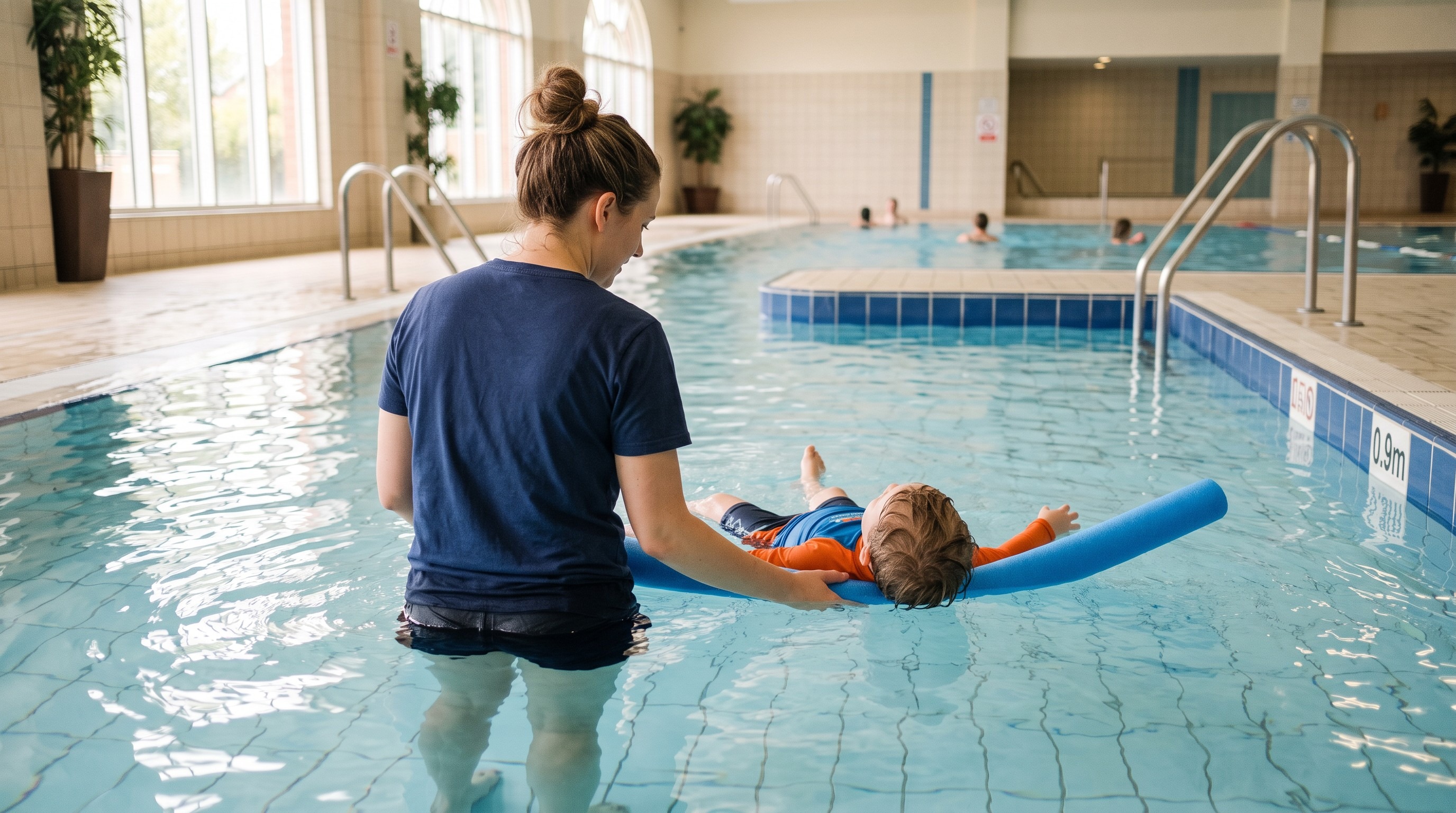
![Complete overview of swimming lessons for children with an intellectual disability: Down syndrome, pace, and self-reliance [2026]](/_next/image?url=https%3A%2F%2Fzvblogpostimages.s3.eu-west-3.amazonaws.com%2FAUTOMATISCH_UPLOAD%2F1_5cd7e56b07df.jpg&w=3840&q=75&dpl=dpl_CmNoatCrP4K6zisEFhNaSgzTUyJF)
Summary
- Children with an intellectual disability learn to swim but often need more time and more repetitions than peers.
- In research among 310 parents, 55 percent took longer than two years for the course and 45 percent of parents worried about self-reliance in the water.
- Short instructions, small groups, fixed routines, and visible progress make the difference, not extra practice material.
- If a component is not possible due to the disability, a swimming certificate may be appropriate alongside the regular swimming diploma.
- Track per student where they stand and what the next goal is, so progress does not depend on one instructor.
Your child has an intellectual disability and is taking swimming lessons. At registration, the swim school may have said that your child "just participates" with the group. A year later, your child is still hanging by the side, the instructor looks at you questioningly, and you don't know if it's your child, the approach, or expectations that were never spoken aloud.
This pattern is not unique to your family. Of the children with a disability who take swimming lessons, 13 percent at age 13 still have no swimming diploma, while nationally this is 4 percent. Almost half of the parents, 45 percent, find their child not self-reliant in the water after the entire course. These are figures about a course that is rarely designed for a child who learns more slowly.
Below is what an intellectual disability means for learning to swim, how long a course may take, how to choose a swim school that fits, and what you as a parent and instructor can do.
What is different with an intellectual disability
Verbal explanations are less retained
An instruction of five sentences usually becomes one sentence in the pool. For a child who processes information more slowly, this is not a detail: the shorter the instruction, the greater the chance it is understood. The National Council for Swimming Safety mapped out with swim instructors where these children get stuck. These stumbling blocks are mainly in the pre-swimming phase: whether or not to enter the water, being startled by an unexpected situation, not daring to look underwater, not daring to lie on the back.
More repetitions, without it being about effort
Where a child without a disability picks up a movement after ten times, a child with an intellectual disability sometimes needs thirty or forty times. A skill that is left unused for two weeks fades faster. Swim instructors working with this group therefore see the same thing repeatedly: the same exercise comes up more often in lessons, and a new component takes more lessons than you expect. Pushing through does not help, because a child who receives too much at once disengages.
Down syndrome: learning is possible, just slower
All people with Down syndrome have an intellectual disability, ranging in severity from mild to very severe. About 6 out of 10 have a mild to moderate disability, 3 out of 10 a severe, and 1 out of 10 a very severe disability, according to PNS, the RIVM screening program. Children with Down syndrome learn more slowly: talking, walking, and swimming take longer. Many eventually learn it. The Down Syndrome Foundation writes that some children participate in regular swimming lessons, while others learn better in adapted lessons or private lessons. So ask at the pool near you what is possible instead of waiting for someone to offer it.
Body and health play a role
With Down syndrome, problems with hearing, eyes, airways, and heart occur more often than average, according to information from PNS and UZ Leuven. A child may also have more difficulty with posture and stability. This changes little about what is possible in the water, but it does affect what you share with the swim school beforehand: which exercises fit, what the pediatrician has said, and what the instructor should watch for. Without that information, an instructor will guess cautiously, costing your child lesson time.
Stimuli in the pool are not a detail
A pool echoes, smells of chlorine, and is full of moving people. A child who has difficulty filtering stimuli must do two things at once: learn to swim and stay upright in the environment. Parents mention in research on appropriate swimming offerings precisely this point, alongside group size and instructor knowledge. A quiet moment in the week often works better than the busy Saturday morning atmosphere.
Swimmigo · Swim lesson app
Free for parents
Follow your child's swimming progress, see where you stand and report absences in the app.

Why swimming yields extra benefits for your child
Self-reliance weighs more than the certificate
Drowning ranks high worldwide among causes of death in children, according to the World Health Organization. In the Netherlands, there are about 200 hospital admissions per year due to non-fatal drowning and an average of 80 fatal drownings annually. Lack of supervision is most often cited as the cause, and learning to swim well remains the best way to reduce risk, states VeiligheidNL based on research by the Mulier Institute. For a child who learns more slowly, this means one thing: the course may take longer as long as the endpoint is that your child can save themselves. According to their parents, 45 percent of children with a disability do not achieve this.
Swimming moves without bearing own weight
The WHO calculated that people with a disability have twice as often conditions such as depression, asthma, diabetes, or obesity, and they move less. One cause the WHO mentions is that they often fall outside regular health and exercise programs. Swimming is one of the few sports for this group where the body is supported by water, so effort does not depend on balance or coordination on land. Uniek Sporten mentions the effect on muscle strength, fitness, and self-confidence, and points out that the lesson can be almost fully adapted to what someone can handle.
Fun sustains a long course
For a course of two years or longer, fun is not an extra. Of children with a disability, 56 percent go to swimming lessons with pleasure, 28 percent do not, and parents see a contribution to motor development in 54 percent of children. A child who goes reluctantly to the pool stops sooner. A child who enjoys the water keeps coming even if an exercise does not succeed for a while.
How long may it take before you worry
What parents experienced in numbers
These percentages come from a survey by the National Council for Swimming Safety among 310 parents of children with a disability or developmental problem, with data analysis by the Mulier Institute. The full research report is online. The figures say nothing about your child but show what is usual.
| What parents experienced | Percentage |
|---|---|
| Course longer than two years | 55% |
| More than 70 clock hours to swimming diploma A | 55% |
| Lesson in a group of fewer than 5 children | 50% |
| Child went to swimming lessons with pleasure | 56% |
| Child had no diploma and no certificate | 42% |
| Child with a swimming certificate instead of a diploma | 22% |
| Parent finds child not self-reliant in the water after the course | 45% |
| Parent satisfied with the quality of the lessons | 80% |
| Parent dissatisfied with the instructor's knowledge of the target group | about one third |
| Child switched to another swim lesson provider | more than one third |
For comparison: children in the Netherlands obtain diploma A on average in about 48 clock hours. In this study, 55 percent of children took more than 70 clock hours. That difference of dozens of hours is exactly why an adapted course costs more money and more patience.
A longer route is not a worse outcome
More than half of the children in the study took swimming lessons for longer than two years. A slow course does not have to be a bad course, as long as there is progress. According to Uniek Sporten, many children with a disability eventually learn all the standards of the regular Zwem-ABC, just more slowly, and the joy of swimming remains. Children who do not meet that standard can be made water-safe via an adapted route with a self-reliance diploma.
What a swimming certificate is and is not
The National Swimming Diplomas and swimming certificates are issued by the National Council for Swimming Safety. Diploma C stands for the National Swimming Safety Standard. If a component is not possible due to the disability, a swimming certificate may be appropriate. In the study, 22 percent of children with a diploma or certificate had a certificate instead of a diploma. Do not let your child hear that it is a temporary solution. What matters is that your child can enter the water, and this achieves that.
When does stagnation become a problem
Three things are reasons to start a conversation with the swim school: your child does not progress on the same component for months, no one can tell you why, or the exercises are never adapted to your child. Growth may be slow. Stagnation without explanation is something else.
How to choose a swim school that fits
Regular group, special group, or private lesson
Half of the children in the study were in a special group, 39 percent in a regular group, and 11 percent switched between groups. Parents of children in regular groups were clearly less satisfied with the lessons than parents of children in special groups. Which form fits depends on your child and not on a principle.
| Type of swimming lesson | What works well | Where it goes wrong |
|---|---|---|
| Regular group | Your child is among neighborhood children, which is socially valuable | Little time per child, and explanations often remain at one sentence |
| Special group or G-swimming lesson | Smaller groups and instructors experienced with this target group | Less availability, longer waiting times, and often a longer travel distance |
| Private lesson or lesson with two children | Pace fully tailored to your child, much repetition possible | Higher rate and less contact with other children |
Group size and calm in the pool
In the study, half of the children had lessons in a group of fewer than five children. That is no coincidence: parents consciously look for small groups and lessons that take excessive stimuli into account. Ask at an introduction about the number of children in the group, who the regular instructor is, and the time of the lesson. Four children on Wednesday morning is a different lesson than eight children on Saturday morning.
Seven questions to ask beforehand
- How many children are in the group, and does that number remain stable?
- Who gives the lesson, and what experience does that person have with children with an intellectual disability?
- How do I as a parent know what my child did in this lesson?
- How is the next goal for my child determined?
- What happens if an exercise does not succeed, and how long may that take?
- At what time of the week is it quiet in the pool?
- How do you handle cancellations, illness, and make-up lessons?
What to watch for during the first lessons
Watch for an instructor who adapts the exercise to your child, keeps the instruction short, and is not surprised if something must be repeated ten times. If you notice your child waits most of the lesson by the side, the approach does not fit, no matter how nice the instructor is. How to recognize a good swimming lesson from the stands is in our overview about signs your child is getting good swimming lessons.
What you can do at home
Use the same words as in the pool
Ask the instructor which words they use for an exercise, and use those at home as well. If the lesson is called "star" and you say "floating on your back," that is a second instruction for your child. Better coordination between parents and instructors is one of the improvements parents and instructors mention in the Mulier Institute study.
Visual support does more than explanation
Reviewing a photo or pictogram of the exercise before the lesson helps more than talking about it afterward. Some swim schools film an exercise or send a picture. If that is not possible, you can demonstrate at home with a doll or your own body what happens in the pool. Recognition is the goal, not understanding the explanation.
Practice water familiarization outside swimming lessons
Getting the face wet, blowing bubbles, putting ears underwater: this can be done in the bath, shower, or shallow water on vacation. Always do this together and stay with your child, even if your child can already do some things. This makes the pool less scary and real lessons progress faster.
Keep the day around the lesson calm
Swimming lessons demand a lot from a child who filters stimuli less well. A morning with shopping beforehand and a birthday party after the lesson makes the lesson itself harder. Plan little around the lesson and keep the dressing and pickup ritual the same. Predictability does more than a reward afterward.
How to keep the same picture with the swim school
One place where what your child can already do is recorded
In the Swimmigo app, the swim school tracks progress per student and per exercise within seven levels with 86 skills. As a parent, you see in the parent environment what your child did in the lesson and what the next goal is, even if another instructor is leading the group. This makes the conversation at the side concrete: you don’t have to ask how it went, you see it. The parent environment is free to use, and you only see your own child.
Visible progress keeps motivation up
A course of two years needs more than a distant end goal. Children who can check off something per level stay more engaged than children who only see progress at the end. Swimmigo issues a certificate per level with your child’s name on it, and parents receive a notification when a new level is reached.
Agreements about illness, cancellations, and make-up lessons
Arrange these agreements before you need them. How do you cancel, until what time is that allowed, is a missed lesson made up, and what applies in case of long-term illness? Parents who arrange this in advance avoid a difficult conversation at an already stressful time. Practical tips are in our overview about cancelling and making up swimming lessons.
For swim schools and instructors
What parents miss in the offering
Parents of children with a disability find it difficult to find information about swimming lessons that fit their child, according to research by the Mulier Institute commissioned by the National Council for Swimming Safety. They look for smaller groups, lessons that consider excessive stimuli, and instructors knowledgeable about the target group. This is not a detail in your offering but exactly what parents select on. Put it on your website: group size, lesson times, instructor experience, and how you communicate with parents.
Knowledge about the target group is not yet standard
About one third of parents were dissatisfied with the instructor’s knowledge about children with extra support needs. In 2019 and 2020, the National Council for Swimming Safety developed material with experts about twelve stumbling blocks in learning to swim, six related to movement and six to behavior, supported by the Ministry of Health. Review this with your team, even if you have only one student with an intellectual disability.
Goals per student instead of one standard
Working with one final standard means you lose students who don’t reach it. Record per student where they currently stand and what the next achievable goal is, and keep that in a place visible to the whole team. In Swimmigo, you do this with groups, levels, and skills, so progress is not only in one instructor’s head if they are sick or leave. Messages with read receipts show if a parent really saw a cancellation or explanation, which helps when there is little time at home or Dutch is not the first language. Notifications are available in five languages.
Costs, reimbursement, and municipality
A course that takes longer costs more. Parents explicitly mention higher costs as a barrier, and municipalities sometimes offer support without national agreements, according to the Mulier Institute. As a swim school, make clear what a lesson package for this group costs and what payment terms are possible. What is and isn’t reimbursed by health insurance in the Netherlands is in our overview about swimming lessons for a child with a disability and health insurance.
Swimming with an intellectual disability abroad
Down syndrome occurs everywhere
Worldwide, about 1 in 1,000 to 1 in 1,100 babies is born with Down syndrome, reports the United Nations. Every country therefore has swim schools with this demand, and in almost every country the offering is sparse. What works in the pool therefore differs less between countries than the surrounding rules.
After the diploma, children continue swimming
Swimming is also a sport with its own competitions for people with an intellectual disability. Special Olympics organizes swimming competitions internationally, with its own rulebook and coach program. Of the children in the Dutch study who do not yet play sports, 34 percent want to swim more often or do other water activities. A swim school that refers on to a swim club or water polo team after the diploma keeps those children involved.
Why the pattern is the same everywhere
The WHO estimates that 1.3 billion people, about 1 in 6, live with a significant disability and that they more often fall outside general health and exercise programs. The pattern parents describe in the Netherlands, with little findable offering, short instructions, and high costs, is therefore not Dutch. Swimmigo is available in five languages and sends notifications in the parent’s language, so progress can also be followed at home when parents do not master Dutch.
Conclusion
An intellectual disability makes learning to swim slower, not impossible. Expect more lessons, a smaller group, and short instructions, and assess the course on self-reliance in the water rather than on the pace of other children. The difference is almost never in your child but in finding a place where someone takes the time and dares to adjust the approach.
If you want to see exactly what happens in the lesson as a parent, look at the app for parents and the structure of the seven levels. If you teach swimming yourself, you will find the environment for swim instructors here. If you have to switch swim schools, read in our overview about switching without loss of level how to carry progress with you.
Swimmigo · Swim lesson app
Free for parents
Follow your child's swimming progress, see where you stand and report absences in the app.
Sources
- World Health Organization: fact sheet disability and health (updated March 7, 2023)
- World Health Organization: fact sheet drowning
- United Nations: World Down Syndrome Day
- PNS (RIVM): what is Down syndrome (updated March 13, 2025)
- UZ Leuven: Down syndrome
- Down Syndrome Foundation: swimming lessons
- Mulier Institute: barriers to learning to swim for children with a disability (2021)
- National Council for Swimming Safety and MEE: research among 310 parents about swimming safety and lessons (2020)
- National Council for Swimming Safety: swimming with a disability
- National Council for Swimming Safety: Zwem-ABC and other National Swimming Diplomas
- Uniek Sporten: swimming lessons with a disability
- VeiligheidNL: young children have the greatest risk of drowning in and around the house
- Special Olympics: swimming
Bob van Soest
As an expert in operating sports facilities (such as swimming pools) and developer of, among others, Swimmigo.com, I am passionately committed to making swimming lessons simpler, more fun and more insightful for parents, swimming instructors and everyone who wants to learn to swim.
Frequently Asked Questions
Related articles
![Complete overview of swimming lessons for children with a sensory impairment: deaf, hard of hearing, visually impaired or blind [2026]](/_next/image?url=https%3A%2F%2Fzvblogpostimages.s3.eu-west-3.amazonaws.com%2FAUTOMATISCH_UPLOAD%2F1_ed68388d8be7.jpg&w=3840&q=75&dpl=dpl_CmNoatCrP4K6zisEFhNaSgzTUyJF)
Complete overview of swimming lessons for children with a sensory impairment: deaf, hard of hearing, visually impaired or blind [2026]
How do you teach swimming if your child cannot hear or see well? What works in the pool, what aids exist, and how do you make arrangements with the swim school.
![Complete overview of swimming lessons for children with a physical disability: cerebral palsy, muscular disease or wheelchair [2026]](/_next/image?url=https%3A%2F%2Fzvblogpostimages.s3.eu-west-3.amazonaws.com%2FAUTOMATISCH_UPLOAD%2F1_29c7908f54c7.jpg&w=3840&q=75&dpl=dpl_CmNoatCrP4K6zisEFhNaSgzTUyJF)
Complete overview of swimming lessons for children with a physical disability: cerebral palsy, muscular disease or wheelchair [2026]
What works when your child has a physical disability and wants to learn to swim? About accessible pools, aids, small groups and the path to a diploma.
Discover Swimmigo
The all-in-one app for swimming lesson progress. For parents, swim schools, and adult swimmers.