Complete overview of swimming lessons for children with a physical disability: cerebral palsy, muscular disease or wheelchair [2026]
![Complete overview of swimming lessons for children with a physical disability: cerebral palsy, muscular disease or wheelchair [2026]](/_next/image?url=https%3A%2F%2Fzvblogpostimages.s3.eu-west-3.amazonaws.com%2FAUTOMATISCH_UPLOAD%2F1_29c7908f54c7.jpg&w=3840&q=75&dpl=dpl_HNfPD3TqcZ6YivYMd3CXCgSrAu42)
Summary
- Children with a physical disability obtain a swimming diploma less often and later, and 13 percent of them do not obtain one at all.
- Water supports body weight and warm water relaxes tense muscles, making movement possible that hurts on dry land.
- Adaptations to the building are needed for the lesson: a hoist, a gentle slope and water around 32 degrees.
- Small groups of two to four students or one-on-one lessons work better for many children than a standard group.
- As a parent and swim school, record in advance who gives the lesson, how your child gets in the water and how progress becomes visible.
If your child has a physical disability, swimming lessons are not a given. A swimming pool is a building with stairs, a changing room and water of a fixed depth, and a lesson is half an hour in which one instructor gives explanations to a group. For a child who uses a wheelchair, quickly feels pain in the joints or has difficulty with muscle tension, each of these points is different. Yet worldwide children with cerebral palsy, a muscular disease or a spinal cord injury learn to swim, in regular pools and therapy pools. Only the route there looks different.
What is different lies in the details: which forms of swimming lessons exist, what a pool needs to be accessible, how you as a parent choose a suitable swim school and what you as an instructor can arrange without completely changing your approach. The figures come from Dutch research among parents and from the practical guidelines of the international swimming sector, where the same questions arise.
What a physical disability means for swimming lessons
About which children it concerns
The group is broad. It concerns children with cerebral palsy, a condition that affects muscle tone and the control of movement. It concerns children with a muscular disease such as Duchenne or SMA, children with a spinal cord injury or an amputation, and children with juvenile arthritis or a condition affecting bones and joints. The severity varies greatly: one child walks with a cane and swims laps after a year, another is in a wheelchair and needs help to keep their head above water. What they share is that moving in water feels different than moving on land.
Why water often works for this group
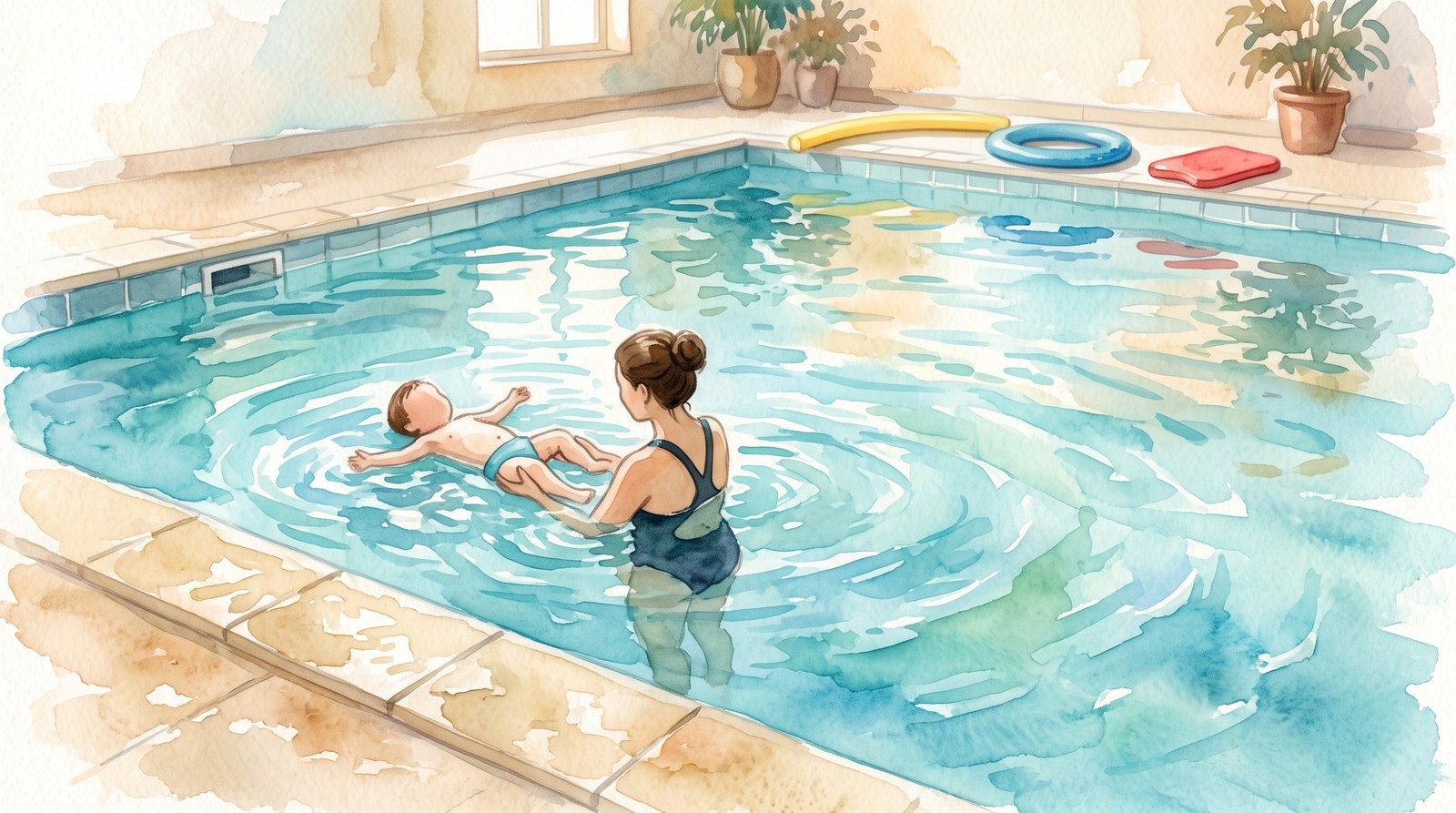
Water supports your weight. In water up to chest height, only a quarter of the body weight rests on your legs, making movements possible that hurt or are impossible on dry land. Warm water around 32 degrees relaxes tense muscles and takes the sharp edge off the body weight. Pediatric physiotherapists have been using water as a treatment place for decades, and internationally this is developed in concepts like the Halliwick method, in which a child step by step learns to relax, float and hold themselves upright.
Swimming lessons and hydrotherapy are two different things, although they rely on the same advantage. For a child with a physical disability, water is often the first place where they can move freely without aids, and that is exactly why the first lesson moments are more than just a swimming diploma in the making.
How often it goes wrong
A study by the National Council for Swimming Safety and the Mulier Institute among 310 parents shows where it goes wrong. Of children with a disability or developmental problem, 13 percent do not obtain a swimming diploma, while that share among all Dutch youth is around 4 percent. 45 percent of parents find their child not self-reliant in the water after the swimming lesson trajectory. More than half of the children attend lessons for longer than two years and need more than 70 clock hours, whereas an A diploma normally requires around 48 clock hours. More than a third of parents switch to another provider during the trajectory, usually because the instructor's knowledge does not match what their child needs.
The Mulier Institute found in later research that children benefit from groups of two to four students and sometimes one-on-one lessons, and that municipal income support for families with financial worries falls short. The lesson from this goes beyond the Netherlands: the swimming itself usually succeeds, finding a suitable place and managing a longer and more expensive trajectory are the real barriers.
The difference with DCD and with a sensory disability
A motor coordination disorder such as DCD concerns the control of movements, without anything being wrong with muscles or joints. A sensory disability concerns hearing and sight. With a physical disability, the practical question lies elsewhere: the building must be accessible, the water warm enough, and the lesson must allow room for a body that cannot do everything the diploma requires. The groups often overlap in practice, because children with more than one disability are common. For the approach in the pool, read the overview about a motor delay or DCD and the overview about a sensory disability.
Swimmigo · Swim lesson app
Free for parents
Follow your child's swimming progress, see where you stand and report absences in the app.

Which forms of swimming lessons exist
Regular swimming lessons with adaptations
Most children with a physical disability swim along in a regular group. The exercises remain the same, the instructions are adapted. A child who cannot jump does the jump from the side with help. A child who has difficulty lying on their stomach first learns to float on their back. Swim schools that do this well look per skill at what is feasible.
Small groups and separate groups
Some swim schools set up separate groups for children with a disability, with two to four students and a fixed instructor. That is not automatically the better route. A child participating in a regular group learns to keep up with peers and simply belongs. A child who gets too many stimuli or needs much extra time does better in a small group. Often a combination works best: start in a small group to lay the foundation, then flow into the regular lesson.
Swimming as therapy alongside the swimming lesson
Hydrotherapy is treatment by a physiotherapist in warm water, focused on muscle tension, posture and movement. It is not a swimming lesson and does not result in a diploma. What it does help with: a child who learns to relax in water and builds confidence steps into the swimming lesson more easily. In some countries, health insurance reimburses hydrotherapy on referral from a doctor, while the swimming lesson remains private. Ask a therapist what applies in your country, as this differs per system.
The route to a diploma if not every skill is achieved
With a physical disability, it can happen that a child never masters a component. In England, the swimming federation works with exemptions for skills a student cannot physically perform, and with intermediate steps such as the Alpha Step Awards for children who take smaller steps (Swim England). In the Netherlands, besides the Zwem-ABC, there are the National Swimming Certificates for people with a temporary or permanent disability (Alles over zwemles, Nationale Raad Zwemveiligheid). Whatever the route, the goal remains the same: that a child can save themselves in the water. Not every diploma requirement is necessary for that.
What your child needs in the pool
Getting in and out of the water
The first barrier is often getting in. A hoist lifts a child from the wheelchair above the water. A gentle slope, a wide staircase with steps under water, lets a child walk in themselves. Some therapy pools have a floor that rises, so the water starts shallow and grows with what a child can do. Ask a pool what facilities are available and if staff may operate them. Also pay attention to the changing room, because a hoist at the pool is of little use if there is no space to change.
Water temperature and lesson time
A regular pool is around 28 degrees. A child who moves little cools down faster in that water, and cold makes tense muscles even stiffer. Therapy pools and target group pools are often at 31 to 33 degrees. Ask about the temperature and the hour when the pool is quiet. For a child who has difficulty with stimuli, a quiet lesson day helps more than any exercise.
Buoyancy aids and how you support a child
Buoyancy aids are tools and not a solution in themselves. A band around the waist keeps a child upright but does not teach them to float. A buoyancy sock or a board under the arms can help a child with little muscle tone to hold a posture. The strongest support is usually in the hands of the instructor: holding a child at the pelvis or shoulders, moving along and letting go in small steps. Which combination works differs per child and diagnosis. Discuss that with a pediatric physiotherapist before the first lesson starts.
Things you bring yourself
Think of a swim cap that does not pinch, swim diapers where applicable, a neoprene band if a child needs help staying warm, and swimwear with room at the hips for those who wear a brace or spreader pants. For children with a feeding tube or catheter, waterproof covers exist. Ask the therapist what is responsible in your situation, and document it so a substitute does not have to guess.
As a parent: how to choose a swim school
Questions for the intake interview
The first lesson starts with the first conversation. These questions quickly give you an idea of what a swim school can offer.
- Do you have experience with children with a physical disability, and what training has the instructor followed for that?
- How do children get in and out of the water: with a hoist, a gentle slope or a rising floor?
- How warm is the water, and at what time is the pool quiet?
- How large is the group, and can it be smaller if needed?
- Who gives the lesson, and is it the same instructor each time?
- Does my child get exemption for parts they cannot physically do, and what intermediate steps are there?
- How do you track progress, and how often do I hear about it?
- What happens in an emergency, and is there extra help in the water if needed?
What to look for if you visit once
Visit before your child starts. Pay attention to how full the pool is, how the instructor uses their voice and posture, and if there is space between the children. Ask if your child may do a trial lesson. Also look at details no one mentions in a brochure: a heated changing room, a working hoist, a fixed place at the side where your child can leave their belongings without anyone tripping over them.
How many lessons per week
A child with a physical disability needs more repetition to retain a movement than a child without. Swimming twice a week keeps the line going, whereas once a week risks starting over each lesson. Also consider the load capacity: a child who needs the whole day to recover from a lesson benefits more from that than from an extra lesson hour. Consult with the therapist and swim school what a feasible rhythm is.
Tracking progress over a long trajectory
Making small steps visible
If a trajectory lasts two to three years, a diploma is too distant a reward for a seven-year-old. Children and parents need something to hold on to earlier. An intermediate step can be anything: the first time swimming independently to the side, daring to look underwater, or a certificate for one component. Schools that celebrate visible intermediate steps keep children motivated longer than schools where only at the end there is something to achieve.
What goes wrong in a long trajectory
Over two years, much happens. Skills are added, some disappear after surgery or illness, and instructors change. What starts in one notebook beside the pool becomes after a year a pile of loose notes and messages. Then the line is lost: parents no longer know what their child can do, and a new instructor starts again asking what worked last year.
What you record, and where
Record per lesson what succeeded, and link that to a skill or level instead of loose notes. The Swimmigo app works with seven levels and the skills per level, so your child sees what already works and what the next step is, and a substitute instructor sees within a minute where the child stands. On the levels and skills you see how that structure looks. Parents follow progress via the environment for parents, without someone needing to report weekly at the poolside.
Agreements that remain with a change
Record the most important agreements in one place, even if the conversation went smoothly: how your child gets in and out of the water, which aids are needed, who helps with changing and how the school contacts the parents. That is exactly the kind of information that disappears as soon as the instructor who arranged it is absent once, and that is often the week something goes wrong.
Costs and reimbursement
Adapted swimming lessons rarely cost much more per lesson, but over a longer period. A trajectory often lasts two to three years and extra lesson moments may be added. Below is where the costs come from and where you can get help.
| Cost item | What it means |
|---|---|
| The swimming lesson trajectory itself | Often lasts two to three years. Providers charge per lesson, per package or per month, and the number of lesson hours is higher than in a regular trajectory. |
| Smaller group or one-on-one | More guidance per lesson means a higher rate per lesson. Research among parents names this as one of the reasons the trajectory is more expensive. |
| Building and equipment | A target group pool, hoist or extra guidance in the water may be included in the price or charged separately. Check this in advance. |
| Help with costs | Funds, municipal schemes and in some countries health insurance cover part. What is available varies greatly per country and region. |
| Travel time and other costs | A suitable pool is not always nearby, and transport and parking costs add up over years. |
Why the trajectory costs more than a regular swimming lesson
Two things make the bill higher: it takes longer, and there is more guidance per child. Research by the Mulier Institute shows that a quarter to half of children cannot join the standard group and that smaller groups and extra instructor knowledge increase costs. For parents with a low income, this adds on top of the rest: CBS figures show that 14 percent of children in poverty have a disability, compared to 8 percent of children not living in poverty.
Funds, municipality and insurance
In many countries there are funds and schemes for families who find the lessons difficult to afford. The Netherlands has municipal income support, where the Mulier Institute advises municipalities to clarify what is reimbursed, simplify the application process and appoint one fixed contact point for parents. The application often runs via the municipality or the swim school and not directly via the parent, so ask both parties what exists in your region. If the route runs via a medical indication, health insurance may cover part; how that works you can read in swimming lessons for a child with a disability and health insurance.
For swim schools: adapting without changing the lesson completely
What an instructor can do without being a specialist
You do not have to become a therapist to teach a child with a physical disability well. The basis is the same as with any child: see what works, build in small steps and keep the exercise predictable. Demonstrate instead of explaining, let a movement be felt by moving together and keep the same order. Ask the parents what works at home and in treatment, and adopt that.
Group composition and safety
Think about the place of a child in the group. A child who cannot get out of the water independently should swim at the side where you stand. A child with little head control needs someone else than you, or an aid that supports the head, and that is not possible if you have a full group under your care. Agree in advance who does what if something happens, and practice that with the team, because most accidents in a pool happen in the minutes the eyes are elsewhere.
What training yields
Parents name the lack of knowledge among instructors as one of the biggest bottlenecks in finding suitable lessons. There are separate refresher courses about swimming with a disability, such as the courses swimming federations in various countries offer (Swim England, inclusion for swimming teachers). Such training rarely results in a completely new approach. It does provide the confidence to tell a parent what you can and cannot do, and that conversation is what helps families to stay.
Administration that does not expand with every exception
The most expensive part about students with a specific need is not the lesson, but the loose agreements around it: notes, messages at the side and oral handovers at a change. Record the agreements once per student and track progress in the same environment as the rest of the group. The environment for swimming instructors bundles groups, levels, progress and parent data, so a student with an exception remains a student with a note instead of a separate file.
Conclusion
A physical disability changes the route to swimming, not the question whether it is possible. With an accessible pool, warm water, small steps and an instructor who looks at what does work, children with cerebral palsy, a muscular disease or a wheelchair get further than their environment often expects. The real barriers lie in the building, the costs and finding a place where someone takes the time.
As a parent you have more influence on that than it seems. Ask the questions at intake, record the agreements and ask about intermediate steps. As a swim school you do not have to solve it alone: a short refresher, one student with a clear note and a fixed place in the pool already get you a long way, without changing the lesson for the other children.
Swimmigo · Swim lesson app
Free for parents
Follow your child's swimming progress, see where you stand and report absences in the app.
Sources
- National Council for Swimming Safety: search for suitable swimming lessons for children with a disability (December 2021)
- CP Netherlands: swimming skills of children with a disability lag behind (research NRZ and Mulier Institute among 310 parents, 2021)
- Mulier Institute: barriers to learning to swim for children with a disability (2021)
- NOS: swimming lessons for children with disabilities must be more accessible (2025)
- Association Sport and Municipalities: risk group children with a disability (swimming safety toolkit)
- Mulier Institute: swimming skills of children in the Netherlands (2024, via open.overheid.nl)
- Alles over zwemles: learning to swim with a disability and the National Swimming Certificates (National Council for Swimming Safety)
- Swim England: SEND and swimming lessons, guidance for parents and carers (2019)
- Swim England: inclusion guidance for swimming teachers (updated)
- World Health Organization: drowning fact sheet (May 2026)
- World Health Organization: Global status report on drowning prevention 2024 (December 2024)
Bob van Soest
As an expert in operating sports facilities (such as swimming pools) and developer of, among others, Swimmigo.com, I am passionately committed to making swimming lessons simpler, more fun and more insightful for parents, swimming instructors and everyone who wants to learn to swim.
Frequently Asked Questions
![Complete overview of swimming lessons for children with a sensory impairment: deaf, hard of hearing, visually impaired or blind [2026]](/_next/image?url=https%3A%2F%2Fzvblogpostimages.s3.eu-west-3.amazonaws.com%2FAUTOMATISCH_UPLOAD%2F1_ed68388d8be7.jpg&w=3840&q=75&dpl=dpl_HNfPD3TqcZ6YivYMd3CXCgSrAu42)
Discover Swimmigo
The all-in-one app for swimming lesson progress. For parents, swim schools, and adult swimmers.